
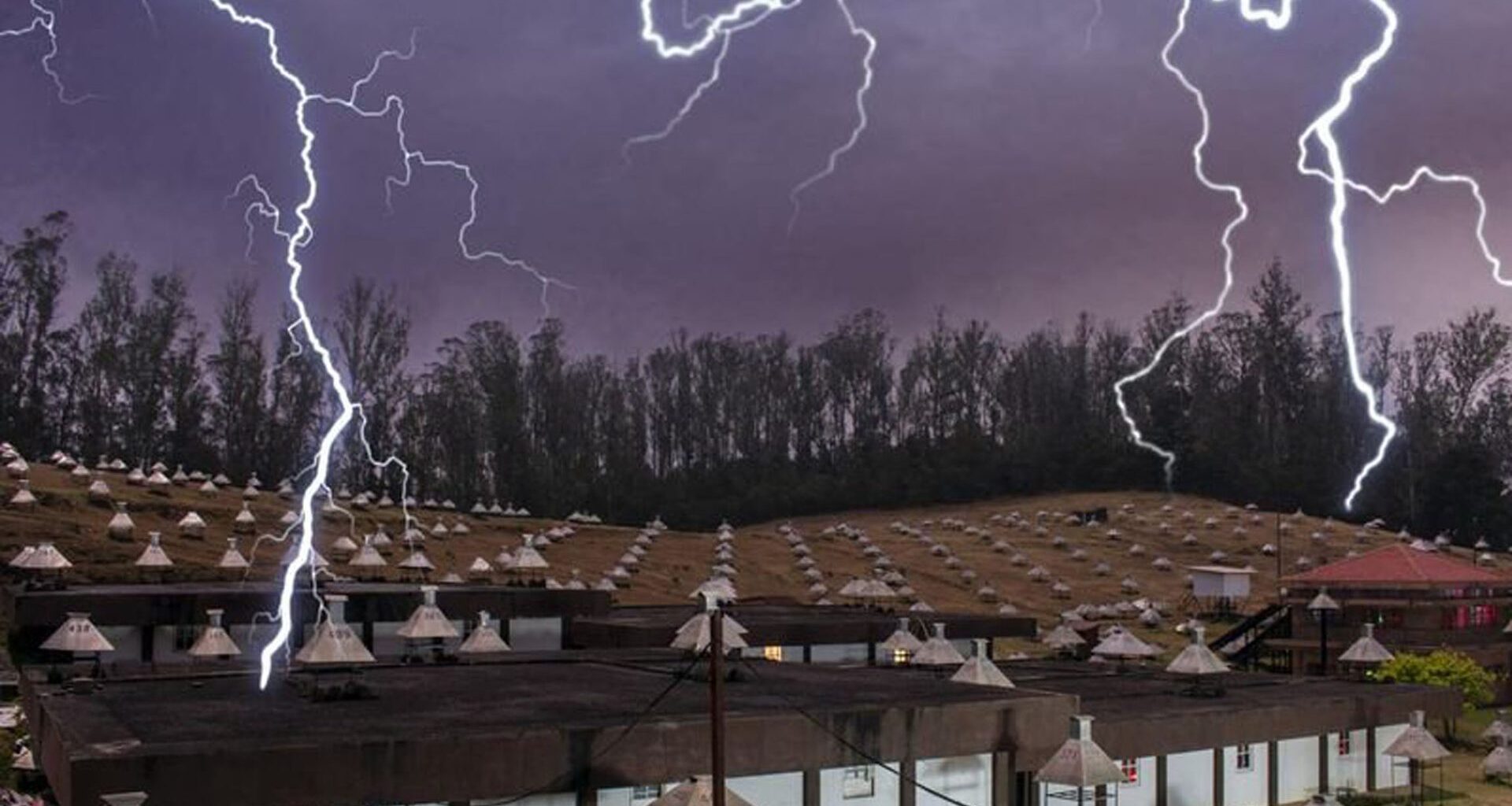
Cosmic rays let a telescope read thunderstorms from the ground, and Earth’s magnetic field explains why it sees far more storms to the east.
Measuring the electricity inside a thundercloud usually means sending a balloon, a rocket, or an aircraft into the storm. Particles from space already pass through every storm on the planet, and a telescope in southern India has been counting them from the ground for years. It picked up nearly six times more storms to its east than to its west, yet the storms themselves weren’t lopsided at all.
New research traces the difference to the telescope rather than the weather. Earth’s magnetic field shapes which particles reach the instrument, and that makes it more sensitive to storms on its eastern side. The result strengthens the case for reading storm voltages with particles that rain down every second.
Physicists at the Tata Institute of Fundamental Research in Mumbai led the work, with partners at Nagoya University’s Institute for Space-Earth Environmental Research and Chubu University in Japan. Their explanation rests on computer simulations, checked against ten years of storm records.
Measuring storms with muons
Cosmic rays are fast particles from deep space – mostly protons – which carry a positive charge. When one smashes into the upper atmosphere, it sets off a shower of new particles. Among them are muons, heavier cousins of the electron that travel at nearly the speed of light.
The GRAPES-3 telescope is about 7,200 feet (2,200 meters) up in the hills at Ooty. Its detectors cover about 6,000 square feet (560 square meters) under a thick layer of concrete, and they record about four billion muons a day.
Positive muons outnumber negative ones, and that imbalance is what lets the telescope sense a storm.
Most thunderclouds build up a positive charge near the top, and that electric field slows positive muons while speeding up negative ones. If the two kinds arrived in equal numbers, the effects would cancel. Because positive muons are more common, a charged storm overhead leaves a small dip in the total count.
“Muons are actually an ideal gift for doing these kinds of studies,” said Sunil Gupta of the Tata Institute. “They are like an electric current flowing through the atmosphere.”
The eastern sky held most storms
Between April 2011 and December 2020, the telescope logged 487 storms, each a dip or rise of more than 0.3% in the muon count. About 81.5% showed up in the eastern part of its view, and only 13.7% came from the west.
The weather didn’t explain the gap. Four ground sensors called electric field mills, spaced up to about 3.7 miles (6 kilometers) apart, track passing clouds. Over the same decade, they recorded 848 storm episodes drifting west and 712 drifting east. If anything, slightly more storms were heading west.
In an interview with Earth.com, Gupta wrote that thunderstorms form at random, last tens of minutes, and discharge in tens of microseconds.
B. Hariharan of the Tata Institute, the study’s first author, added that a balloon or rocket samples only the air around it, for a few hours at most. The telescope, Gupta added, has watched about 500 square miles (1,200 square kilometers) of sky around the clock for 15 years.
“If one wants to study a phenomenon occurring at the speed of light then a probe performing measurements at the speed of light should be used,” Gupta told Earth.com.
Earth’s magnetic field changes the mix
In the 1930s, physicists found that more cosmic rays arrive from the west than from the east, because the magnetic field bends charged particles on their way in. Gupta wrote that the storm pattern seemed backward at first glance, since the side with fewer cosmic rays had more storms.
The magnetic field accounts for that too. It filters out more of the weaker positive particles arriving from the east, and it keeps bending the particle showers they set off in the air. When the team simulated those showers for Ooty’s location, the mix of muons came out lopsided.
Looking east, the simulations estimated about 1.37 positive muons for every negative one. Looking west, the estimate was about 1.14.
A larger surplus of positive muons means a storm causes a bigger drop in the count, so eastern storms clear the 0.3% bar far more often. Eastern storms aren’t more powerful. The telescope just sees them better.
The gap vanished with equal muons
To test the idea, the team ran simulated storms, using the range of voltages the telescope had actually measured. With the real east-west mix of muons, the simulated telescope saw about five times more storms in the east, close to the sixfold gap in the real data.
Then the researchers gave every direction the same muon mix, and the east-west gap disappeared. Hariharan told Earth.com that their simulations showed the telescope would have no sensitivity to thunderstorms at all if positive and negative muons arrived in equal numbers.
All seven sets of physics models produced the same east-west pattern. Those choices shifted the muon mix by up to about 7% and the estimated storm voltages by up to about 14%, but every version favored the east.
What remains unknown
One part of the pattern still has no explanation. Storms clustered in the four diagonal directions of the telescope’s view, while the straight-overhead view caught almost none. The team named the muon mix as one factor but wrote that the exact cause is far from understood.
Overlapping storms are another limit. When several arrive at once, the electric field readings get so tangled that working out each storm’s height and voltage is nearly impossible, the researchers wrote.
“This instrument was not built to study thunderstorms but was designed to measure the direction of muons which no other large instrument did,” Gupta wrote.
Next, Hariharan wrote, the team wants to study the moment a storm discharges as lightning, a release that usually lasts less than a second. According to Gupta, such discharges are already known to produce antimatter, and the group hopes to estimate how much.
The full study was published in the journal Journal of Cosmology and Astroparticle Physics.
—–
Like what you read? Subscribe to our newsletter for engaging articles, exclusive content, and the latest updates.
Check us out on EarthSnap, a free app brought to you by Eric Ralls and Earth.com.
—–