
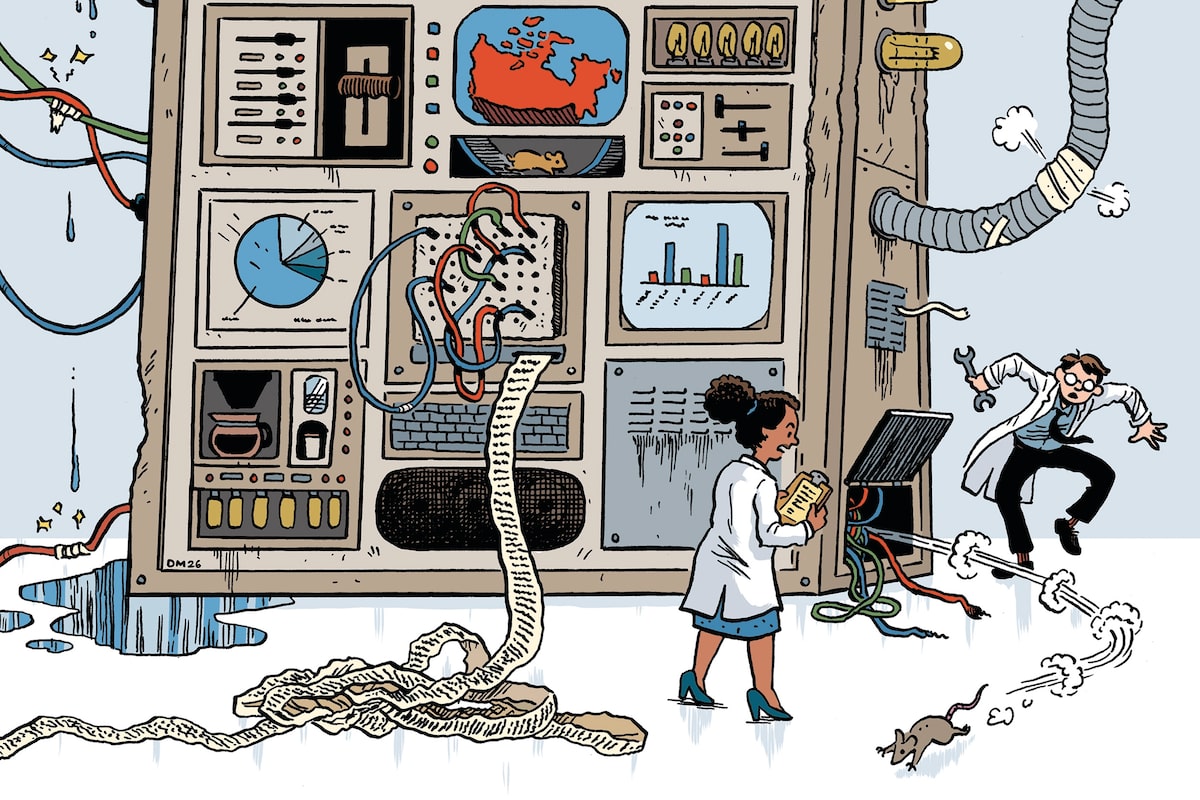
Illustration by Dakota McFadzean
On Sept. 29, personal economics reporter Erica Alini and editorials editor Patrick Brethour answered reader questions on how Canada’s tax system works, which solutions are being suggested to improve it and other governments we can look to for ideas.
The Q&A came on the heels of our Tax and Effect series, in which we spoke to economists about whether cutting personal income taxes and raising the GST instead could help kick-start Canada’s sluggish economy, asked tax experts for their biggest and boldest ideas on overhauling the tax system and tracked where your tax dollars go.
Readers asked about more support for seniors, what changes could help Canadians and what other countries have tried. Here are some highlights from the Q&A.
Changing Canada’s tax system
Do you think this government would think it is politically palatable to consider reviewing the Canadian tax system?
Patrick Brethour: The government has said that tax reform is its aim. How far is it willing to go? We will find out, but I would say that incremental tinkering will not do the job. The government has shown some willingness to be bold – the investment deduction introduced this month is evidence of that. But at the same time, the Carney Liberals still want to steer investment. They have yet to buy into the idea that millions of private investors are better placed to decide how to spend their money than a few hundred (or few dozen) people in Ottawa.
Should the federal and provincial governments leave more earned money in the pockets of Canadians?
Erica Alini: Many economists would agree that Canada’s personal income tax rates are too high, something they say discourages work and saps productivity. The problem is that cutting income taxes wouldn’t necessarily pay for itself. So one idea experts have put forward is cutting personal income taxes but also simultaneously raising the good and services tax (GST). You can read more here on why economists say that tax mix would be better for the economy.
What is the consensus on what constitutes a meaningful tax income reduction? If income tax is reduced but HST is increased, would it not be a net-zero benefit to the taxpayer?
Alini: The idea of cutting income taxes and raising sales taxes at the same time isn’t to reduce how much people pay in tax. That should stay relatively the same. The idea is that shifting more of the burden to sales taxes would help boost productivity and economic growth. So, ideally, for the same amount of that we’d get a faster growing economy, which would result in fast-growing incomes for households (in the long run and on average).
How Ottawa could cut personal income taxes – without creating a fiscal mess
What is the one single change we can make to improve the competitiveness of the Canadian economy?
Brethour: The reality is that Canada suffers from chronic underinvestment, so any tax-reform program will have to take aim at that problem. And that means reducing the tax burden on investment, and thereby improving the economics of said investments.
Where should the Old Age Security clawback level be set? Inflation may reduce the current benefit for senior couples.
Alini: OAS is adjusted for inflation on a quarterly basis, which is more often than many other benefits. In terms of where the phase-out should begin, Generation Squeeze has proposed lowering that income threshold so clawbacks would start at around an annual income of $100,000 for couples. You can read more about that here.
Brethour: I would add: The OAS is indexed to inflation, so benefits aren’t affected. But they could be – deindexation of the threshold would be one way to at least start to address the deep inequities of sending monthly income support payments to rich Canadians who also happen to be senior citizens.
Why not a national property tax instead? Canada has plenty of valuable land.
Brethour: Canada is already relatively more reliant on property taxes, nearly double the OECD average. Setting aside the effect on municipal tax revenues, which are dependent on property taxes, and you have a series of sticky questions: What should that rate be? Should those in pricey urban cores pay the same rate as much cheaper rural properties? What about asset-rich but cash-poor seniors?
A better option is to boost value-added taxes, such as the GST. As is the case with your suggestion, a VAT targets consumption, not nearly so mobile or subject to gerrymandering as is income.
Illustration by D. McFadzean
Why does no one ever talk about a progressive consumption tax, an idea that seems a lot more economically and psychologically robust?
Brethour: Canada essentially does have a progressive consumption tax, which I would define as better-off households paying higher rates. Let me explain.
The GST, as a value-added tax, doesn’t change depending on the income of the purchaser. So, it starts out as regressive. The same amount of tax paid by a lower-income and higher-income household is a heavier (relative) burden for that lower-income household. The problem is obvious.
So, Canada, like many jurisdictions, provides credits for lower-income households to cushion the regressive effect of the GST. So, to the extent that regressive effect is countered, you end up with a progressive-like sales tax.
Many taxpayers have no deductions or credits. Is it workable to eliminate the need to manually file a T-1 general?
Alini: The Carney government has been working on something along the lines of automatic tax filing, but only for lower-income taxpayers with a simple tax situation so far (more on that here). But the general consensus is that for automatic tax filing to become possible for a much larger share of Canadians, it would require simplifying the tax system first.
Illustration by Melanie Lambrick
Looking to other countries
Can you explain the changes if we were to model our taxation system on Sweden? Can we entice more corporate investors by doing this?
Brethour: The Swedish approach is straightforward enough. Much reduced taxation of corporate income, and a reduction in personal income marginal tax rates. To make up the revenue difference, the Swedes broadened the reach of their value-added tax and increased the rate. Tax consumption more, tax success less, galvanize growth and productivity.
Sweden was also careful to provide support for lower-income households, meaning that income inequality grew a little bit, but not too much (Sweden still has less income inequality than Canada).
How has tech investment changed the importance of Canada’s tax competitiveness compared to other countries?
Alini: Capital is mobile and so how Canada’s corporate tax rates compare to those of other countries certainly matters. But taxes are just one factor businesses look at when deciding where to invest. Having a competitive, efficient tax system is not a silver bullet – but it does seem a good start.
This Q&A has been edited and condensed.