
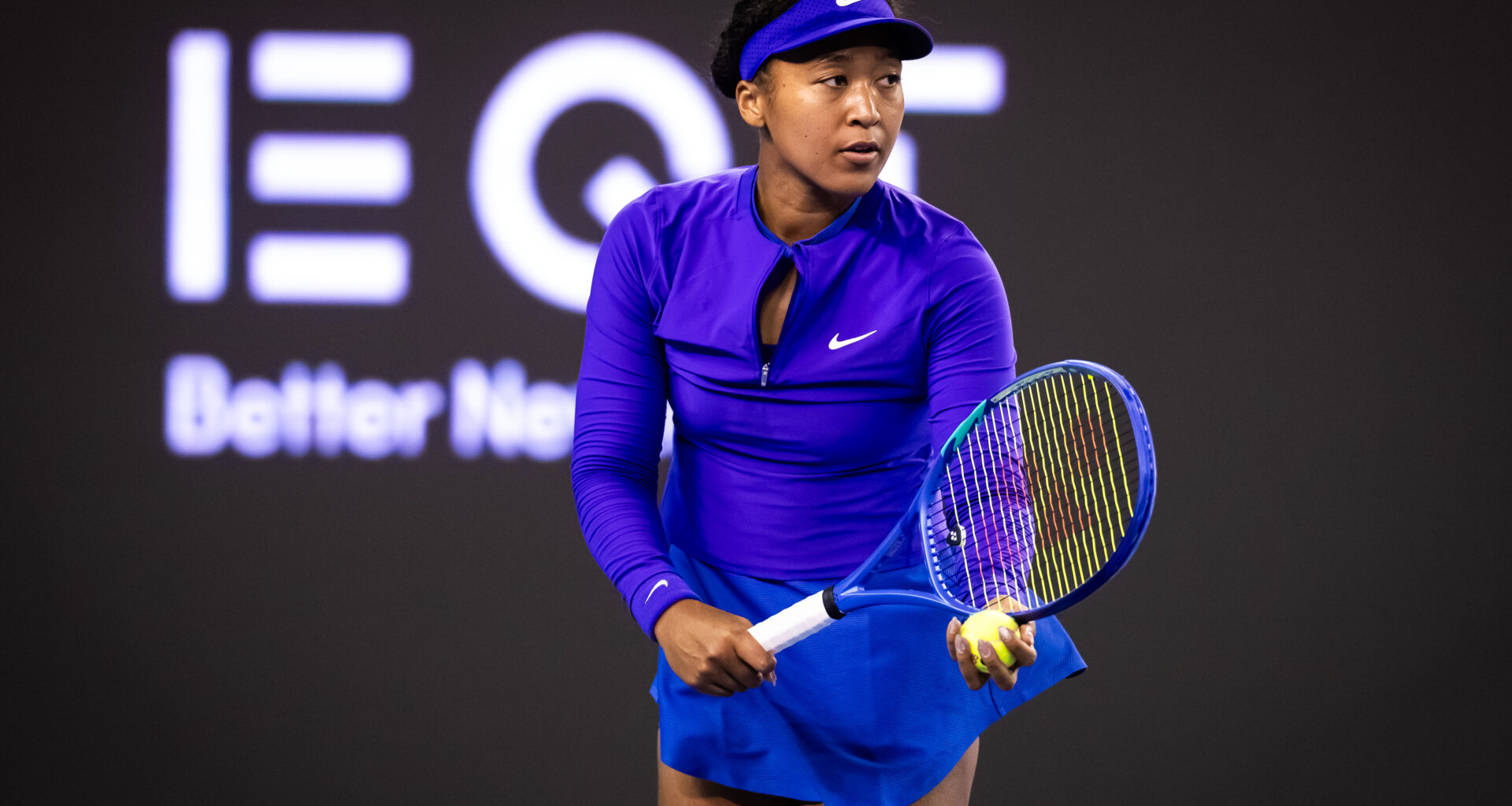
Naomi Osaka passed a stern test against No. 20 seed Sara Bejlek on Sunday, overcoming a determined challenge to earn a 7-6 (4), 6-4 victory and advance to the Round of 16 in Beijing for the fourth time. The former World No. 1 needed just over two hours and five match points to secure the win.
Beijing: Scores | Order of play | Draws
Osaka not only had to fend off Bejlek, but also battle difficult playing conditions that included strong winds and cold temperatures.
“I’m really happy with how I played,” Osaka said in her post-match interview. “Obviously the conditions weren’t amazing, but we both have to play in them, so I never try to complain [about] that. She’s an incredible player, so it’s nice to have pulled out a two-set victory against her.”
Little separated the two players throughout the match. Bejlek held four set points in the opening set and generated nine break-point opportunities overall, but Osaka excelled in key moments to win their first career WTA Tour Driven by Mercedes-Benz meeting.
Osaka also continued to prove herself as one of the tour’s best front runners. She improved to 28-2 this season when winning the first set, with her only losses in those matches coming against the world’s top two players: Aryna Sabalenka in Madrid and Elena Rybakina in Toronto.
Here were three keys to Osaka’s third-round win:
Clutch factor
Osaka delivered in the match’s biggest moments. After being broken late in the first set, she broke back as Bejlek served for the set. A few games later, while serving to force a tiebreak, Osaka saved four set points — including one with a well-timed volley winner — before taking four of the final five points in the tiebreak to claim the opening set after 64 minutes.
After Bejlek double-faulted to hand Osaka a break for a 4-2 lead in the second, the four-time Grand Slam champion again rose to the occasion, saving three break points with a trio of overheads to consolidate for a 5-2 advantage.
Then, after a shaky service game in which she double faulted on match point and was broken while serving for the match, Osaka regrouped. She outlasted Bejlek in a five-deuce game — the third of the match — to earn the decisive break and close out the victory.
Overhead mania
While Osaka is best known for her serve and powerful groundstrokes, she frequently moved forward against Bejlek. The tactic paid off, highlighted by a series of overhead winners.
She unveiled a surprise serve-and-volley early in the first set, finishing the point with one of several overhead winners before holding at love for 2-2. Later, she used a backhand volley winner to hold for 3-3.
Her most emphatic overhead came in the first-set tiebreak, when she hammered a winner to bring up the only set point she would need. The overhead also proved crucial late in the second set, helping Osaka fend off a barrage of break points to maintain control of the match.
First-serve prowess
Given her track record, it was no surprise that Osaka excelled behind her first serve despite facing nine break points.
Big serve 👊 @naomiosaka takes the opening set, 7-6(4)! #ChinaOpen https://t.co/Gc8Yr9oEax
— wta (@WTA) October 4, 2026
She landed 69% of her first serves and won 76.7% (46 of 60) of those points. That efficiency proved especially important given that she won just 37% of points behind her second serve.
Coming into the match, Osaka ranked fourth on tour in first-serve points won at 72.3%, trailing only Rybakina, Zheng Qinwen and Linda Noskova.
What’s next
Osaka will face No. 7 seed Karolina Muchova next. Muchova owns a 4-3 edge in her career head-to-head against Osaka, including wins at Bad Homburg and Wimbledon this year.
“I played Muchova recently in the quarters at Wimbledon, which sucked for me, but was great for her,” Osaka told reporters. “She’s an amazing player. She’s someone that you know is very dangerous no matter what. She could pretty much beat anybody. But I think from my end, no matter who I play I just have to focus on myself.”