
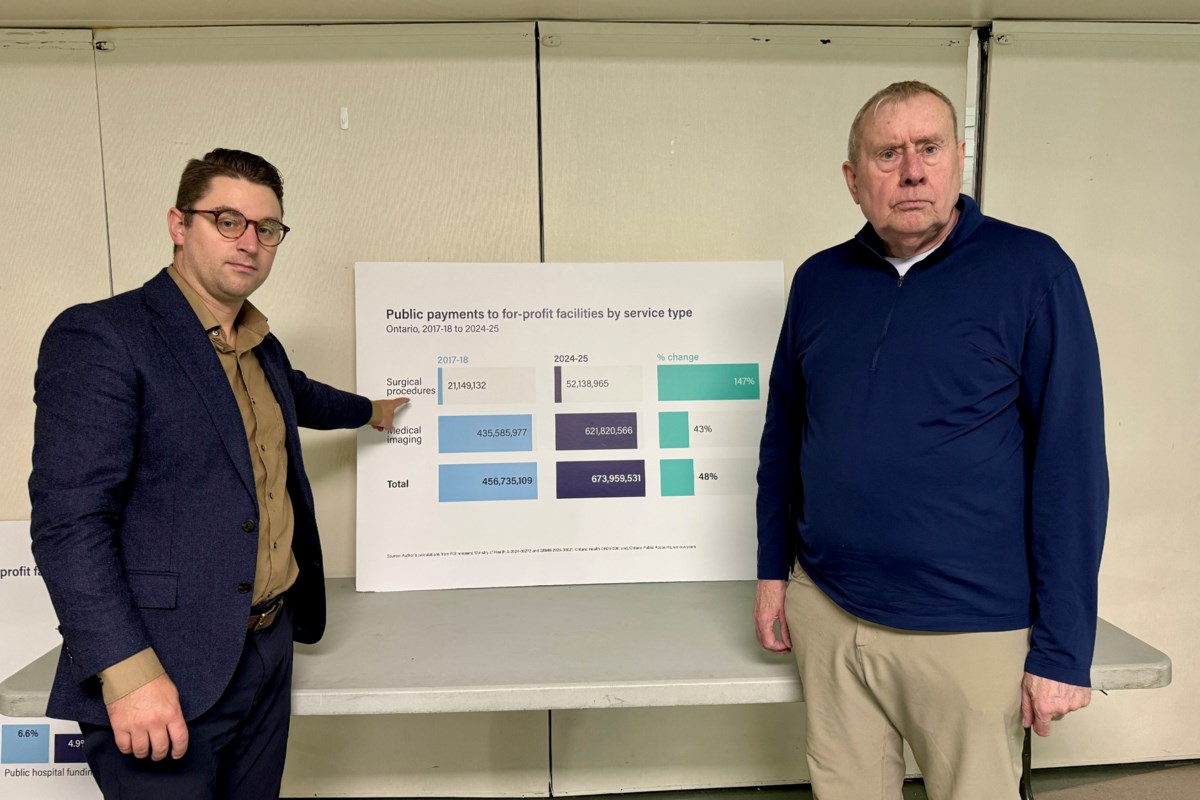
‘Sault Area Hospital is losing out on dollars that could be allocated to it, but instead they’re flowing increasingly to private for-profit facilities,’ said researcher
Although Premier Doug Ford has said private health care facilities will reduce surgical backlogs, a new report warns that increased funding for these facilities has had the opposite effect – while putting the public system at risk.
Published by the Canadian Centre for Policy Alternatives, Not adding up: Surgical and diagnostic privatization in Ontario reports that the province spent $4.1 billion on private health care facilities between 2017 and 2025 as wait times for numerous publicly funded procedures – such as MRI scans and cataract surgeries – increased over that span.
The boost to private facilities arrives as publicly funded facilities like Sault Area Hospital have underutilized resources, including an MRI machine that does not operate overnight, and only four of six local operating rooms utilized due to staffing shortages.
This year, the hospital also faces a $25.7 million deficit due to ongoing pressures on a variety of fronts.
“Sault Area Hospital is losing out on dollars that could be allocated to it, but instead they’re flowing increasingly to private for-profit facilities, and it’s not going to benefit Sault area residents,” said Andrew Longhurst, report author and senior researcher with CCPA.
“The growth of this industry is coming at the expense of public hospitals, while those public hospitals across the province are faced with funding austerity.”
According to freedom of information requests carried out for the report, the provincial government’s funding for private facilities jumped from $457 million in 2018 to $674 million in 2025, providing a range of services from ultrasound, radiography, plastic surgery, eye surgery, MRI scans and more.
Despite that funding, median wait times for MRI scans increased from 35 to 47 days over that span, while cataract surgeries jumped from 67 to 68 days – despite substantially increased private funding for these procedures.
“This comes despite a 185 per cent increase in public dollars going to private facilities exclusively for ophthalmologic procedures,” Longhurst said.
“It really is hard to make this make sense when you’re seeing significant public funding flowing to these for-profit facilities for eye procedures and cataracts specifically, and yet wait times have not improved.”
At the same time, Longhurst reports that private facilities, or integrated community health services centres, are beginning to carry out more and more surgeries across Ontario.
While the number of surgeries performed in public hospitals increased by 10 per cent between 2017 and 2025, the number of surgeries in private facilities spiked by 117 per cent – even though the report states private procedures are more costly than those in public hospitals.
In private settings, Longhurst reports that cataract surgeries are twice as expensive to carry out and knee surgeries are two-to-three times more expensive.
“They’re for-profit, so there has to be a return on the capital invested. There has to be a profit margin,” Longhurst said.
“We’re paying for them to finance and build a facility and maintain it, and then on top of that, they need to turn a profit margin for their investors.”
There are also hundreds of instances where patients were billed for their procedures between 2017 and 2025, Longhurst reports.
“There have been 715 contraventions for unlawful extra billing or patient user fees, and nearly one third of those just between 2023 and 2025,” he said.
“In the areas where the government has been aggressively privatizing those procedures, claiming that it won’t come at out-of-pocket cost to Ontarians, we’re actually seeing a significant share of those illegal practices of charging patients out of pocket for services that are publicly covered by OHIP.”
Beyond dollars and cents, Longhurst said funding private facilities also “pulls resources from the public hospital system, including anesthesiologists, operating room nurses, imaging technologists, technicians, and support staff.”
As a result, Longhurst recommends the province should stop privatizing surgeries and medical imaging, with funds utilized to bolster capacity in public hospitals.
“We’re seeing that the research evidence over the eight years of this study does not show it to be reducing wait times, even though we’re a number of years into this policy direction,” he said.
“It doesn’t align with the international and Canadian research evidence that shows sustained investments in public hospital capacity have the greatest ability to reduce wait times over the long term.”
SooToday has reached out to the Ministry of Health for comment on this story.