
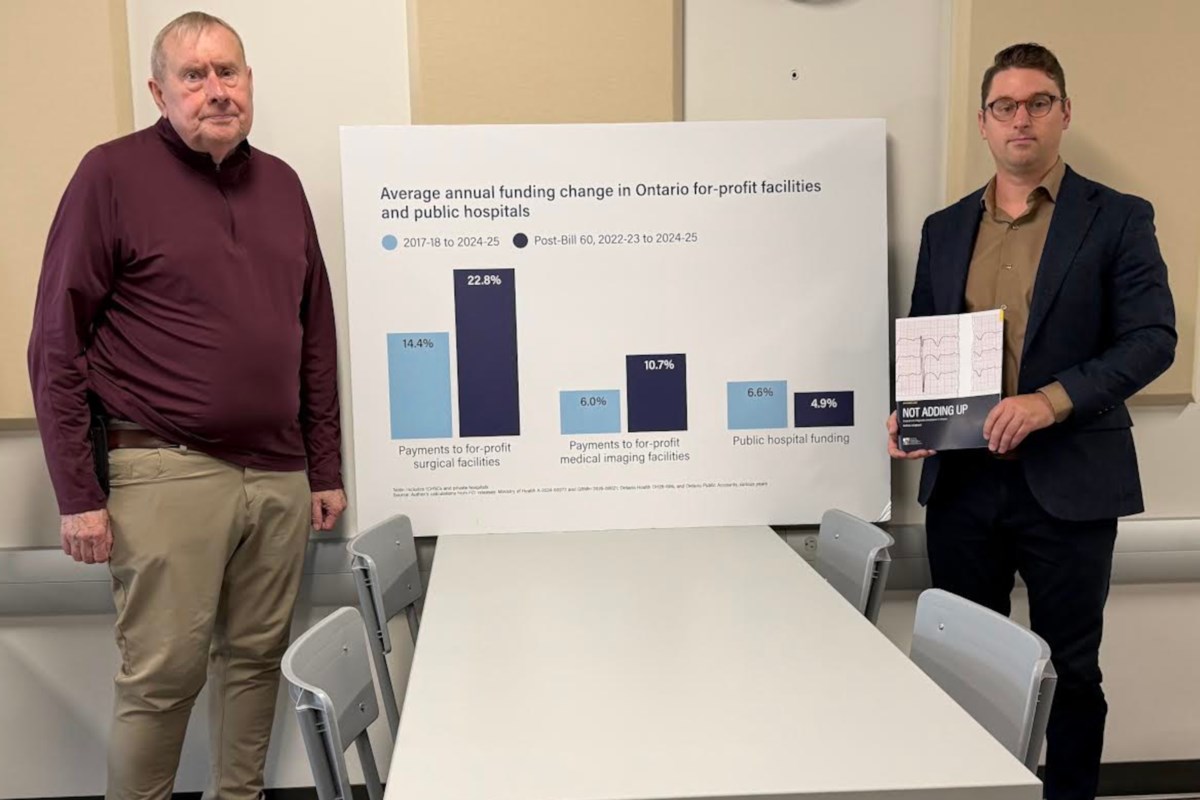
The Canadian Centre for Policy Alternatives joined Ontario Council of Hospital Unions of CUPE in pushing back against the privatization of health care during a media event in Sudbury
Pushing back against the province’s privatization of health care, the Canadian Centre for Policy Alternatives has joined CUPE in a media tour of the province.
On Oct. 3, Canadian Centre for Policy Alternatives senior researcher Andrew Longhurst joined Ontario Council of Hospital Unions of CUPE president Michael Hurley in visiting Sudbury.
Although their pushback is provincial in scope, they came armed with a local example to drive the message home.
Per recent reporting by the Ontario Health Coalition, Longhurst noted that the MRI machine at Health Sciences North is underutilized, which he cited as indicative of broader provincial prioritization of for-profit health-care providers over public.
There are two MRI machines at HSN, he reported.
One is open 24 hours per day on weekdays and closes at 4 p.m. on weekends. The other runs 24 hours on Tuesdays, and is otherwise closed for seven hours daily.
This, Longhurst said, is “an acute snapshot of the situation” unfolding across the province.
“That, I think, provides a look into the policy direction and the problem with the provincial direction, where you’re seeing significant funding going into for-profit facilities, and yet across the province, including in Sudbury, we see underfunded, understaffed capacity when there’s infrastructure that’s already been paid for and we don’t have staffing to staff it.”
More generally, Longhurst said the province’s push to privatize health care will make things both more expensive for everyone and result in longer wait times.
Among recent findings they pointed out this weekend were:
The volume of surgeries performed in public hospitals increased by 10 per cent between 2017 and 2025, while the volume of surgeries performed at Ontario’s 918 licensed private centres (called integrated community health services centres) increased by 117 per cent.
Provincial payments for for-profit surgeries increased from $457 million in 2018 to $674 million in 2025.
Between 2022 and 2025, the average annual growth rate of public payments to for-profit surgical facilities (22.8 per cent) and medical imaging (10.7 per cent) outpaced that of public hospital funding (4.9 per cent).
Of unlawful extra-billing and user-fee contraventions from 2023 to 2025, one-third were related to cataracts and other eye procedures, which is a focus of surgical privatization.
Between 2017 and 2025, median wait times for eight of 12 publicly funded priority procedures increased in Ontario, including MRI scans, cataract surgeries and all cancer surgeries.
Ontarians are “at a critical juncture,” Longhurst said.
There’s the expansion of for-profit investment and activity which further a two-tier health care system and makes things more expensive for everyone, as seen in Alberta, or Ontarians can chart a different course.
This, he said, involves “increasing and expanding capacity in our public hospitals among institutions that serve Ontarians no matter their income, no matter their health status, available in communities across the province.”
Hurley last spoke with Sudbury.com during a media conference in August, at which he joined CUPE researcher Doug Allan in highlighting a perceived gap in Sudbury of $105 million and 1,079 staff.
The Ministry of Health refuted their numbers as “entirely misguided,” but Allan, in turn, stuck to his guns and asserted that the province was misguided in the numbers they shared.
Allan’s criticism was directed, in part, at the province’s claim that they added 20,000 new doctors and 100,000 new nurses since 2018.
“Nurses are hired, but they also retire or quit,” Allan said at the time. “The number we should be looking at is the total number working.”
On this point, the College of Nurses of Ontario counted 173,935 nurses employed in Ontario in 2018, and 207,002 employed in the province in 2025, representing a 33,067 net increase.
The College of Physicians and Surgeons of Ontario counts 42,815 physicians on register (36,961 in active practice) in 2018 and 49,478 doctors on register (36,424 in active practice) in 2025 (per annual reports).
Sudbury.com reached out to Health Sciences North and Ministry of Health spokespeople for a response to the information shared this weekend by the Canadian Centre for Policy Alternatives, but they did not immediately respond, with the inquiry falling on a weekend.
Relevant now within the Ministry of Health’s previous response in August was their assertion that, “According to the Canadian Institute for Health Information (CIHI), the average wait time in Ontario for a cataract surgery has improved by over 55 per cent, at the same time, our action to expand cataract surgeries in community surgical diagnostic centres has increased cataract surgery volumes by over 172 per cent.”
A follow-up story will be published in the event HSN and/or the Ministry of Health spokespeople respond.
Tyler Clarke covers city hall and political affairs for Sudbury.com.