
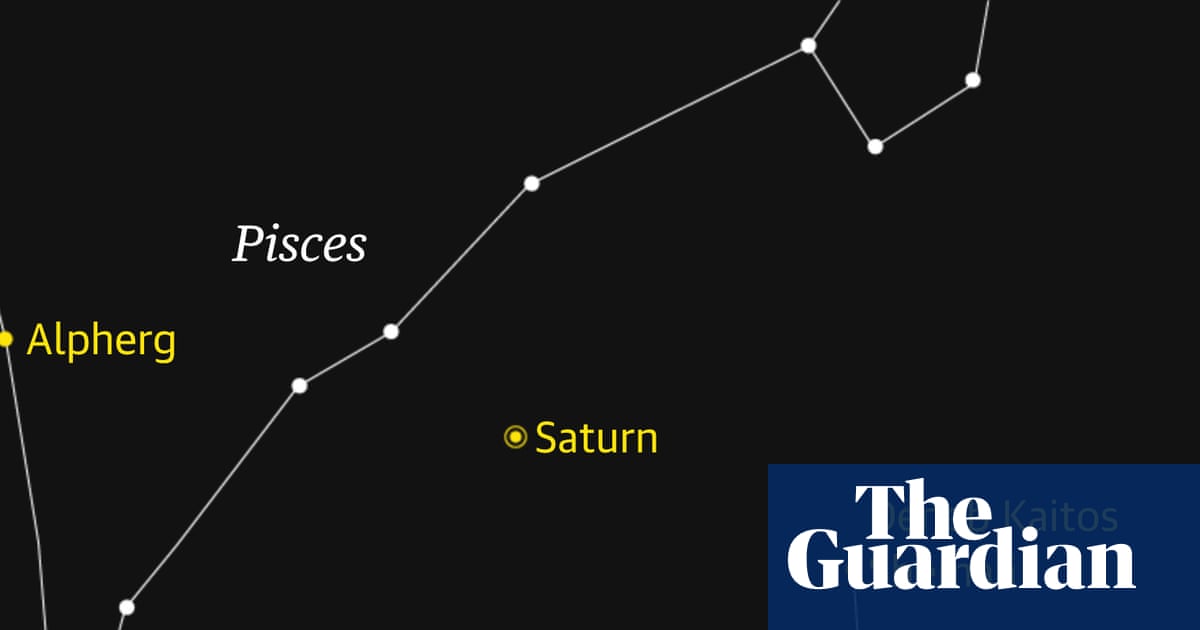
This week offers an excellent opportunity to track down Saturn. The giant planet, situated about 10 times further from the sun than the Earth, reached opposition on 4 October. In this configuration, Earth is passing almost directly between the planet and the sun.
This makes opposition an excellent time to see a planet: the distant world rises as the sun sets, remains visible throughout the night and sets around sunrise. It is also at about its closest point to Earth for the year.
Saturn is easily visible to the naked eye, looking like a moderately bright, creamy-white object. Unlike most stars, however, its light remains steady rather than noticeably twinkling.
The chart shows the view looking east- south-east from London at 2100 BST on 5 October. By this time, Saturn is already well clear of the horizon and will continue climbing higher as the evening progresses. It lies beneath the Great Square of Pegasus, which provides a distinctive signpost to the planet.
Saturn is currently shining at about magnitude +0.3. Once you have identified it, try returning to it on subsequent evenings. Unlike the surrounding stars, Saturn slowly changes position as it travels against the background constellations.
Although the planet itself is an easy naked-eye target, you will need a small telescope to see its famous rings. From the southern hemisphere, Saturn is even better placed, climbing higher into the sky.