
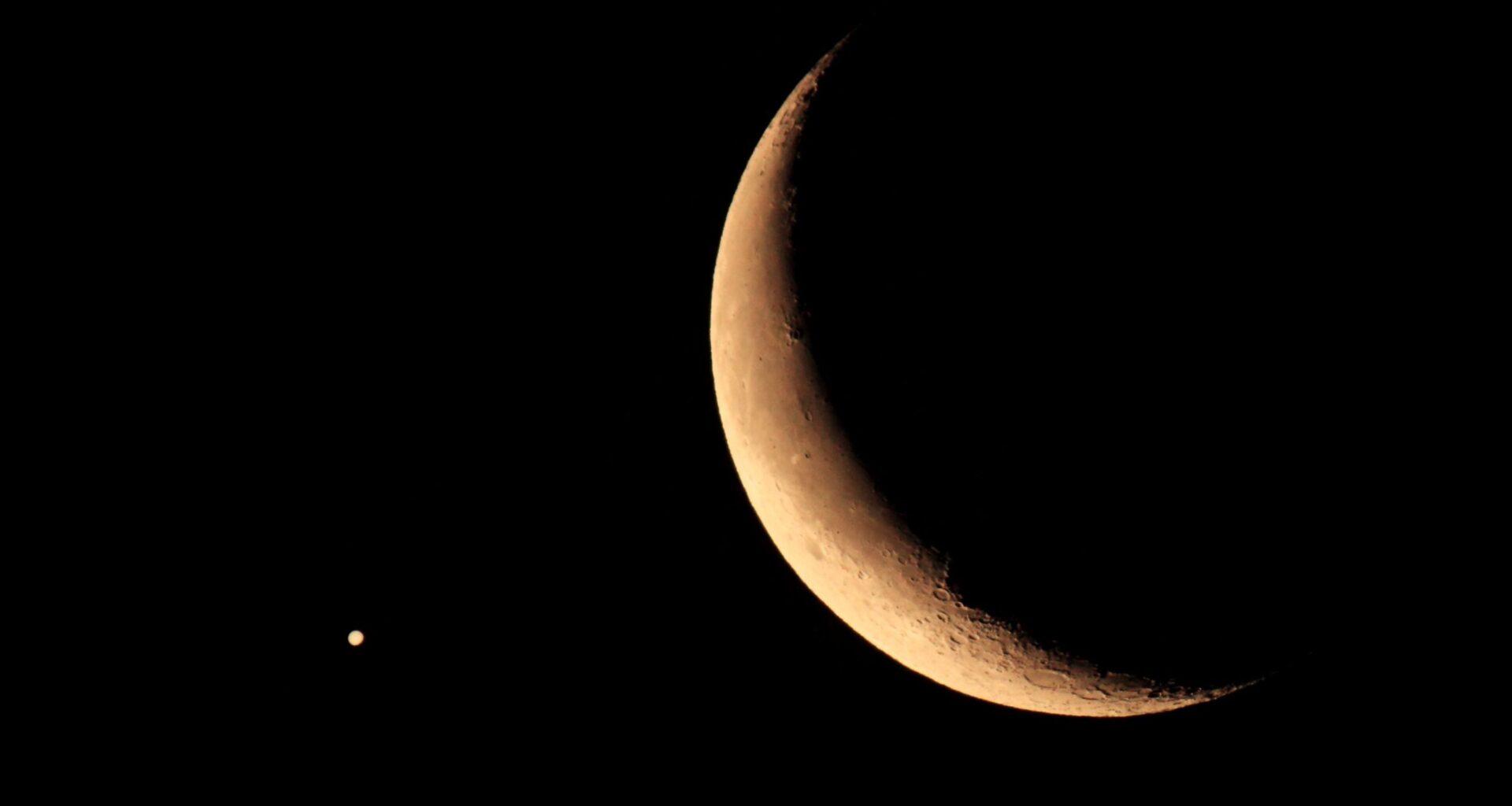
Heads up stargazers! Jupiter will appear to “vanish” from the predawn sky on Oct.6. Here’s how you can see it for yourself.
Early birds will be treated to quite the show on Oct. 6, as the slender crescent moon, just 20% illuminated, passes in front of Jupiter, appearing to swallow the gas giant whole and spitting it out about an hour later.
The vanishing act will be visible across parts of North America, and for those outside the occultation zone, don’t fret; you’ll still see a stunning sight as the gas giant appears remarkably close to the lunar disk after local moonrise (weather permitting).
Known as a lunar occultation, the event happens when the moon passes in front of a more distant object from our perspective on Earth. While occultations of Jupiter occur fairly regularly somewhere around the world, seeing one from any particular location under a dark sky is much rarer — occurring on average about once every 13 years, according to Space.com skywatching columnist Joe Rao.
The best views of the occultation will come from the eastern and central eastern U.S. and parts of southern Canada, where Jupiter will disappear behind the moon‘s bright crescent before emerging from behind its dark, Earth-lit limb roughly an hour later.
You may like
Exact timings depend on your location. Here are the disappearance and reappearance times for several major cities, based on predictions from the International Occultation Timing Association (IOTA). All times are local time.
Swipe to scroll horizontally
Jupiter occultation timings
City
Jupiter disappears
Jupiter reappears
Boston, MA
4:26 a.m. EDT
5:29 a.m. EDT
New York, NY
4:23 a.m. EDT
5:27 a.m. EDT
Washington, DC
4:20 a.m. EDT
5:24 a.m. EDT
Atlanta, GA
4:15 a.m. EDT
5:16 a.m. EDT
Miami, FL
4:20 a.m. EDT
5:09 a.m. EDT
Chicago, IL
3:22 a.m. CDT
4:17 a.m. CDT
Winnipeg, MB
3:45 a.m. CDT
4:03 a.m. CDT
Farther west, the moon and Jupiter will still be below the horizon when the occultation begins. From Denver, for example, Jupiter’s disappearance won’t be visible, but skywatchers can catch the planet reappearing from behind the moon at around 3:11 a.m. MDT.

Across much of the western U.S., including Washington, Oregon, California and most of Arizona, the occultation will already be over by the time the moon and Jupiter rise. But you’ll still be treated to a striking close pairing, so it’s still worth a look.
Want to make sure you don’t miss Jupiter’s disappearing act? Check out our complete guide to the Oct. 6 Jupiter occultation for detailed maps, viewing times and everything you need to know to watch it.