
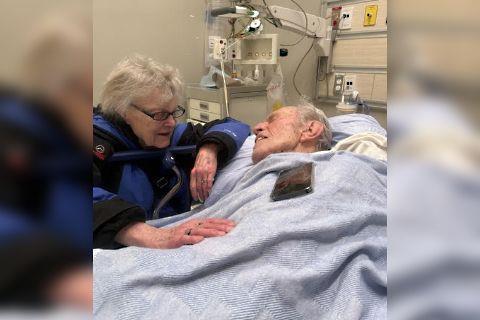
The family of a South Surrey senior who died waiting for hospice care is sharing his story in the hopes of saving other families with vulnerable loved ones from experiencing what they describe as “deeply dismissive” end-of-life treatment.
Donald Reagh was diagnosed with terminal cancer in late June, at the age of 91, after low-grade cancer he’d had for some two decades ago metastasized to his hip. While hospice care was recommended by his GP, it was a placement that never materialized – despite determined efforts by his wife of 68 years, Donna, and son, Barry, to secure him that level of dignity.
Instead, “he died alone … in a long-term care facility never designed for active end-of-life care,” said Barry.
It was “inconsistent with the best care for my father during his last days on this planet.”
Fraser Health officials confirmed in late August that the authority’s Patient Care Quality Office “are working to support the family.”
In an emailed statement, they extended “our heartfelt condolences,” but did not speak to the family’s specific concerns – which include “delay, deflection and disregard” – saying the health authority’s care teams in long-term care communities “work closely with residents and their families to support them in accessing and provide compassionate, quality end-of-life care throughout every step of their journey.”
“Our care teams ensure people are physically, emotionally and spiritually comfortable in the later stages of their lives with a palliative approach to care.”
Barry disagrees, describing a rollercoaster of frustration and failures.
At the time of his father’s diagnosis, Donald Reagh was a temporary resident of a White Rock care home; a placement Barry says a Fraser Health contract guaranteed would continue until a bed became available at one of three preferred long-term care facilities identified by his family.
The family’s nightmare began that same month, he continued, describing alarming news of an apparent attempt to force his father out of the care bed he’d occupied since late February, contrary to the Fraser Health contract.
Facility staff “took everything off his walls and was going to put him in a taxi,” Barry charged, noting the steps followed word his mom received of a 24-hour window that she had to move his dad to a Langley care home.
Barry alleged the situation was the result of care-home officials “trying to get rid of everybody that’s subsidized” in order to make space for private-pay residents. (The care home is not currently among four White Rock facilities on Fraser Health’s list of long-term care service providers.)
It took the threat of legal action to stop his father’s transfer, Barry told PAN, explaining the blunt measure was recommended after care-facility management insisted his mom had signed an agreement that allowed the transfer, but then refused to produce a copy of it.
All of this was unfolding as the family continued to process the reality of not knowing how much time they had left with their loved one. At the time of his diagnosis, the patriarch was given anywhere from a few weeks to six months to live.
After the senior went to Peace Arch Hospital following a fall from his care bed, Barry said he fought against having his father returned to a care home “where the owners don’t want him,” referring to the White Rock facility. Unable to care for himself, the senior needed to be in a hospice or stay at the hospital, he said.
Though assured by palliative-care officials that his father “undoubtedly” deserved the end-of-life care a hospice provides, and was on an “expedited transfer arrangement” for a hospice bed, the push to return Reagh to the care home continued – and ultimately was carried out the day after Barry returned home to Arizona, he said.
“I was told … that he would not be going back. The day after I left town, they sent him back.”
It was a “completely unacceptable” move that his family should “absolutely not” have had to deal with, he added.
Transferred to a South Surrey care facility in July, the family waited for a “required” meeting with Fraser Health’s palliative care team and approval for the hospice transition. Barry noted he confirmed for himself that beds were available at the Melville Hospice Home at the time, however, with access to these beds controlled by the health authority, he could not arrange the transfer himself.
He said Fraser Health officials told him hospice was “too expensive,” even though Reagh would have been contributing 80 per cent of his pension – around $3,500 per month – to the tab.
By Aug. 1, with the senior still not on the waiting list for hospice care, Barry said he knew “without a doubt, he will pass away without ever receiving the end of life care he deserves.”
He died at 2 p.m. Aug. 4.
Barry said Sept. 28 that the memory of his father’s final months continues to weigh heavily, and that the family has yet to receive any meaningful accountability from Fraser Health. After his father was transferred to the South Surrey facility, he was asked not to contact them again, he said.
“That response was… deeply dismissive of the care failures that initially denied then obstructed and ultimately refused his transfer to a certified hospice facility,” he said.
He described the road his family travelled as one that “remains an ongoing problem for many families in our community.”
“This is not one family’s private grief,” he continued. “It is a public failure that every resident of this province has a stake in ending. I’m advocating for the survivors or the remaining elderly people. Of course we’re all going to die, but we should die with some dignity and comfort.
“It’s just appalling to think that his last days were misery for him. If (sharing the story) helps somebody else not have them go through that, at least there’s some light at the end of the tunnel.”
As of Oct. 5, Fraser Health had not addressed PAN’s questions regarding care-facility contracts and the authority’s hospice-care process.
“Our PCQO team remains available to help answer any questions they may have about their loved one’s care,” the emailed statement concludes.