
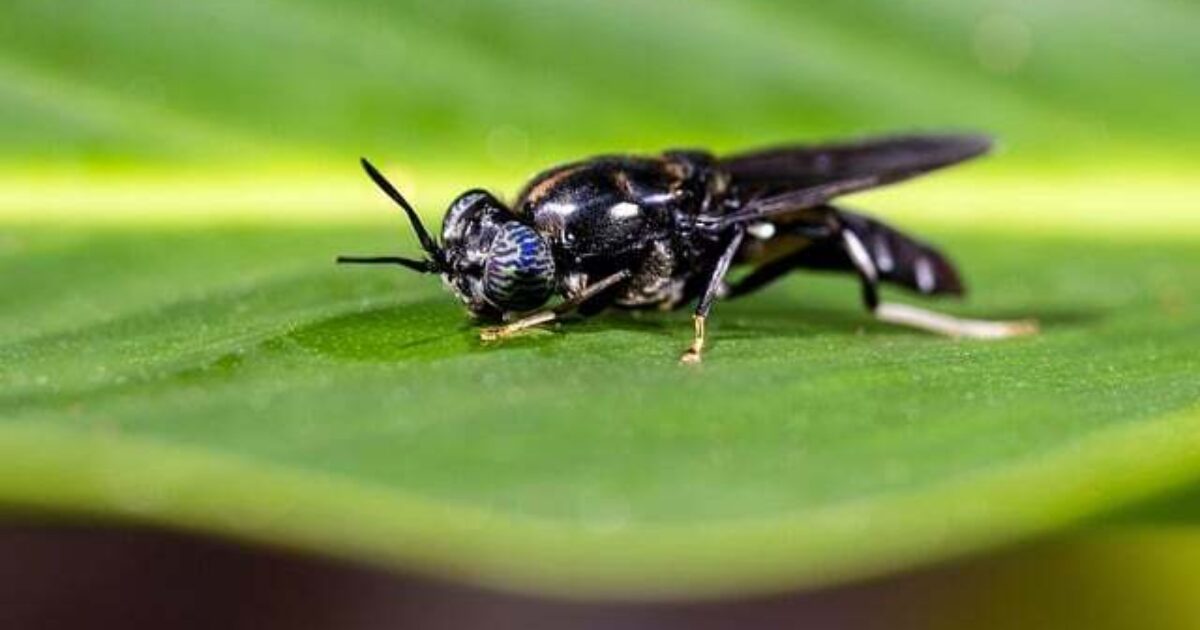
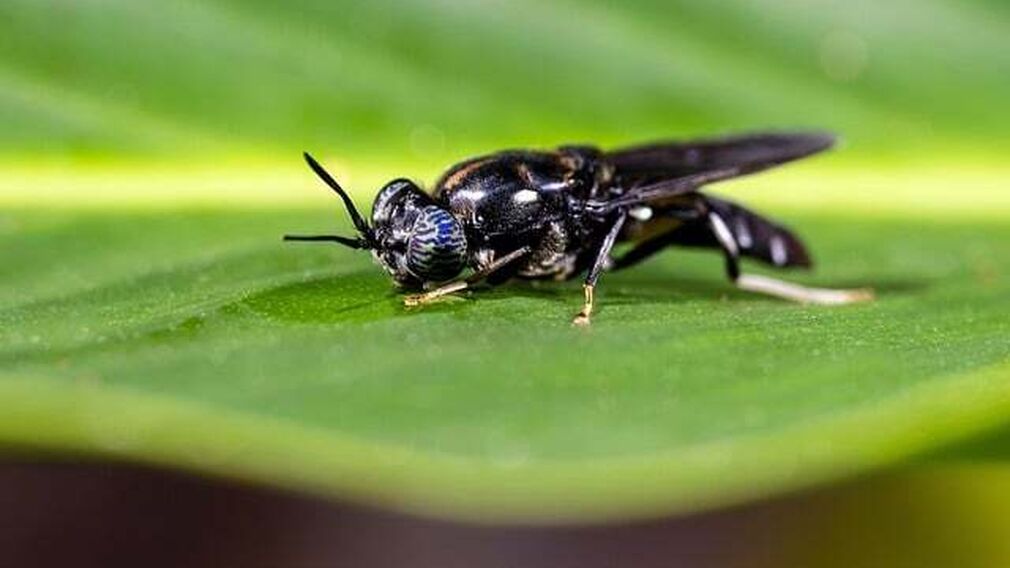
A black soldier fly partnership between NRGene Canada and Ile-a-la-Crosse Fish Company has produced poultry feed rich in omega-3s. Image source: Pixabay
A black soldier fly (BSF) partnership between NRGene Canada and Ile-a-la-Crosse Fish Company has produced poultry feed rich in omega-3s from fish processing byproducts.
The partnership’s aim was to process local waste into a feed supplement for poultry that, when fed to laying hens, could produce eggs with a higher omega-3 content, the companies said on 16 September.
As part of a semi-industrial trial at the North American Insect Center in Saskatoon, Saskatchewan, NRGene Canada produced approximately 90kgs of MaxBSF larvae (approximately 3.3 wet feed conversion ratio) from 0.3 tonnes of feed containing 50% fish processing byproducts, reaching harvest after an 11-day cycle – five-day nursery stage and a six-day grow-out.
“We set out to demonstrate that a difficult waste stream could be converted … at a commercially meaningful scale,” said Yossi Levi, chief business officer of NRGene Canada.
Analysis by Canadian Association for Laboratory Accreditation (CALA)-accredited laboratory Prairie Tide Diversified found that the fish-fed larvae contained several times more total omega-3 and contained marine omega-3s eicosapentaenoic acid (EPA) and docosahexaenoic acid (DHA), which were not detected in standard-fed larvae.
Larvae reared on the fish-based feed contained 5.16%-7.94% total omega-3 as a share of total fatty acids, compared with 1.12% in larvae of the same genetics on standard feed. The marine omega-3s EPA (1.14%-1.89%) and DHA (0.37%-0.65%) were present in the fish-fed larvae but not detected in the standard-feed larvae.
“Conventional BSF larvae generally contain very limited levels of EPA and DHA,” said Dr Ben Gradus, director of product, BSF at NRGene Canada.
“By incorporating fish processing byproducts into the feed, we can produce MaxBSF larvae that combine insect protein with … marine omega-3 fatty acids.”
The enhanced nutritional profile also created new potential for MaxBite, NRGene Canada’s dried BSF larvae product for animal feed, the companies said.
Following the trial, the partners said they were planning to construct a BSF rearing facility on site in Ile-a-la-Crosse, Saskatchewan.
FairGene, the joint venture between NRGene Canada and Fairville Farming Co in Bassano, Alberta – which started producing BSF eggs at the production facility in July 2026 – would supply the neonates for the project.
The project would follow NRGene Canada’s hub-and-spoke model, pairing centralised egg and neonate production with regional rearing sites close to local byproduct streams.
“This is a scalable model, not a one-time project,” said Levi. “We take a local organic byproduct, develop a dedicated feed, supply … neonates from a central egg facility and establish the rearing operation close to the feedstock.”
Saskatchewan-based NRGene Canada develops BSF genetics that process organic waste into protein and fertiliser.
Ile-a-la-Crosse Fish Co is a community-based business jointly owned by Sakitawak Development Corp and Big Island Fishermen’s Cooperative.