
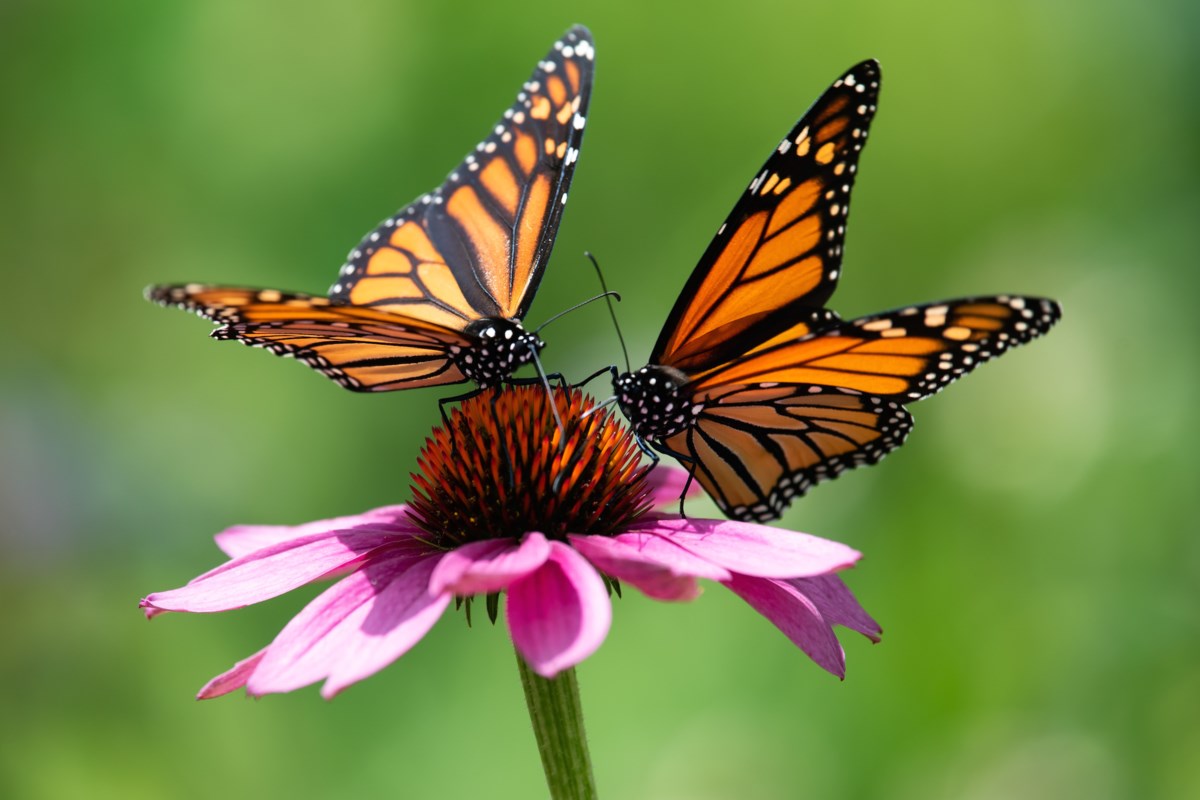
Tracking data shows monarch ON_w03 refueled at Orillia area locations including Atherley and Victoria Point before heading south on its 4,000-km odyssey
Perhaps it was a storm that swept him up on Sept. 13. Perhaps gusty winds. Or maybe he just lost his way and didn’t want to ask for directions.
Whatever the case, Monarch Butterfly ON_w03 found himself in Orillia on Sept. 14, a couple hundred kilometres off-course from Kettle Point and Ipperwash where he had spent the previous days.
In Orillia, he nectared on some goldenrod and asters during his forays into Atherley and Victoria Point. He may have visited a few Orillia gardens where people had grown the native nectar plants to provide crucial fuel for his journey. He made a little trip down to Line 15 to sample some nectar there, too.
I hope he found Orillia welcoming, even if it hadn’t been on his itinerary.
He stayed the night in Mara Provincial Park, probably with a roost of other monarchs clustered on tree branches.
On Sept. 18, ON_w03 set out for Mexico: that day he was detected in Guelph just 1.5 km from the University of Guelph, where he had been captured, fitted with a tiny backpack transmitter, and released 11 days earlier. Then Woodstock, London, and finally Port Bruce in Elgin County. About 300 kilometres in a single day, and that includes pit stops to fuel up on nectar.
On Sept. 20, ON_w03 crossed Lake Erie and was detected in Huron, Ohio.
Since then he has flown through Ohio, Indiana, Illinois, Missouri, Arkansas, Oklahoma; at the time of writing he is southwest of Dallas, Texas, and has travelled 2,032 kilometres from release.
We’ve known since the pioneering work of Fred and Norah Urquhart in the 1970s that monarchs fly from Ontario to Mexico each fall. Their migration is a feat so incredible – an insect flying 4,000 or more kilometres to a place it has never been – that many people still think it takes place over several generations of butterflies. This is not the case.
The monarchs that migrate south are actually part of an annual “Super Generation” of monarch butterflies, born in Canada and the northern United States each August with larger wingspans, brighter colours, and 10 times the longevity of their parents and grandparents that were born over the spring and summer.
Changes in light and temperature during their caterpillar days signal these “Super Monarchs” to put reproductive maturity on hold (scientists call this reproductive diapause) and instead put their energy into being bigger, stronger, faster: only the toughest will complete their migration.
They will travel to Central Mexico, overwinter in the oyamel fir forests there, and begin the journey back north in the spring, finally reproducing in northern Mexico and the southern U.S. and giving way to the next generation, which will continue the journey north to breeding grounds in Canada.
Being able to watch that incredible journey via cellular tracking makes it all the more awe-inspiring. ON_w03 is one of dozens of transmitter-bearing monarchs released by the University of Guelph, in partnership with Project Monarch, Cellular Tracking Technologies, and Cape May Point Science Center.
The BlūMorpho transmitter devices weigh about the same as a grain of rice, and use the same frequency as Bluetooth so that cellphones can act as receivers. The transmitters are fixed to the butterflies’ backs, and don’t appear to hinder their flight.
The transmitter from Project Monarch is how we know that Orillia was part of ON_w03’s journey – albeit an unplanned one.
And it allows us to follow along.
Will ON_w03 make it to the overwintering grounds? Will he survive there until spring, when he will fly north and pass on his genes?
The hazards are many: predators, weather events, lack of food, chemicals and pesticides (mosquito spraying during migration has been known to lead to monarch mass murder in some states), cars, habitat loss … the list goes on.
To follow ON_w03’s journey, download the Project Monarch app. You can find ON_w03 (and other butterflies released from Ontario) by selecting University of Guelph in the Institutions drop-down menu in the map tab.
I didn’t expect to spend my autumn cheering for a bug, but here we are.
You can help monarch butterflies and other insects at risk by growing native plants, avoiding pesticide use, and using wildlife-friendly gardening practices.