
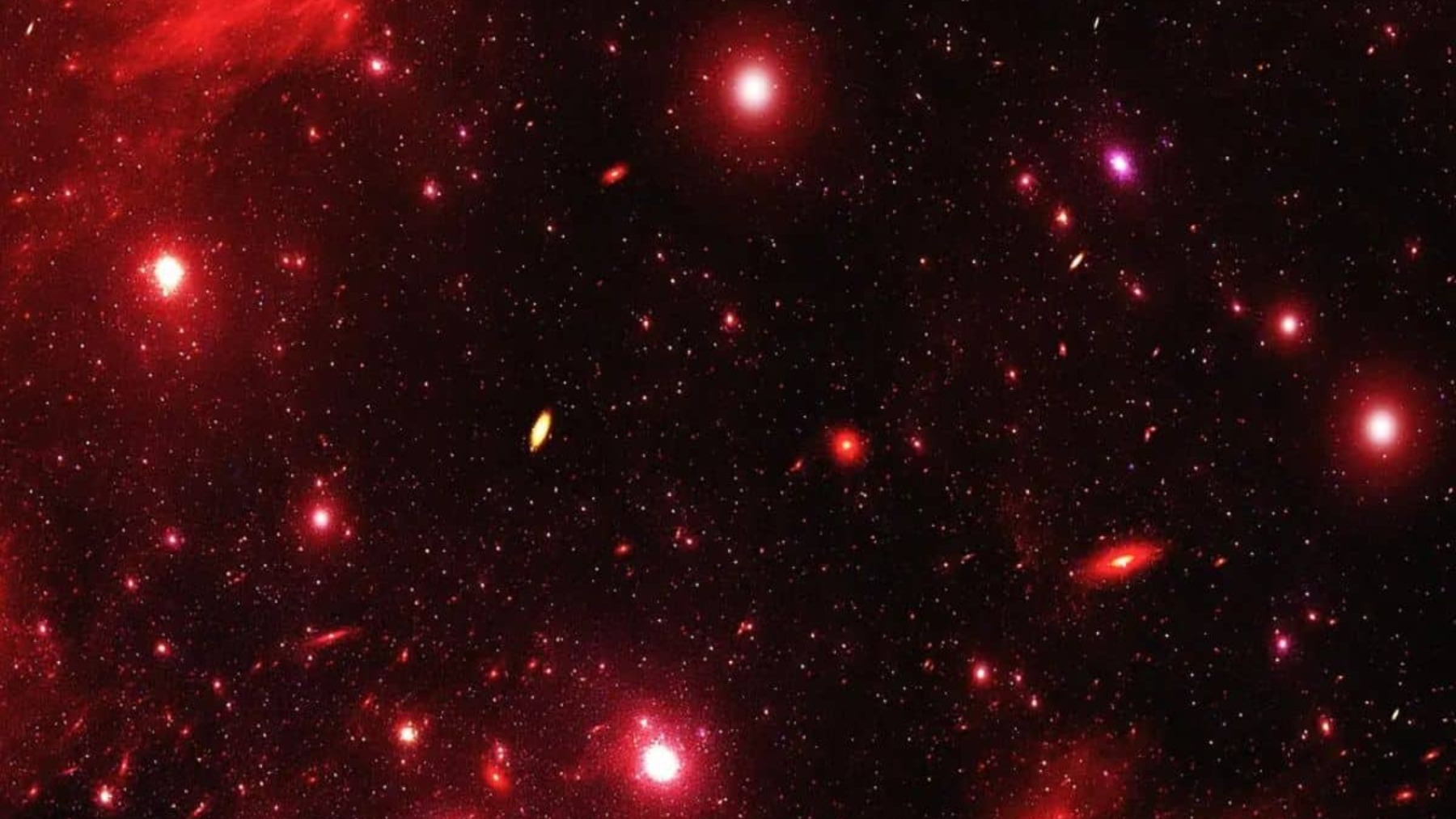
When the James Webb Space Telescope first opened its golden mirrors in 2022, it delivered breathtaking views of the cosmos. But tucked into those images was something unexpected: tiny, faint, little red dots scattered across the ancient sky. They weren’t ordinary stars or galaxies. They were puzzling new objects, glowing faintly from when the universe was only a few hundred million years old. And for more than two years, scientists have been scratching their heads over what they really are.
Now, new research may finally solve the mystery. Far from breaking physics, the red dots could be the natural by-product of how the first galaxies formed inside dark matter—the mysterious, invisible glue of the universe.
What exactly were these little red dots?
The James Webb Telescope is designed to capture infrared light, which is perfect for spotting distant, ancient objects. As the universe expands, light from early galaxies stretches and reddens. That’s why many of the faintest objects JWST detects appear in shades of red.
But these red dots weren’t just any galaxies. They were tiny, sometimes just 2% the size of our Milky Way. They were also oddly compact, packed with stars or gas in ways that didn’t fit our models. Some seemed so dense that they should have collapsed under their own weight. Others looked too faint to be quasars—supermassive black holes devouring matter.
In short, they didn’t make sense.
The first theories: galaxies, black holes, or both?
Astronomers rushed to explain them. One idea was that they were ultra-compact galaxies, brimming with stars at densities we’d never seen before. But this strained the limits of physics.
Another camp argued the red dots might be powered by supermassive black holes. If a black hole was surrounded by thick gas, it could glow faintly, producing exactly the kind of reddish signal JWST was detecting. Some even floated more exotic ideas: enormous “black hole stars” or quasi-stars—giant gas shells with a black hole at their heart.
The new explanation: slow-spinning dark matter halos
Researchers Avi Loeb and Fabio Pacucci a different theory: these little red dots are galaxies forming in slow-spinning halos of dark matter.
But how, if dark matter is invisible? Well, it does make up about 85% of all the matter in the cosmos. It doesn’t shine or reflect light, but its gravity sculpts the universe. Galaxies form inside dark matter “halos”, much like seeds forming inside a protective shell.
Normally, these halos spin. That rotation stretches galaxies outward, giving them shape—like pizza dough being spun in the air. But what if a halo barely spins at all? The galaxy inside would stay compact, tiny, and dense.
That’s exactly what the red dots look like. According to Loeb and Pacucci, they represent the rare 1% of halos that spin unusually slowly. Over time, those halos would gain speed, spreading out their galaxies until they looked more like the familiar spirals and ellipticals we see today. The red dots, in other words, are pictures of galaxies before they grew up.
But the debate isn’t over
Of course, science is rarely settled by one paper. Other teams still argue that many red dots are powered by actively feeding black holes. Some Webb data shows gas swirling at millions of miles per hour around their cores, a clear sign of black hole activity. Still others suggest the dots could represent a brand-new class of cosmic object we’ve never seen before.
The truth might be a mix: some little red dots are compact galaxies in slow-spinning halos, others are baby black holes shrouded in gas, and some could be both. What’s certain is that JWST has opened a window into a part of the universe we never had access to before.
The faint red dots that baffled astronomers just two years ago may turn out to be one of the keys to understanding how the cosmos built itself. Instead of defying physics, they may reveal how dark matter, galaxies, and black holes worked together to shape the universe.