
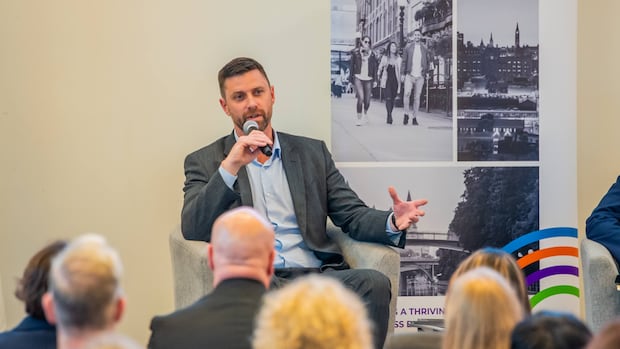
Alex Lawson has become the second leading candidate to promise a tax cap if he’s elected mayor of Ottawa.
He’s looking to outdo incumbent Mark Sutcliffe with a promised freeze of property taxes for 2027. Lawson said there will be no increase at all that year if he wins.
In a fiscal plan he released Thursday, he also committed to ceilings for the three years after that: one per cent in 2028 and two per cent in each in 2029 and 2030.
Sutcliffe has promised to hold tax increases in the range of two to 2.5 per cent in 2027 and 2028, but said it isn’t realistic to make any firm commitment beyond that. He said he would aim to keep any tax hikes as low as possible.
Lawson’s plan said that Ottawa does not have a revenue problem, but “a leaky bucket problem.”
“Fix the bucket, put every dollar to work, and Ottawa can hold the line without cutting the services people count on,” the plan said.
The last time Ottawa froze property taxes was in 2007 under Mayor Larry O’Brien, though taxes increased steadily throughout the rest of his term.
Under Sutcliffe’s watch, taxes increased 2.5 per cent each of his first two years, followed by 3.9 per cent in 2025 and 3.75 per cent in 2026. This year’s increase meant about $166 more in these taxes for the average urban homeowner.
WATCH | Mayoral candidates pressed last week on tax pledges:
How much could you pay in property taxes? Most mayoral candidates make no promises
Some Ottawa mayoral candidates say voters deserve to know if their taxes will rise before going to the polls. Others say it’s impossible to say before going over the numbers. The CBC’s Elyse Skura reports.
The city operating budget this year is $5.2 billion, plus $1.9 billion for capital. It’s facing familiar pressures from inflation, fuel prices and pay increases for city staff.
Some departments, like OC Transpo, have posted persistent deficits.
Unlike revenue sources available to the provincial and federal governments, city property tax revenues do not rise automatically like taxes based on personal incomes or corporate profits. While there is always extra revenue from new homes, those new residents also put more demand on city services.
On top of that, Lawson has made promises that will cost money, including scrapping the vacant unit tax while still keeping the $12.5 million in affordable housing money it funds, plus a higher tax break for small businesses he estimates would cost $8.4 million in lost revenue.
He would also lose almost $20 million in revenue by getting rid of paid parking across the city.
While the Lawson team said that would have little impact on the bottom line since the earnings from paid parking barely cover its costs, some of those costs are expenses like snow clearing the city would still have to pay.
Requires $85M-$105M in savings, Lawson says
Lawson’s plan said he would find the fiscal room to keep his tax pledge by “getting back to basics.”
He said he would have to find about $85 million to $105 million in savings to cover the budget pressures plus his own promises in only his first year. He said his plan actually finds $77 to $148 million a year.
By contrast, Sutcliffe is promising $250 million in savings over four years, an average of about $63 million.
Lawson arrives at his number in part by removing increases for OC Transpo from the equation and by including the money the city expects from taxes on new homes added to the assessment rolls. Otherwise the budget pressure would be higher still.
His plan does include a detailed list of where he hopes to cut waste, with the largest savings said to come from more competitive and transparent procurement, bringing more consultant work in-house and being more disciplined in hiring, including through relying more on artificial intelligence to save staff time.
He also said he would rein in year-end spending spikes at city departments.
The city already has a freeze on hiring non-essential workers and on discretionary spending in a bid to control costs.
Lawson’s plan does factor in the cost of two promises: axing the vacant unit tax and his small business tax break, but not any possible pressures from the loss of parking money.
Other campaigns respond
Two other leading mayoral candidates have not committed to tax caps.
Jeff Leiper isn’t saying how property taxes might increase overall should he be elected, though he said he would dedicate a one per cent increase to fix infrastructure, a hike that would come on top of the number for other city services.
He responded to Lawson’s tax plan by saying it will mean fewer bylaw officers, calls to 311 that go nowhere and planning files that sit on the shelf for months.
“Promises are easy. Potholes, cracked bridges and late buses don’t care about campaign slogans,” he said in a written statement. “A tax freeze sounds great until the service you count on gets cut, or the bill lands on our kids. A freeze doesn’t just mean fewer services. It means fewer people to deliver them.”
Lawson denied in his plan that his freeze would mean cutting services that people count on. He said no bus driver, paramedic, firefighter or snowplow operator would lose their job.
Neil Saravanamuttoo has said it would be irresponsible to commit to a specific tax number when so much is unknown, like the size of the infrastructure funding gap or the amount of savings he’s sure can be found at city hall.
In a written statement reacting to Lawson’s new pledge, Saravanamuttoo said his approach is more honest.
“Alex Lawson, like Mark Sutcliffe, is pulling numbers out of the air to make promises they have no way of knowing if they can keep,” he said.
“Unlike my opponents, I don’t make promises unless I’m sure I can keep them. When I’m able to say we can cut taxes, it will be because I’ve done the hard work of finding the overspending that allows us to cut costs without cutting services.”