
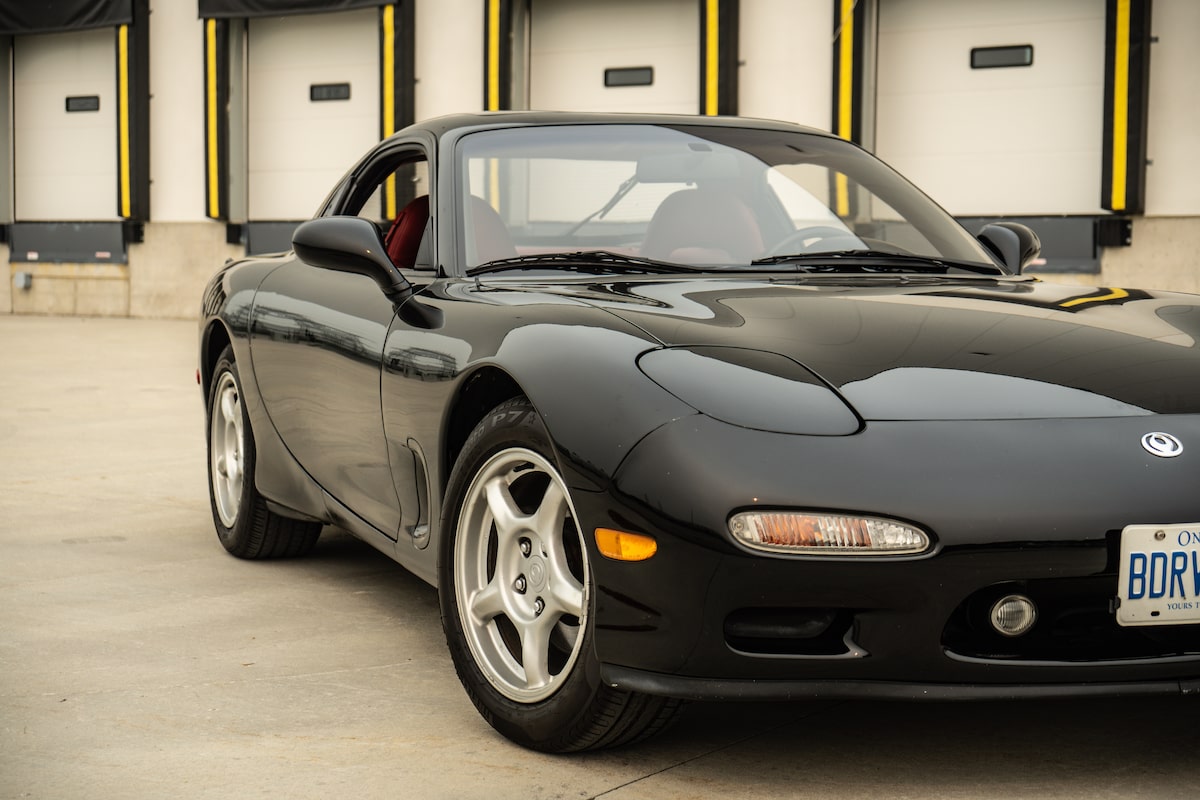
After 33 years, the car still looks showroom perfect with only 15,000 kilometres on it.Kunal D’souza/The Globe and Mail
There is a cultural theory called the nostalgia pendulum, in which popular media, fashion and trends tend to follow a 30-year cycle as consumers of culture become its creators. It explains why I am suddenly obsessing over cars from the 1990s that I pined for in my youth – cars like the Mazda RX-7 that I recently drove.
Walking up to this pristine 1993 model was one of those meet-your-heroes moments. Here was a car I had only experienced in video games and magazines during my formative years, when my high school self dreamed of taking this rotary-engine sports car for a spin.
The starter motor whirs for a few seconds before the engine ignites. It doesn’t take long to warm up, at which point I bury my right foot into the carpet, sending the tachometer needle swinging toward red, before I lift, push the clutch in and engage the next gear to do it all over again. The experience is every bit as glorious as I had imagined. The key is in the engineering – partly the incredible lengths Mazda took to reduce weight, but mostly it is the special engine under the hood.
Assisted by twin sequential turbochargers, the RX-7 produced 255 horsepower and 217 lb-ft of torque.Kunal D’souza/The Globe and Mail
Mazda is the only car company in the world to successfully mass-produce the rotary engineKunal D’souza/The Globe and Mail
Mazda is the only car company in the world to successfully mass-produce the rotary engine, which remains in production as a range extender in the electric Mazda MX-30, currently available only in Japan.
The Wankel may be one of the most distinct engines in the industry. Instead of pistons, it uses triangular rotors that spin inside an epitrochoid – or elongated, oval housing – to drive the eccentric shaft. It’s lighter than a typical piston engine, has fewer moving parts and the main block is about the size of a small toaster. This compact size allows it to be mounted close to a vehicle’s centre of gravity, making it particularly suited to sports cars.
However, there are major shortcomings. A rotary engine isn’t as thermally efficient as a piston engine, which results in higher emissions and fuel consumption. It’s also more prone to combustion gas leakage and the mixing of unburned gases and oil. Furthermore, the design inherently consumes more oil, which is introduced into the combustion chamber for lubrication and cooling.
As a result, there isn’t much of a business case to continue using this type of engine, especially as emissions standards become more stringent. Mazda’s global communication team says meeting emissions regulations poses a greater challenge for rotary engines and requires advanced technological development. But this is more than just engine technology, according to Mazda – it embodies the company’s engineering DNA over many years. It also separates the small, Hiroshima-based automaker from juggernauts such as Honda and Toyota.
The first Mazda to use it was the Cosmo in 1967; the most well-known is the RX-7, which debuted in 1978 with its period-perfect wedge shape and pop-up headlights. The third and final generation of the RX-7 was discontinued in North America in 1995 because of slow sales, but was produced for other markets, including Japan, until 2002.
The third-generation RX-7 used the chassis code FD3S and debuted in 1993 during the golden age of Japanese sports cars, a period that included the Acura NSX, Nissan Skyline GT-R and Mark IV Toyota Supra.
Our tester was black on burgundy with leather seats, a rare colour on the inside for the RX-7.Kunal D’souza/The Globe and Mail
The touring model has a five-speed manual transmission and a Bose Acoustic Wave audio system.Kunal D’souza/The Globe and Mail
Mazda Canada keeps two of those RX-7 models in its heritage fleet, one in competition yellow mica, the other in a brilliant black. They were among the first FD3S RX-7s in North America when the company bought them in 1993. A few times a year, these cars are loaned out to stretch their legs, and Mazda was kind enough to let me drive the black one for a few days. It was a touring model with a five-speed manual transmission, burgundy leather interior and a Bose Acoustic Wave audio system.
After 33 years, the car still looks showroom perfect with only 15,000 kilometres on the odometer. Of all the rare and expensive cars I’ve driven, this one made me the most nervous. Perhaps it was Mazda’s public relations representative telling me it was “rare and irreplaceable.”
North American FD3S RX-7s in stock form are few and far between because they were only sold here for two years. Finding one with such low mileage and in all-original condition is akin to finding a unicorn.
The headlights pop up and have a spray nozzle similar to the windshield.Kunal D’souza/The Globe and Mail
Needle-and-gauge instruments on the dashboard.Kunal D’souza/The Globe and Mail
Of the Japanese domestic market supercars of the era – and these truly were supercars with performance rivalling Ferraris of the time – the Mazda was the lightest and, in my opinion, the coolest. It weighed just 1,270 kilograms, with its tiny 1.3-litre twin-rotor Wankel engine mounted low and well behind the front axle. Assisted by twin sequential turbochargers, it produced 255 horsepower and 217 lb-ft of torque.
Power-to-weight was a big advantage the rotary had over traditional piston engines, as it was some 136 kilograms lighter than the engines used in the competition. Mazda went further with the RX-7, obsessing over every detail to cut weight. The spark plug leads were trimmed to the perfect length so no extra wire was used. It featured a hollowed-out steering rack, hollow aluminum upper and lower control arms at all four corners, composite seat frames, and a brake and clutch pedal hewn from aluminum with holes drilled into them to save additional weight. Even the factory 16-inch alloy wheels weighed just 5.9 kilograms each.
The Supra was a heavyweight by comparison at 1,542 kilograms, and even the NSX, with its state-of-the-art aluminum monocoque, was heavier at 1,370 kilograms.
The smell of the RX-7’s leather interior and the simple analog controls took me back 30 years, but the way it drives – especially at speed – puts modern sports cars to shame. The steering alone was worth the price of admission, brimming with feedback. The road and tire noise in the cabin is unthinkable in a modern car, but here it simply adds to the experience. It takes just a few corners to appreciate the RX-7’s true purpose, as it flows through them like a 1.5-times scale Miata with double the power.
The 1.3-litre rotary is sublime, aided by twin sequential turbochargers – one operating at low rpm and the other engaging for the higher rev ranges. It’s incredibly smooth, with a turbine-like whir as it sings to 8,000 rpm. There’s none of the severe turbo lag often associated with cars of this era; combined with its high power and light weight, the vehicle is surprisingly quick, able to sprint to 100 kilometres an hour in about five seconds.
The Wankel rotary was invented by German engineer Felix Wankel, who conceived the design in 1924 and received his first patent in 1934. Wankel partnered with West German automaker NSU Motorenwerke in 1951 to develop the technology, and the company officially unveiled the completed rotary engine concept in late 1959. In 1963, NSU debuted the Wankel Spider, a small convertible that became the first production automobile powered by a rotary engine.
Recognizing the performance potential of the rotary firsthand, Mazda – then known as Toyo Kogyo – signed a formal agreement in 1961 to license the technology from NSU. However, the Spider suffered from reliability issues caused by prematurely wearing apex seals – critical components that are the rotary equivalent of traditional piston rings.
Determined to find a solution, Mazda developed an apex seal made from a carbon-aluminum composite, paving the way for the debut of the Cosmo and eventually the RX-7. Mazda credits its success in overcoming these challenges to persistent advancements in materials and lubrication technology, machining precision and engine design optimization.
NSU was unable to survive the financial burden brought on by spiralling warranty claims for blown rotary engines. The company was eventually absorbed by the Volkswagen Group in 1969 and merged with Auto Union to form Audi NSU Auto Union AG, which later became Audi AG.
While the rotary serves as a range-extending generator in the MX-30 – a crossover that ended its Canadian run at the end of the 2024 model year – development continues.
In 2023, Mazda showed the Iconic SP concept – a gorgeous rotary-powered sports car – at the Japan Mobility Show. A year later, the automaker established the rotary engine development group, reviving a dedicated organization to advance the technology. The rotary can be adapted to run on hydrogen and carbon-neutral fuels, and its compact size and packaging flexibility make it suitable for integration into electric vehicles.
The company says the rotary is not just a historical technological asset but an important technology it will continue to explore.
The trunk has enough space for some tools.Kunal D’souza/The Globe and Mail