
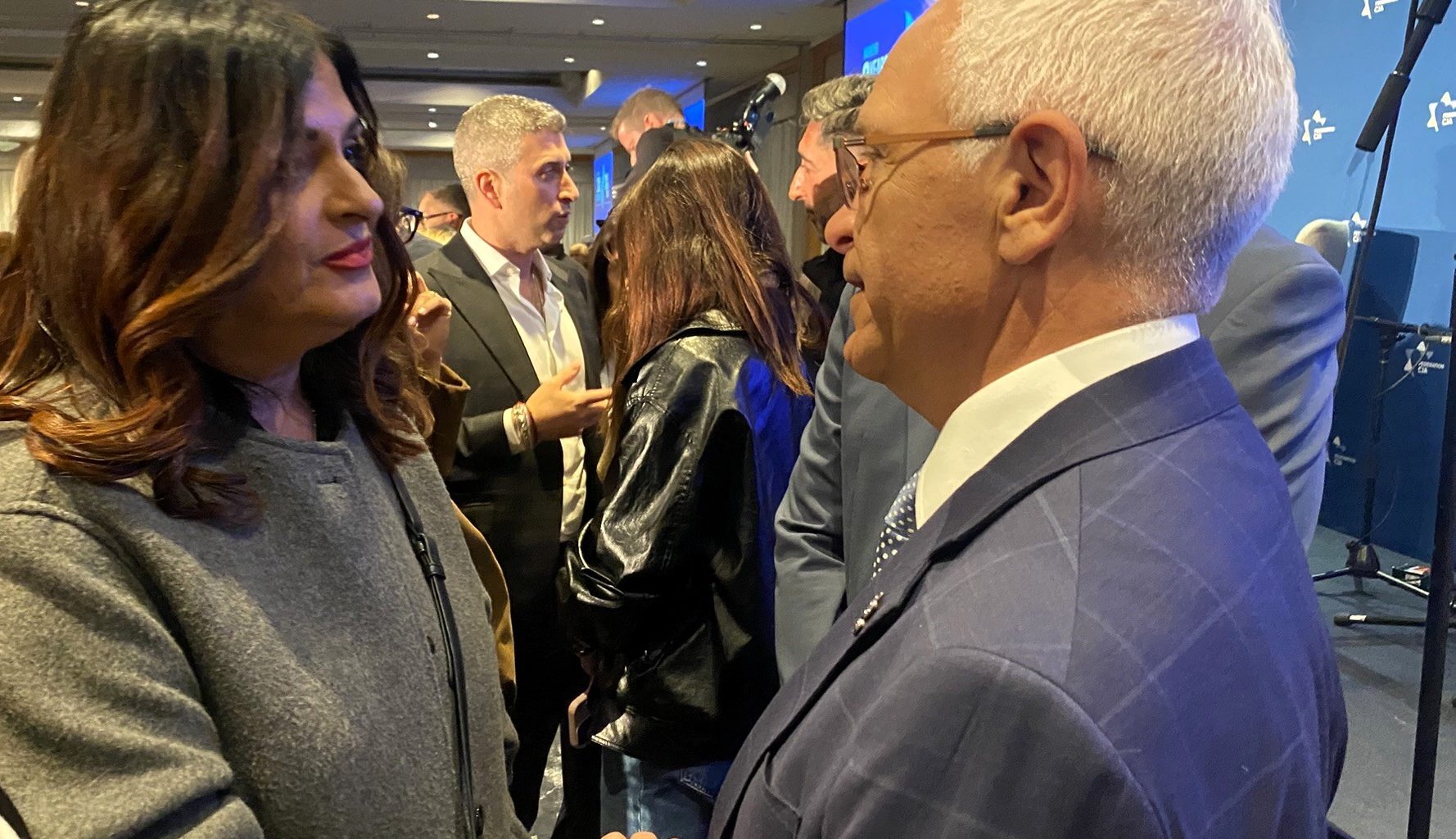
Some 400 people gathered at Montreal’s Gelber Centre on Wednesday night to mark the third anniversary of Oct. 7, hearing tributes, firsthand accounts of the terror attacks, and stirring musical performances by a troupe of young Israelis.
The evening was also a tribute to Kibbutz Nirim, which Federation vice-chair Samantha Mintz Vineberg recalled visiting in May 2024. Located less than two kilometres from the Gaza border, the kibbutz was heavily damaged during the attacks, and Montreal’s Jewish community subsequently committed to helping rebuild its physical infrastructure and support its recovery.
“When we were there, we bore witness to the devastating aftermath of October 7th. Homes burned to ashes, schools destroyed, dormitories for young people left damaged beyond recognition. But amidst that destruction, we also met extraordinary people, purposely determined to rebuild, refusing to let hate and terror define their future. The ultimate victory over this terror is that we do not break. The highest tribute we can pay to those lost is to stand united with the State of Israel and remain unshakable in our commitment to our people, our heritage, and our future.”
Israeli Consul-General for Quebec and the Atlantic provinces Eliaz Luf noted “the IDF, when it was established in ’48, the motto was ‘Never again defenseless.’ Citizens will never face slaughter in their homes without an army between them and annihilation.” The nation failed on that morning, he said, “big time,” but Luf recounted one of the many stories of heroism, that of Col. Asaf Hamami, who fought terrorists at Nirim with two other soldiers, leaving their base to protect nearby families. All three were killed and their bodies taken to Gaza. “It was a very bad sign for the Jewish people, what may happen to us, all of us, if we are caught off guard, if we are defenceless.”
“No matter the price, no matter what condemnation we get at the UN or from this, or other countries; life comes first, Jewish life matters, and Jewish lives are the most important thing we must defend, day and night. To make sure that no one will ever even think about doing such a thing again.”
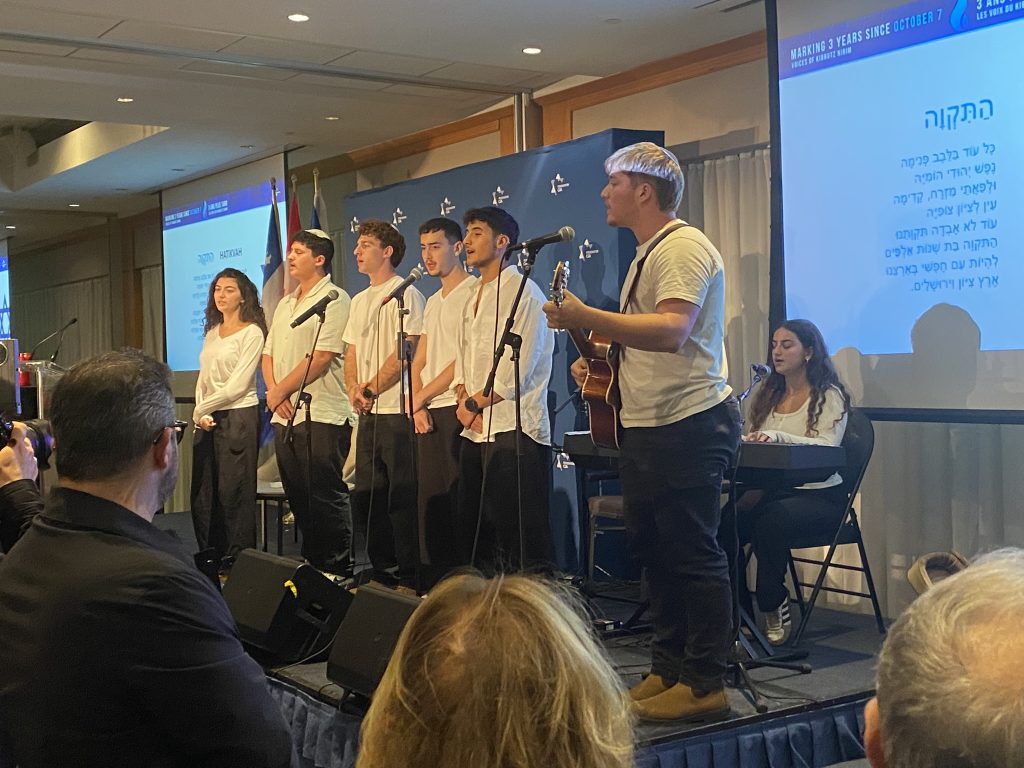 Youth ambassadors (shinshinim) lead the audience in Hatikvah at Montreal’s commemoration event, on Oct. 7, 2026 (Credit: Joel Ceeausu)
The program featured prayers by Israel’s deputy chief of mission Moria Segal, Montreal Hillel director Yoni Troy and several Israeli youth ambassadors. Federation president and CEO Yair Szlak also paid special tribute to Montrealer Alexandre Look, who was murdered on Oct. 7 while trying to protect people sheltering from the attack.
“When I had the profound honour of eulogizing Alexandre once he returned home, I called him gibor, hero of Israel, which was reaffirmed to me when I was with (his parents) Alain and Raquel in Israel and met some of the living witnesses who actually lay inside the migunit (small protective shelter) as Hamas showed up in their white trucks. Alex, being the ultimate diplomat and man of good words, stood in front of the migunit, believing he could protect the people inside. Unfortunately, his humanity was not met with any. But when you heard those who survived because of him, you realized the power of one person.”
‘All hell came’
Israeli police officer and Kibbutz Nirim resident Lee Rahav gave his riveting account of the Oct. 7 attack on his home, recalling when the red alerts came, “we jumped off the bed, took our three children and two dogs to the safe room.” Rahav’s wife Michal put protective vests on the kids, while he stood in his living room assembling his weapons.
His wife headed to the safe room armed with a pistol, and from his son Itamar’s bedroom Rahav watched Hamas terrorists walking outside his home. “One smashed the window with his rifle and stuck his head inside to do a quick search. The last thing he saw was me pointing my gun at him. I shot him twice and he fell back dead on the ground. A second later all hell came on our house.”
Rahav said the house was sprayed by bullets from multiple shooters, and a grenade was thrown into Itamar’s bedroom after he ran to join his family. “It’s probably going to be the end of the Rahav family in this chapter of life, I told them… We thought this was the end.”
The family remained trapped for 10 hours. “We waited for someone to help us, silently, no one speaking, no one crying, no one understanding what’s going on. I promised myself that if something God forbid will happen, I will run outside and kill as many as I can to protect my family before I am shot.” Eventually a special unit came to clear the area and escort them from the house, “and I remember Michal told me she doesn’t want anything from the house but the kiddush cup, hanukkiah, and tallit,” adding he grabbed the main Israeli flag on the way to the kibbutz clubhouse.
His neighbour Doron Meir, a school security guard, “did what any Israeli father will do to protect his own family. He shot when he saw the terrorists outside his house. They shot him back. He collapsed immediately in the middle of the living room and his daughter Mor, who just joined the IDF, did what every Israeli and daughter will do, she ran to try to save her father.” She too was shot dead.
Rahav says he’ll never forget the horror and the fear in his children’s eyes as they drove away, “and when I looked back and behind them, saw the smoke coming from our houses and fields, and it was silence.” Rahav’s family and other residents were eventually evacuated to Eilat and housed in hotels for more than four months before they were relocated to apartments in Beersheva.
He says he was especially moved by Montrealers who decided to “fly to a war zone, get in a bus, travel to a restricted military area and land with boots on the ground, to walk with us and ask what we need. The Jewish community of Montreal did more than you can imagine for the people of Nirim.” Federation committed $1 million over three years to help Nirim rebuild, including a new spacious dining hall, and a new children’s playground. Today, he says, Nirim is back, bigger and better and most people have returned. “Surprisingly, we had even 10 new families who decided to build a house in Nirim,” coming just like waves of new members did over the years.
“This is Israel. We are here forever,” said Rahav, “like Israelis who want to do more for their country, we came to live on the border, to fight with my enemy or make peace, whichever comes first.”
In his closing remarks, Szlak reminded the crowd that included many non-Jewish allies, that antisemitism is not the problem of Jews, but “the problem of those who hate us.” Since October 2023 he said, Israel has fought a war on seven fronts, and the Jewish people on an eighth – the surge of antisemitism and radicalization, which he said Wednesday night is fueled by Iran and the Muslim Brotherhood.
Radicalization of society
“The problem is radicalization of society plaguing the public square, filtering itself through universities, bureaucracies, institutions of higher learning, hospitals. That’s not a threat against the Jews. All you’ve got to do is look across the ocean at our partners in Paris and France, what they’re going through right now. Radical extremism is not our problem as a Jewish community. It’s a problem of liberal democracies who are allowing intolerant minorities to use our liberties against tolerant majorities… We need allies to stand up and say it’s enough.”
A few hours earlier on the south lawn at McGill University, some 150 Jewish students gathered to commemorate the day. It was quiet, unlike the usual sight of pro-Palestinian and anti-Israel demonstrators harassing and disrupting Jewish and pro-Israel gatherings. On Wednesday, it was serene.
Many stood arm-in-arm, waving flags, hearing songs, testimonials, and speeches from community leaders and a Holocaust survivor, under the watchful eye of more than 40 Montreal police (SPVM) officers on foot, bicycle and horseback, as well as dozens of McGill security staff positioned at strategic points throughout the campus grounds. The scene was punctuated by the sounds of nearby students merrily tossing a football, curious onlookers, some taking photos, and a few passersby making offensive gestures and comments, albeit quietly.
Rabbi Reuben Poupko was not quiet. He addressed the students and all within earshot: “We come here with broken hearts, there’s no question” he said, recounting those murdered on October 7, the hostages killed and returned alive. “We remember each and every one of them. Every soldier that fell in the months and years after. We remember all the heartbroken parents, shattered widows, orphans left without parents. We remember all the families with empty chairs at their Shabbat tables.”
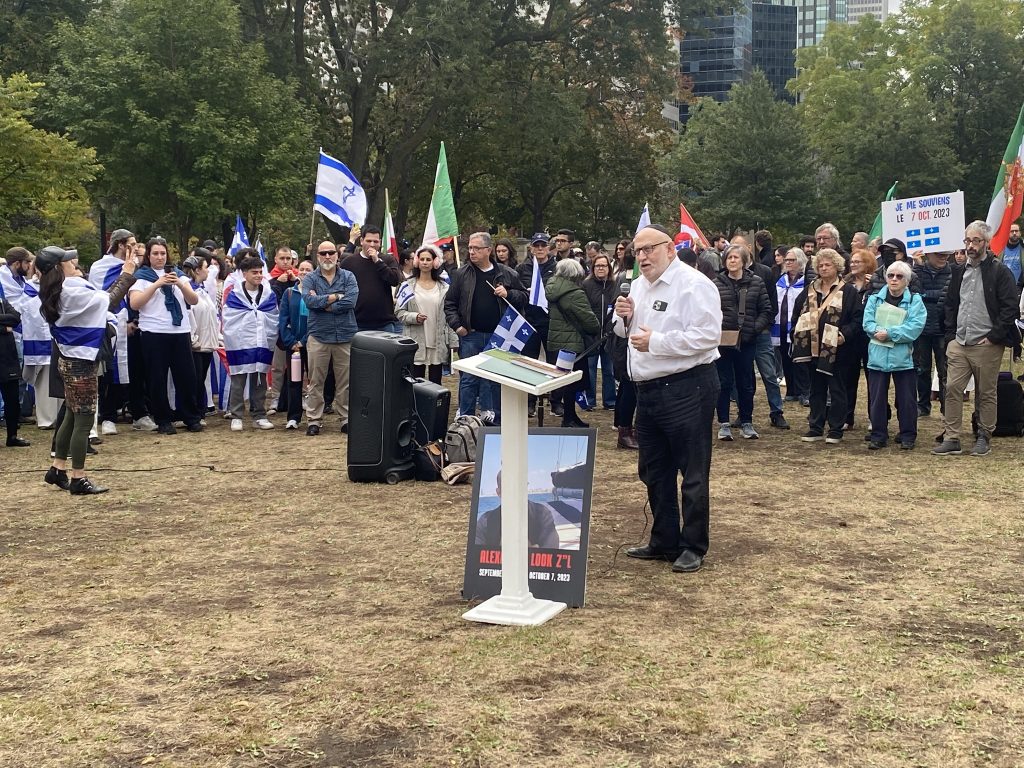 “The wound will never heal,” Rabbi Poupko told students on the McGill campus on Oct. 7, 2026 (credit: Joel Ceausu)
He recalled the morning of October 7, “and the scrambling of people in the congregation trying to cross the border to get to New York to get on those planes to go back to their units. People scrambling to get to Israel, to be in Israel to serve.” Rabbi Poupko said the wound will “never fully heal,” emphasizing the courage of Israeli soldiers and young people who responded, and noting the hatred unleased in the hours after the attack. “Fifty years from now, historians and psychiatrists will be trying to figure out what motivated people on October 7, 2023, to celebrate in downtown Montreal and in Times Square in New York.”
A hundred metres away, outside the iconic Roddick Gates which have served as a stage for virulent anti-Israel demonstrations over the last three years, a group of people, many masked and shrouded, hoisted Palestinian flags as demonstrators gathered for the first of a day-long series of downtown protests.
Across the entrance stood a gathering of Jewish, Québécois and Iranian activists denouncing hateful demonstrations and extremism in Quebec, the two groups separated by the SPVM’s special intervention squad. Pro-Palestinian demonstrators then broke out onto the road, blocking Sherbrooke Street and soon beginning to march, as they were joined by demonstrators from elsewhere in the downtown core.
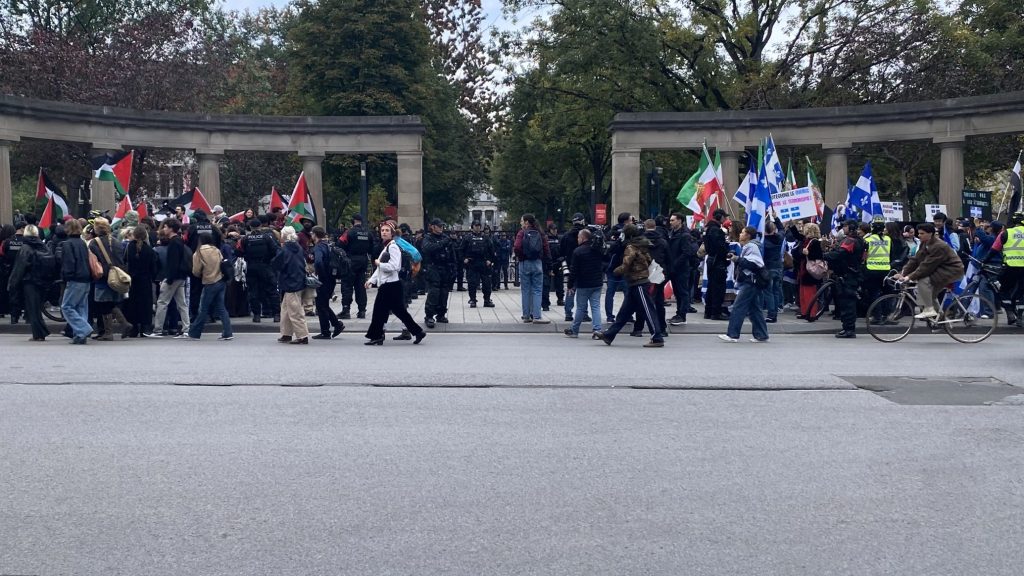 Demonstrators face off at Roddick Gates at McGill on Oct. 7, 2026 (Credit: Joel Ceausu)
Messages of hope
In her message to the community early Wednesday, Communauté sépharade unifiée du Québec president Esther Krauze held out great hope, remarking that despite three years marked by mourning, uncertainty and sacrifice, “Israel continues to live. Israel continues to build, to teach, to heal, to innovate, to celebrate life, and to believe in the future. Children continue to go to school. Families continue to gather around the table for Shabbat and holidays. Citizens continue to demonstrate admirable courage and resilience. This ability to rise again, to preserve their humanity even in adversity, is one of the greatest strengths of the Jewish people.”
Outgoing Quebec Transport Minister and former Minister responsible for fighting racism Benoit Charette, attended Wednesday’s event after taking to X, cautioning Quebecers to “not let ourselves be convinced that these attacks do not concern us because they took place thousands of kilometers away, reminding that “among those murdered on October 7, 2023, were Quebecers and Canadians.”
“Some of our fellow citizens are targeted by this hatred” wrote Charette. “Just listen to the violence of the rhetoric at certain ‘demonstrations’ in Montreal… Tonight, in our streets, ‘protesters,’ in a spirit of pure provocation, will take up this hateful discourse that has no place in Quebec or Canada… calling for the destruction of Israel and the death of Jews,” he said. “We must be concerned about this and oppose it.”
That echoed what Luf told the Gelber audience, calling out demonstrators. “They are not pro-Palestinian. They are pro-monsters. What they did on October 7 was much more than an act of war. It was a monstrous attack that some of the details we could not even imagine, even after the Nazis. It’s all black and evil. Find me one person that will say, ‘I want a two-state solution, I want peace.’ No, all they want is destruction.”
Other dignitaries present included MNAs Elisabeth Prass, Valerie Assouline, and outgoing Environment Minister Pascale Déry, as well as a number of local municipal officials. Newly elected east-end Parti Québécois MNA Stéphane Paquette was also present, sharing a brief, warm exchange with Alexandre Look’s mother, Raquel, as she left the room. “It’s my first official appearance anywhere,” a clearly moved Paquette told The CJN as he left the room. “I’m very honoured to be here.”
For his part, Szlak’s message earlier Wednesday was also one of determination, recalling that merely three days before the three-year anniversary, “the story unfolding in the skies above the Arabian Peninsula, a flight bound for Tel Aviv, a hijacker whose only intention was to kill Jews.”
Ordinary Israelis, he said, people expecting nothing more than a routine journey home, rose from their seats and ran toward danger instead of away from it. “Jewish people have learned many painful lessons from a history that includes tragedy and conflict.” The concept of lachtor le’maga, he said, “to run towards a threat” not away from it, is “too familiar to Israelis. A concept that saved 180 passengers on that flight and perhaps an untold number had the flight entered Israeli airspace. We, as Jews, have always known in our core: that when the moment demands it, we do not look away. We act. We protect one another. We choose life.”
On Simchat Torah, Szlak remarked, Jews read the final verses of Deuteronomy then almost immediately move onto Genesis. “Judaism does not permit the story to remain at its ending. Death is followed by creation.” These truths epitomize he said, “what it has always meant to be a Jewish community.We grieve, we protect, we advocate, and then we build and give hope. Because Jewish continuity has never been a passive inheritance. It is something every generation has had to choose time and time again.”
Joel has spent his entire adult life scribbling. For two decades, he freelanced for more than a dozen North American and European trade publications, writing on home decor, HR, agriculture, defense technologies and more. Having lived at 14 addresses in and around Greater Montreal, for 17 years he worked as reporter for a local community newspaper, covering the education, political and municipal beats in seven cities and boroughs. He loves to bike, swim, watch NBA and kvetch about politics.