
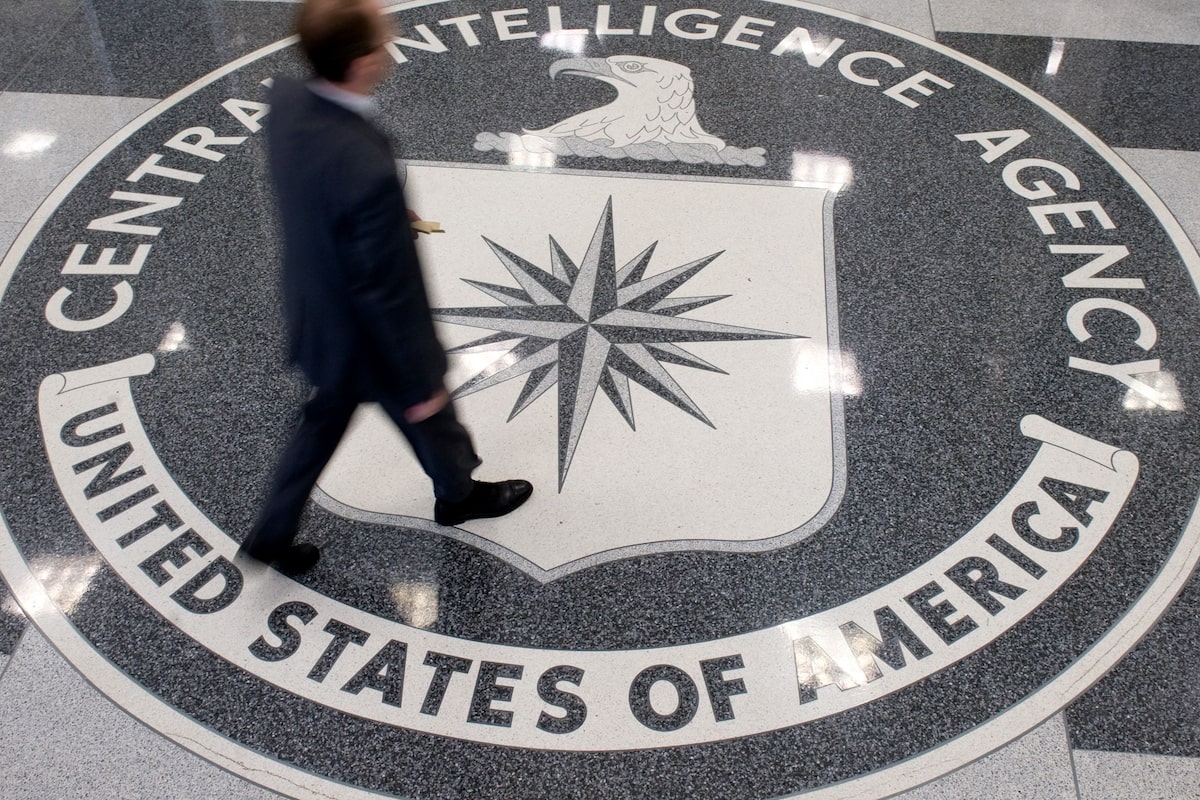
Newly declassified information sheds more light on the role U.S. intelligence agencies played in facilitating the settlement of Nazi collaborators in Canada.SAUL LOEB/AFP/Getty Images
The government has declassified portions of a report on the resettlement of Nazi war criminals that reveal new details of how dozens of people, including those suspected of collaboration with the Third Reich, were helped to come to Canada after the Second World War through a secret CIA program.
The newly declassified information sheds more light on the role American intelligence agencies played in facilitating the settlement of Nazi collaborators in Canada, in some cases by providing false identity papers. Sections of the report kept secret for decades also reveal new specifics about the number of people thought to have entered the country with U.S. covert help.
The federal government Thursday declassified more of a 40-year-old report written by historian Alti Rodal for the 1985-86 Commission of Inquiry on War Criminals in Canada, headed by former Quebec judge Jules Deschênes. The commission investigated allegations that Canada had become a safe haven for Nazi war criminals.
Last month, a Federal Court judge ordered Ottawa to publish redacted parts of the Rodal report. Canadian Identity Minister Marc Miller decided not to appeal the court ruling, which followed a legal action by Jewish organization B’Nai Brith.
Most of Ms. Rodal’s report had already been made public, with further declassified details released in 2024.
Opinion: Despite trials and tribulations, international criminal justice is still worth pursuing
The report found that Nazi collaborators who had aided the United States, including by providing information, were assisted in entering Canada by the Research and Resettlement Branch of the United States Army in Europe (USAREUR).
The Rodal report said USAREUR was then a cover organization for the Central Intelligence Agency and other such U.S. agencies. The U.S. Army organization admitted that some of its informants had criminal records, including a number arising from cases involving moral turpitude – the category under which Nazi collaborators were listed.
According to the newly unredacted text, the RCMP had reported to Ottawa in 1954 “that some forty persons had been presented for admission to Canada in 1953 by USAREUR.”
Another unredacted section says that American intelligence personnel “could well have assisted persons with war criminal background to immigrate to Canada.”
“They were in a position to provide such persons with false documentation and to report to Canadian Visa Control officers in the course of their routine checks that there was nothing adverse about these prospective immigrants,” one declassified section of the report said.
Another newly unredacted section shows that the RCMP pushed back against admitting dozens of suspected war criminals to Canada by rejecting some applicants sponsored by the covert U.S. program.
A declassified section of the report suggests the RCMP was not aware of the precise number of suspected war criminals who settled in Canada with American help.ETHAN CAIRNS/The Canadian Press
A 1954 memorandum from the then-RCMP commissioner to a former Canadian undersecretary of state referred to 35 people who had already come to Canada with the assistance from USAREUR. It added that there were “52 additional names of applicants sponsored or advanced by USAREUR but rejected by the RCMP, mainly on security grounds.”
Another declassified section of the report suggests the RCMP was not aware of the precise number of suspected war criminals who settled in Canada with American help: “The RCMP for its part was convinced in 1954 that larger numbers than those actually detected had been pushed through the Canadian immigration stream with false documentation arranged by USAREUR.”
Jared McBride, a history professor at the University of California, Los Angeles, who provided witness testimony during the court hearing, said the declassified information is “more revealing than previously anticipated.”
“It is known that U.S. intelligence sought to relocate defectors and displaced persons who had provided services to them – not only to the United States after the war, but also to other countries. What is far less known is that U.S. intelligence sought to deliberately deceive its allies by creating fictional biographies for these individuals, as described by Canadian officials and summarized by Rodal in this report.”
In ordering more sections of the 618-page report to be unredacted last month, Judge Simon Fothergill said he considered “the importance of the historical record” and “the passage of time.”
Only one redacted portion of the report, Nazi War Criminals in Canada: The Historical and Policy Setting from the 1940s to the Present, now remains. Part two of the Deschênes Commission report, which included a list of names of suspected war criminals, has never been released.
Simon Wolle, B’Nai Brith Canada’s chief executive officer, hailed the release of almost all the secret passages in the Rodal report as a “historic outcome.”
“We are pleased this information has been made available to historians, survivors of the Holocaust and their descendants, and the public. The time has finally come to obtain justice for the Jewish people, for Canadians to learn from the past, as well as to pursue truth and accountability in Canada.”
Ms. Rodal told The Globe and Mail that Justice Deschênes had intended in 1986 that her report be made public and accessible.
“My hope is that the saga surrounding my report will lead to greater transparency about important aspects of our past, to a greater sense of responsibility to preserve and make accessible the historical record, particularly records relating to the Holocaust,” she said in a statement Thursday.
Bernie Farber, former CEO of the Canadian Jewish Congress, who for decades has urged Ottawa to open its archives on Nazi war criminals, said successive governments have found reasons to conceal this history, but “with this release, the past is finally catching up with the present.”
“Alti Rodal’s report for the Deschênes Commission examined how Nazi war criminals entered Canada and lived peacefully here for decades. It exposed grave failures of judgment by Canadian officials in the late 1940s and 1950s,” he added.
The federal government came under renewed pressure to release previously classified elements of the commission’s work after Yaroslav Hunka, a 98-year-old who served in a Nazi-led Ukrainian SS division, was given standing ovations in the House of Commons during a visit by Ukrainian President Volodymyr Zelensky in 2023.
Historian Per Anders Rudling of Lund University in Sweden, who researches Nazi war criminals in Canada, said the government should now release the full list of suspected Nazi war criminals who came to Canada.
He said “if Libraries and Archives Canada is interested in stimulating understanding, now would be a good time to open their relevant archives to researchers.”