

Listen to this article
Estimated 3 minutes
The audio version of this article is generated by AI-based technology. Mispronunciations can occur. We are working with our partners to continually review and improve the results.
B.C. lost 20,000 jobs in September marking the province’s first monthly decrease since March, according to new Statistics Canada data.
The jobs lost in B.C. make up almost a third of the 68,000 jobs shed across Canada in September.
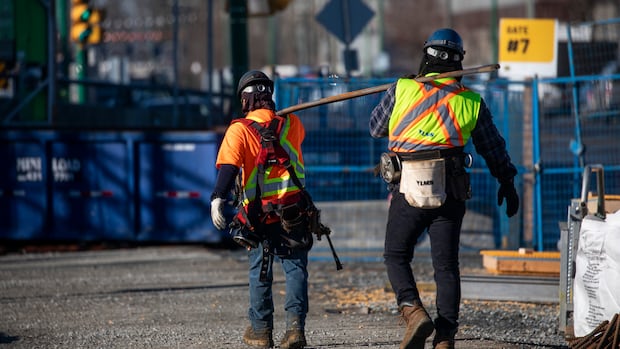
The hardest hit sectors were construction with 9,800 jobs lost, manufacturing with 8,100 jobs lost, and health care and social assistance with 6,800 jobs lost.
B.C.’s unemployment rate fell slightly by 0.1 percentage points, to 6.4 per cent.
Bryan Yu, chief economist at Central 1 Economics, said the job losses are indicative of a sluggish economy the province is seeing right now.
“Not a great number,” he said.
“Really it aligns with a soft economic environment when we think about some of the newer trade risks that we’ve seen, a pretty slow housing market.”
He said the U.S.-Canadian trade war can partly explain the loss of jobs in manufacturing, while job losses in construction are expected amidst a weak housing market.
There were also job losses in educational services, accommodation and food services, public administration, and professional, scientific and technical services, utilities, and transportation and warehousing.
The largest job gains were in business, building and other support services, adding 7,300 jobs.
An additional 4,500 jobs were added in the information, culture and recreation sector.
Yu said a loss in accommodation and food services jobs could be partly due to the aftermath of a boost in hiring in the tourism sector this summer for the World Cup games held in Vancouver.
But he is hopeful for B.C.’s job market in 2027, noting LNG Canada’s announcement to move forward with its expansion project in Kitimat will create jobs.
“I don’t think there’s any magic bullet right now in terms of turning around this economy,” Yu said.
“I think there are quite a few challenges when it comes to . . . the business environment that we’re currently in.”
On his campaign trail this week, NDP Leader David Eby emphasized the importance of providing jobs to youth in B.C., promising a tax credit to small and medium-sized businesses who hire young employees.
“The urgency of getting young people into the workforce to give them the experience, the training, the opportunities to be successful is paramount,” he said at a news conference in Burnaby on Friday.
Conservative Party Leader Lorne Doerksen called the Statistics Canada data “bad news” on his campaign trail Friday.
On Saturday, the Conservative Party announced a similar tax credit, which it says “rewards businesses that hire young British Columbians for their first job.”
“We have a plan to supercharge the economy in British Columbia, to create jobs and put more money in people’s pockets,” said Doerksen.