
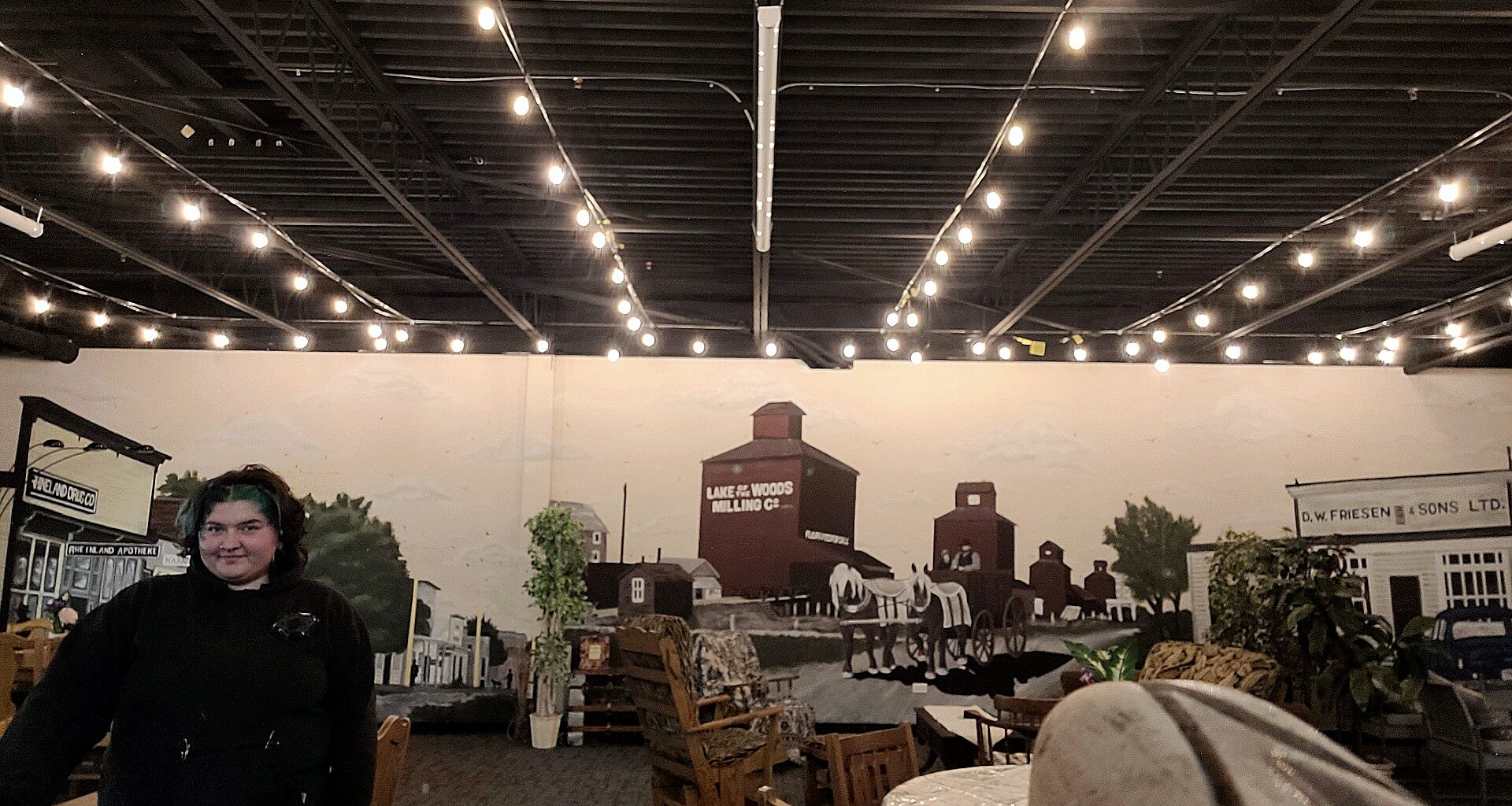
A massive mural inside Altona’s new Love Well Drop-in Centre is giving visitors a chance to step back in time, thanks to a local artist who spent over 100 hours bringing familiar pieces of the community’s past to life.
Shayla Hoeppner, an Altona resident who works as an educational assistant with kindergarten to Grade 3 students, took on the largest art project of her career this summer, transforming a 43-foot-wide, 12-foot-high wall into a detailed depiction of historic Altona.
The mural, located along the back wall of the drop-in centre in the Altona Mall, features historic storefronts, grain elevators, a horse and buggy, and the old Friesens building. Each section draws inspiration from archival photographs, combining different eras of the town’s history into one continuous scene.
For Hoeppner, the project was an opportunity to use her artistic abilities to create something meaningful for a community she calls home.
“It’s been an honor because just having that much trust put into you for such a big project and something that hundreds, thousands of people will see over the years, it’s such a cool thing to know that everyone’s going to be able to look at it and everyone’s reactions have been so positive and I’ve gotten lots of praise for it.”
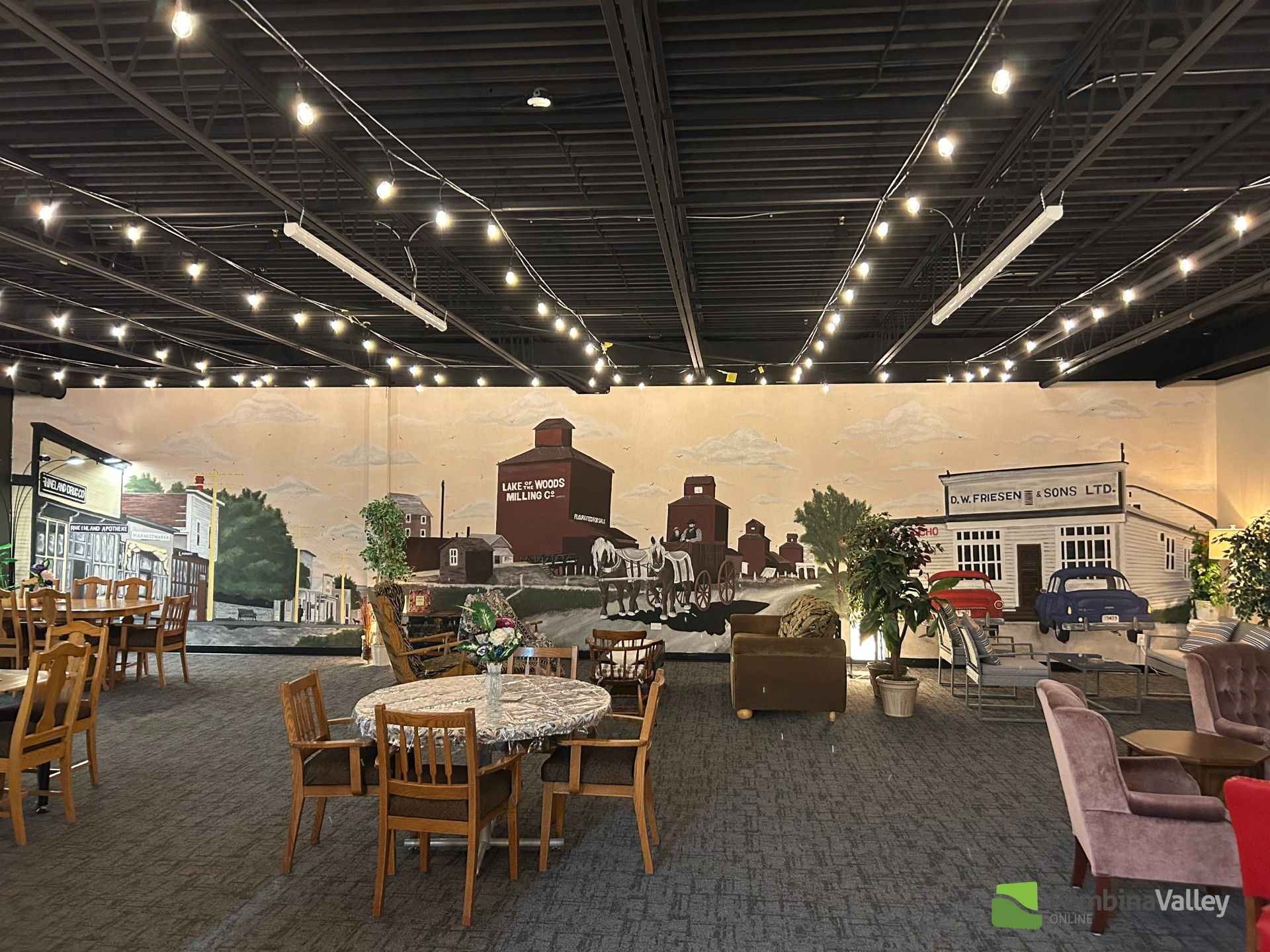 A photo of the mural at the grand opening of the Love Well Drop-in Centre
Bringing old Altona back to life
The idea began when Love Well Drop-in Centre Director Robin Sierks, whom Hoeppner had met while working at a local tattoo shop, approached her about creating a mural for the new drop-in centre.
Knowing Hoeppner’s artistic background and her connections with women involved in Love Well, Robin believed she would be a good fit for the project.
After discussing the size of the wall and the vision for the artwork, Hoeppner agreed to take it on. Within a couple of weeks, preparations and painting were underway.
To develop the design, Hoeppner connected with Altona’s historical society and obtained photographs showing recognizable locations from the town’s past.
The images, which she believes date from approximately 1912, the 1930s, and the 1950s, provided the foundation for three distinct sections of the mural.
One section features a classic streetscape, including Rhineland Pharmacy, a laundromat, and a harness maker’s shop. Another depicts grain elevators and a horse and buggy, while the third highlights the old Friesens building.
The goal was not simply to recreate historic photographs, but to give visitors a scene they could connect with.
“And we loved the idea of some of the ladies coming down to the drop-in center and being able to recognize that.”
Hoeppner said the group wanted the mural to reflect a time that might bring back memories for some visitors, while giving younger generations a glimpse of what Altona once looked like.
A blank wall and 100 hours of work
Despite her artistic experience, Hoeppner had never attempted anything on this scale.
Standing in front of 43 feet of freshly prepared wall was intimidating, even for someone comfortable working with paint.
“So it was a lot of just staring at the wall for a while.”
She eventually decided to begin with the most technically challenging section, the historic storefronts.
Their straight lines, building angles, and perspective required careful planning before she could move on to the grain elevators and Friesens building.
From there, the process involved moving back and forth between sections, adjusting details and making sure the three separate historical images worked together.
Clouds and birds were added to help connect the scenes visually.
The painting itself took approximately a month and a half, with Hoeppner balancing the project alongside other part-time jobs during the summer.
Some days began as early as 8 a.m., while other painting sessions stretched late into the evening, occasionally until 11 p.m. or midnight.
She initially lost track of her hours after reaching the 50- to 60-hour mark, but estimates from people who knew how frequently she was working suggested the finished project required approximately 100 hours.
Finding enough time was one challenge. Creating the right colours was another.
Rather than purchasing every shade individually, Hoeppner worked largely with basic paint colours, mixing custom shades to recreate the look of the historical buildings and streets.
That meant repeatedly trying to match colours from one painting session to the next.
“But on a mural this big, I had to custom make my colors because we started just from primary colors.”
One particularly important detail was the blue used for the Friesens building, which required its own carefully selected paint.
Hidden family tributes and special requests
Although the mural is rooted in historical photographs, Hoeppner found opportunities to add personal touches that make the artwork unique.
Some of those details honour her family and their connections to the Altona area.
The licence plates on vehicles in the mural feature birth years belonging to her mother, father, and grandmother, all of whom are from the area.
She also incorporated ivy climbing a wall as a tribute to her sister, Ivy.
Other additions came directly from women involved with Love Well.
A chipmunk, an old bench, and other small features were added at their request, allowing them to contribute their own ideas to the finished piece.
For Hoeppner, seeing their reactions was one of the most rewarding parts of the experience.
“It was cool to just Execute people’s visions and give them that little thing, ’cause when seeing them light up and point it out and be like, Oh, you finally added that thing I wanted! I’m like, Of course I did.”
Those smaller additions have also given visitors something extra to discover when they spend time looking at the mural.
A mural that will continue to grow
While the main painting was completed in time for the drop-in centre’s grand opening, Hoeppner said she doesn’t consider the artwork entirely finished.
In fact, she plans to continue adding small surprises over time.
Her idea is to occasionally return to the centre without announcing what she is painting, leaving new details for visitors to discover.
Women attending Love Well events or craft nights could then search the mural for the latest addition, with the possibility of a small prize for whoever spots it.
“Little surprise things.”
The ongoing additions would give returning visitors another reason to look closely at the artwork and help keep the mural an interactive part of the centre.
Related stories:
More than a painting
Beyond its size and historical detail, Hoeppner hopes the mural creates a sense of peace and connection for people visiting Love Well.
She said the women involved in the project talked about the importance of remembering a time when they felt communities were more closely connected.
The artwork is intended to encourage reflection on Altona’s past and the relationships that have helped shape the town.
“And just having a photo to look at that brings us back to simpler times, I think it’s just, it provides a peaceful, Moment for anyone who decides to go sit down there and just gives them something cool to look at, kind of to reflect on the past a bit.”
The experience has also changed how Hoeppner views her own artistic future.
Having successfully completed her first mural of this size, she said the project has expanded her experience and encouraged her to think about other opportunities.
Finishing the painting brought a mixture of relief and disbelief after spending so much of her summer working on it.
For weeks, the mural had become part of her daily routine. Suddenly, after countless hours of painting, adjusting colours, and adding details, the main project was complete.
Now, visitors to the Love Well Drop-in Centre in the Altona Mall can take in the artwork, search for its hidden details, and revisit pieces of the community’s history, all without leaving the building.