
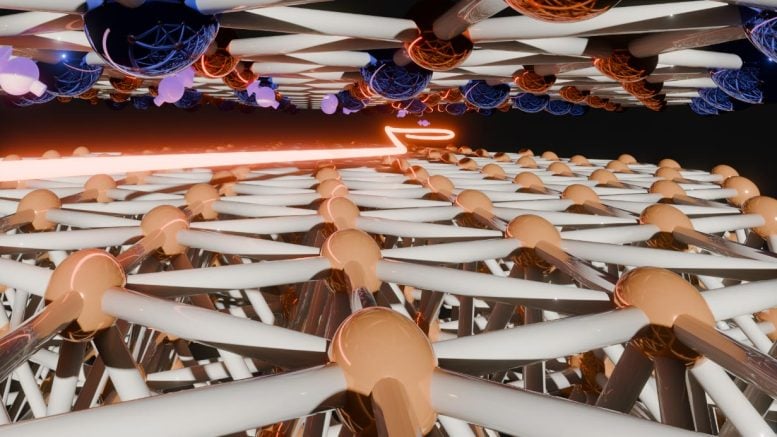
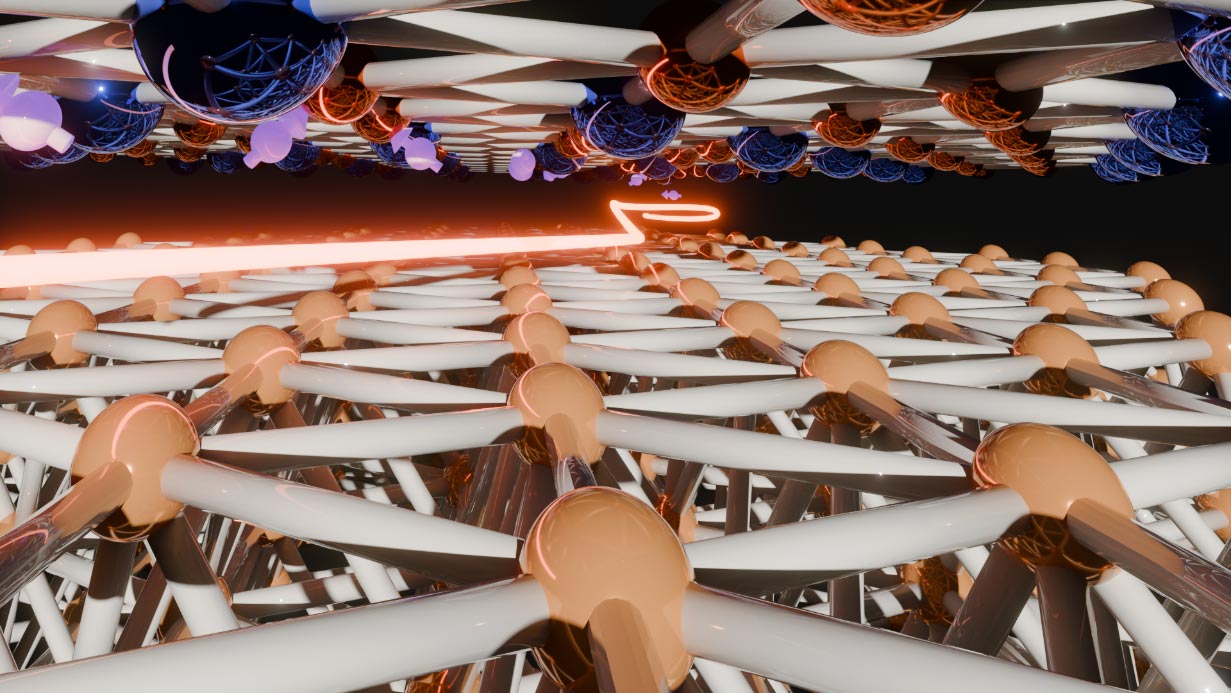
 Artistic illustration of electrons interacting at the interface between a one-atom-thick material and a metal, forming an unusual heavy-fermion quantum state through interactions between localized and mobile electrons. Credit: Takuto Nakamura
Researchers have directly observed an unusual quantum state emerging at the boundary between an atomically thin material and a metal.
Scientists have directly observed an unusual quantum state forming where a material just one atom thick meets a metal. The discovery, made by a research team led by the University of Osaka, demonstrates how interactions between electrons in different materials can produce a state known as a heavy fermion, potentially offering new ways to engineer quantum materials.
Heavy-fermion states occur when strong interactions cause electrons to behave as if they have unusually large effective masses. These states are closely associated with exotic quantum phenomena, including unconventional superconductivity, in which electrical current can flow without resistance through mechanisms that differ from those in conventional superconductors.
Two Distinct Quantum States at an Atomic Interface
To investigate how these states emerge, the researchers created a high-quality, one-atom-thick layer of ytterbium and copper (YbCu₂) on the surface of a copper crystal. They then used intense synchrotron light to examine the electronic structure of the combined materials and identify interactions occurring at their boundary.
The measurements revealed two separate heavy-fermion states. One was concentrated primarily within the two-dimensional YbCu₂ layer, while the other extended into the three-dimensional copper substrate. The second state formed through hybridization, a process in which localized ytterbium 4f electrons interact with mobile conduction electrons in the underlying metal. This provided the first direct experimental evidence of a heavy-fermion state arising from electronic interactions across such an interface.
Engineering Materials With New Quantum Properties
The results suggest that researchers could deliberately create and control heavy-electron states by combining carefully selected atomic layers with suitable substrates. Adjusting the atomic arrangement at the interface, the electronic orbitals involved, and moiré patterns formed by overlapping crystal lattices could make it possible to produce quantum behavior unavailable in conventional materials.
“This achievement was made possible by our continued efforts to create high-quality materials and measure their electronic states as precisely as possible,” says senior author Professor Shin-ichi Kimura. “Our next goal is to engineer and control such heavy-electron states, opening the way to previously unexplored quantum states, including unconventional superconductivity.”
Reference: “Interfacial heavy fermion formation in a two-dimensional Kondo lattice YbCu2 on Cu(111) substrate” by Takuto Nakamura, Hiroki Sugihara, Toshio Miyamachi, Yitong Chen, Kaito Nishihara, Ryo Ichikawa, Hiroka Yamaguchi, Ryu Yukawa, Kiyohisa Tanaka, Yuri Hasegawa, Yoshiyuki Ohtsubo, Fumio Komori and Shin-ichi Kimura, 6 October 2026, Communications Materials.
DOI: 10.1038/s43246-026-01332-5
Funding: Japan Society for the Promotion of Science
Never miss a breakthrough: Join the SciTechDaily newsletter.
Follow us on Google and Google News.