Reprint from Vancouver Sun (Douglas Todd, 10-Oct-2026). Link – https://vancouversun.com/opinion/columnists/douglas-todd-vancouver-30-year-high-density-agenda-beyond-defeated-villages-plan
Vancouver’s official development plan reveals city council remains committed to seven mass upzoning agendas
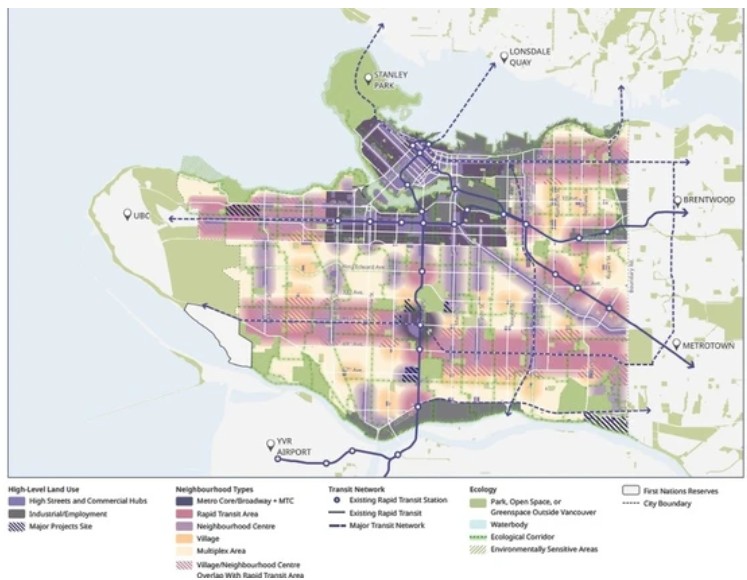
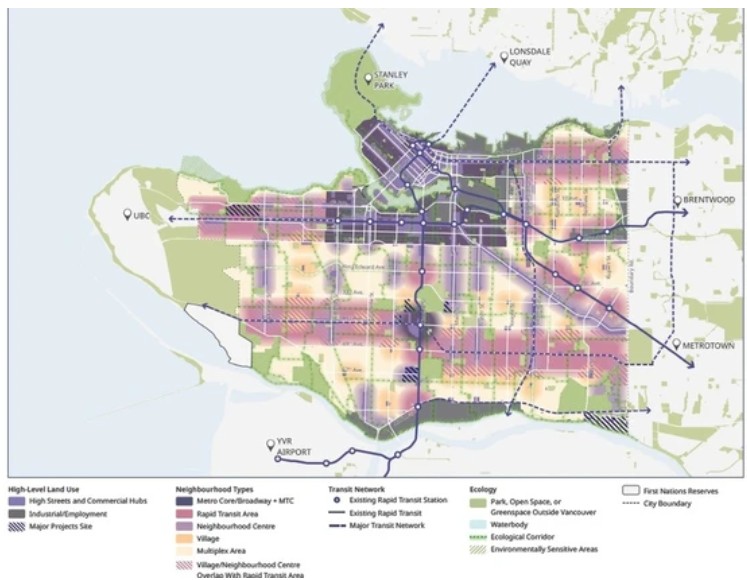
City of Vancouver ODP map outlines city council’s continuing intention to create 17 ‘villages’ (orange circles), towers along transit corridors (various purple shades), and small apartments almost elsewhere else (soft yellow).
This summer the City of Vancouver was deluged with a “tsunami” of complaints about the villages plan, admitted one city councillor. The plan would have mandated 17 “villages” with buildings up to six storeys on one-sixth of the city’s properties.
The villages plan was council’s fifth mass upzoning scheme in the past few years — after the Broadway plan, the Jericho Lands plan, the Cambie corridor plan and the Rupert and Renfrew Station plan.
Those plans came on top of two more pieces of sweeping upzoning pushed by the provincial NDP government on Vancouver and all municipalities — for small apartment buildings, on virtually all standard lots, as well as highrises within 800 metres of transit hubs.
Given that many Vancouver residents expressed fury about the villages plan — and it was just three months before the Oct. 17 civic election — council killed it.
But what the public generally doesn’t know is that council has set all these blanket upzoning strategies, and more, in place for the next 30 years. It’s accomplishing that agenda through the official development plan. And it was hardly noticed when council unanimously approved it in the spring. The development plan commits Vancouver to all the wholesale upzonings mentioned above, including the villages plan. It maps out major redevelopment for almost every block and neighbourhood of the city, ranging from four- to eight-unit apartment blocks to 26-storey highrises, without requiring a minimum of parking.
A coalition of more than 20 architects, planners and academics, called Housing Reset, urges repealing the development plan. While Housing Reset supports affordable housing initiatives, it doesn’t want it decreed through the “one-size-fits-all” plan.
“Anyone can draw circles on maps and call it a plan,” Housing Reset says.
Here are four of the problems the coalition cites with the plan:
It promotes more “entitlements” for developers, which will “inflate land values and displace thousands of residents without addressing the fundamental lack of affordable housing.”
Homeowners and tenants will have “less to no public involvement in the future of their neighbourhood.” Most rezoning “will not require a public hearing going forward.”
The development plan’s drastic upzoning pivots on exaggerated population projections from the development industry. Already, thousands of Vancouver condo units sit unsold, while more than 140 highrises have been approved, but not built.
“The plan includes almost no increased infrastructure, parks, recreation, schools and amenities for the massive increase in projected growth.”
After the B.C. government mandated all B.C. municipalities revise their official development plans, Vancouver’s plan was unanimously approved in March by Mayor Ken Sim and the ruling ABC Vancouver councillors, the Green party’s Pete Fry, COPE’S Sean Orr and Onecity’s Maureen Maloney. Rebecca Bligh of Onecity was ineligible to vote.
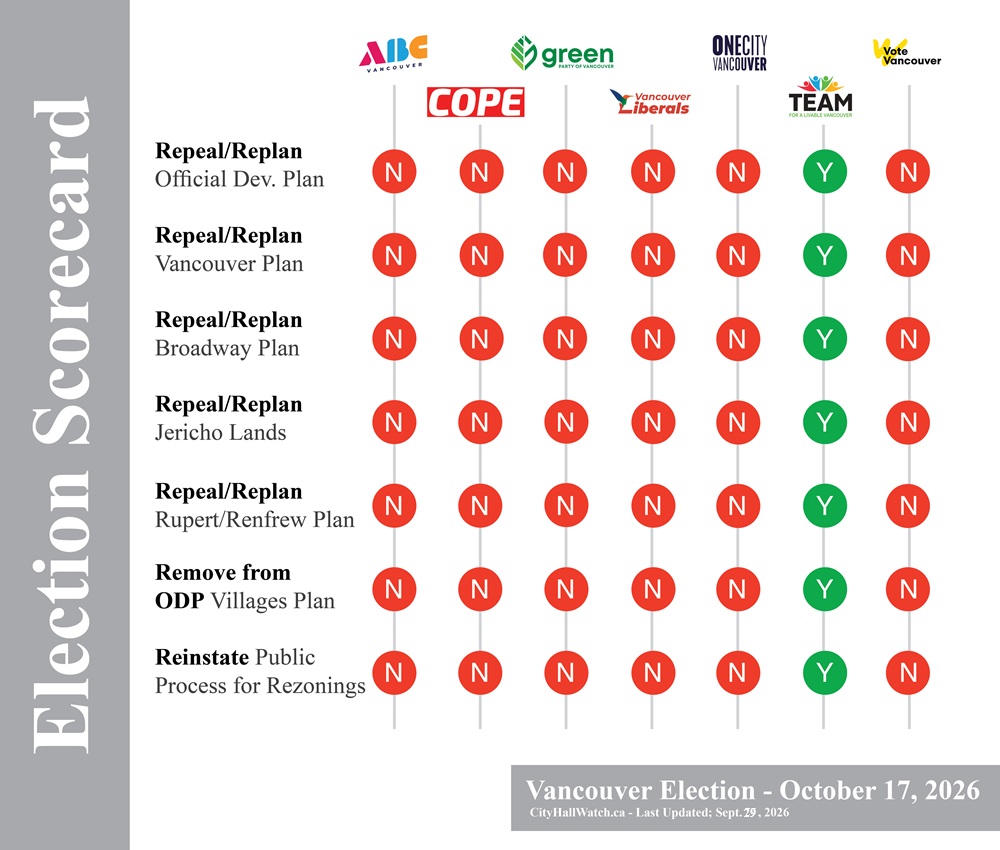
As of now, TEAM for a Liveable Vancouver, which has put forward former councillor Colleen Hardwick for mayor, stands as the only party that promises to repeal the plan. It wants to replace it with a neighbourhood-based planning model.
TEAM candidates say they’re finding, during door-to-door canvassing on the east and west side, that voters have no idea that the plan will impact their residential blocks.
Postmedia News directed questions to everyone who voted for the plan, as well as Bligh.
ABC Vancouver responded with an unsigned statement, which said council defeated the villages plan because the public had concerns about how it “would apply on the ground. Supporting more housing and a growing city does not require council to accept every individual planning proposal exactly as presented.”
However, the ABC party says it remains committed to the development plan because “Vancouver needs a long-term plan that provides certainty about where and how our city will grow over the coming decades.”
Fry, mayoral candidate for the Greens, as well as unofficially for Onecity and COPE, was the only individual councillor to respond.
“I voted for the (plan) not because I was committed to it, but because we were legally required to pass it (by the B.C. government). I believe there is room for improvement, and fortunately the law requires the (plan) to be reviewed at least every five years,” he said.
“I don’t think the (plan) is one-size-fits-all. It contemplates a range of distinct land uses across Vancouver’s 144 square kilometres,” Fry said, adding, “I have concerns about (its) limits on community input and have said so publicly.”
Housing Reset, however, doesn’t accept that blame for the development plan should fall so heavily on the provincial government.
“The claim that `the province made me do it’ is not actually correct,” say the coalition’s signatories. “Most of the plans in the (plan) were initially approved or formulated by the city before the provincial legislation was proposed.”
In almost all cases, the coalition says, Vancouver’s “policies exceed the provincial density requirements.”
Signers of Housing Reset’s statement on the plan include Larry Beasley, former co-chief planner for the City of Vancouver; University of B.C. planning professor emeritus Penny Gurstein; and Andy Yan, director of Simon Fraser University’s City program.
ADDITIONAL NOTE: CityHallWatch has published an Election 2026 Scorecard that shows how the parties have voted and their platforms on the main key development plans that affect the city for the next 30 – 100 years, essentially for the foreseeable future. This is what is at stake and the Scorecard article explains the specific plans covered in the Scorecard and the rationale.
https://cityhallwatch.wordpress.com/2026/09/25/vancouver-civic-election-2026-scorecard/
Comparing the Parties on Their Voting Records and Platforms – A Voter Guide