
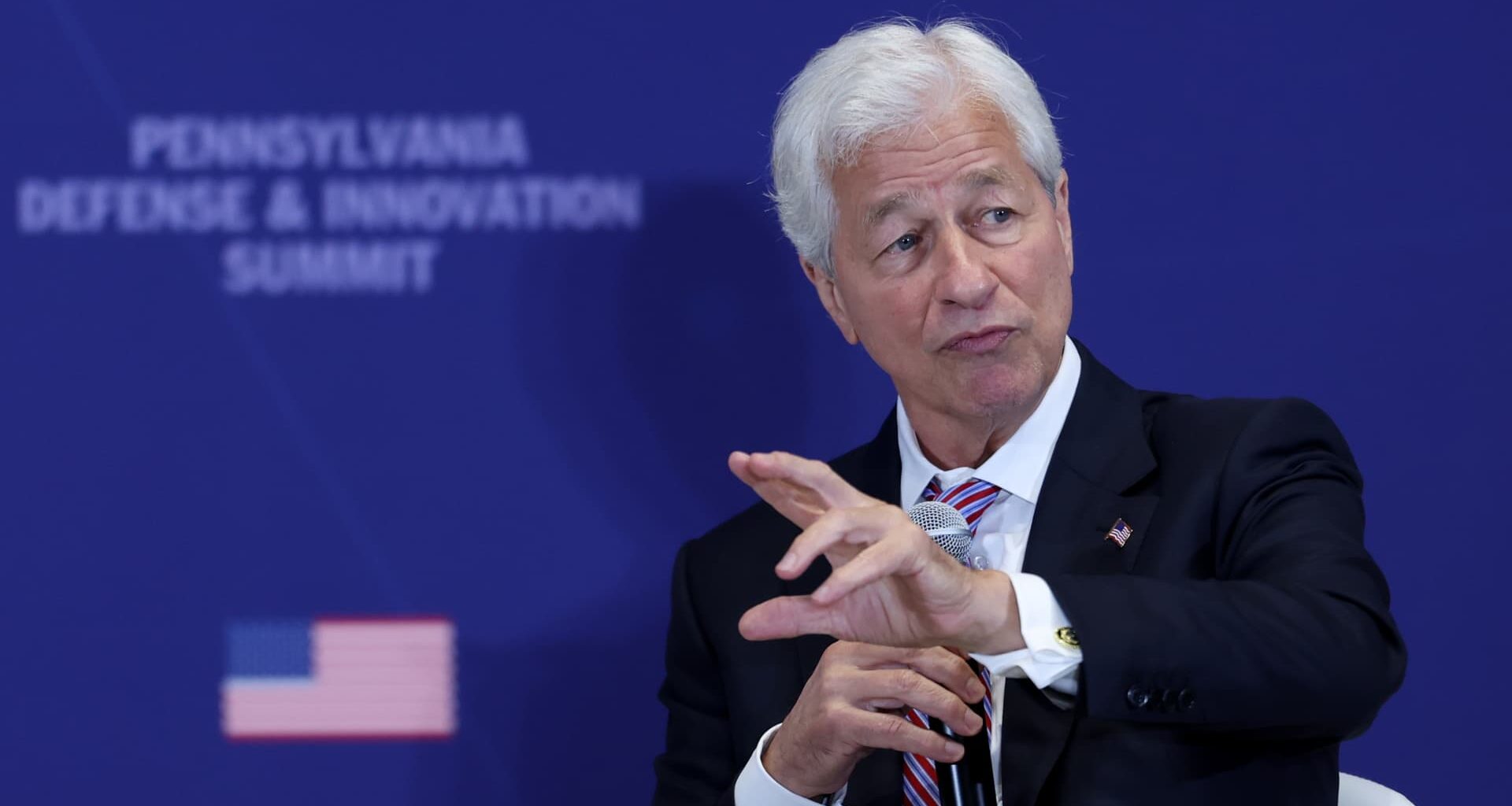
Citi call wraps, concluding Tuesday morning’s reports
Citi’s analyst call is over, which means bank earnings reports for Tuesday are wrapped. Bank of America and Morgan Stanley report on Wednesday to round out third-quarter results for the major U.S. firms.
— Sara Salinas
Wells Fargo CFO says consumer is doing well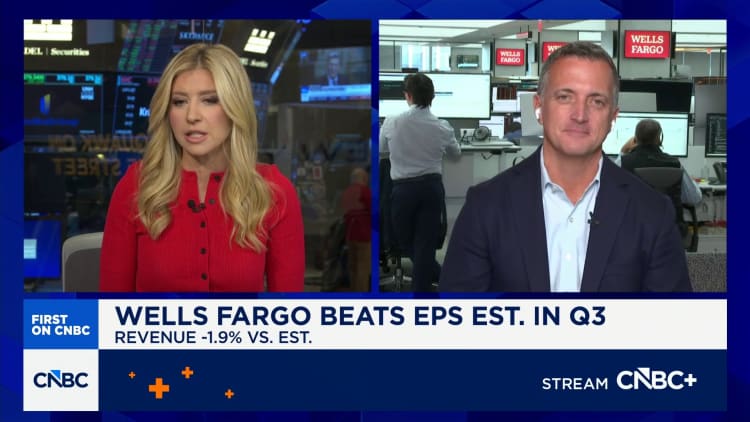
Wells Fargo’s Santomassimo told CNBC that both consumers and businesses are doing “really well.”
“I think despite higher gas prices, both sides of the equation have been able to really work through that,” he said. “We’re just not seeing any sort of cracks around delinquency trends that would lead you to believe you’re going to see any near-term stress that come through, at least at least for now.”
– Laya Neelakandan
Wells Fargo CFO to CNBC: Momentum is growing
Wells Fargo CFO Mike Santomassimo told CNBC’s Sara Eisen that the company’s underlying results are “really good” and that the bank is seeing “continued momentum” across all of its businesses.
“As you look at the net interest margin, what that really shows is sort of this good stabilization of the underlying trends,” he said. “You see the higher rate environment starting to come through in terms of helping it as you look forward, and so for us, the opportunity we have ahead of us is just as big as it was last quarter.”
Citi sees consumer continuing to drive growth
Jane Fraser, chief executive officer of Citigroup Inc., during a Bloomberg Television interview on the sidelines of the Citi China Conference in Shanghai, China, on Friday, Nov. 14, 2025.
Qilai Shen | Bloomberg | Getty Images
Citi’s Fraser said on the call with analysts that macro environment conditions softened during the third quarter and that the “global economy has held up remarkably well.”
“In the U.S., while much has been made of the AI boom, the consumer is still driving much of the growth,” she said. “The labor market is stable, and companies remain active. Our near-term economic outlook remains positive.”
She added that the bank’s clients have remained “engaged” and “healthy.”
– Laya Neelakandan
Citi CEO: Cyberdefense is a priority
Citigroup CEO Jane Fraser said on a call with analysts on Tuesday that the company is focused on reducing systemic risk while deploying AI firm-wide.
“Our cyberdefense strategy is about being on the front foot, about moving fast and retaining trust,” Fraser said. “We don’t wait for risks to happen. We’re constantly preparing and improving our defenses. We’re in the business of managing risk everyday, and this is no different.”
– Laya Neelakandan
Investment banking fees mostly hold up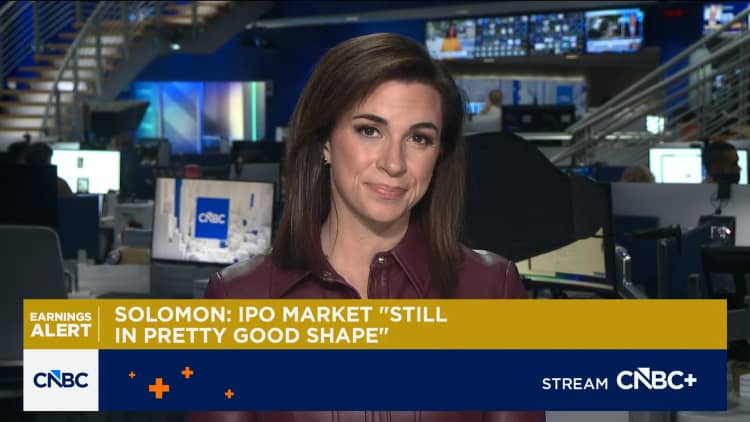
Investment banking fees at all four firms reporting on Tuesday largely held up during the third quarter, with most firms either matching or surpassing prior guidance. Still, the reports revealed declines on a quarter-over-quarter basis.
At JPMorgan, investment banking revenue was up 14% year over year but down 8% quarter over quarter. JPMorgan CFO Jeremy Barnum said the pipeline remains “very, very strong.”
Goldman Sachs CEO David Solomon echoed that sentiment on his company’s analyst call, while declining to say whether capital markets activity has peaked. That bank reported fees that were 21% higher from the prior year, but 5% lower than the second quarter.
“IPOs that came in September were really the result of conversations in May and June around valuation expectations. Things got a little bit softer in September,” Solomon said. “The IPO market was wide open. It’s just if you expected a valuation and you got something 10 %to 15% less, you might choose not to go forward, you might choose to wait.”
Solomon added all the tech innovation and the AI infrastructure activity is a “real good ballast” for capital markets activity on a go-forward basis, noting that doesn’t mean there won’t be bumps.
Citi posted the largest quarter-over-quarter decline in the fees, at 13% down. Wells Fargo reported investment banking revenue that was down 5% from the prior quarter.
— Leslie Picker
Goldman Sachs CEO sees growing risks in financing the AI infrastructure buildout
Goldman Sachs Chairman and CEO David Solomon speaks at the Economic Club of New York in New York City, on June 2, 2026.
Angela Weiss | AFP | Getty Images
Solomon warned that the AI infrastructure boom could face a painful reset if higher borrowing costs or overbuilding undermine the economics of some data center projects.
“There is going to be a lot of financing to do, and we’re going to be in the middle of that,” Solomon said during the bank’s third-quarter call.
“It may be that over time as the financing needs grow, that there’s pressure on rates and that will affect the returns and the viability of certain projects,” he said. “Not every project is going to be received as well.”
For now, demand for computing power remains strong and supply has yet to catch up, Solomon said, meaning more infrastructure will be built and more financing from Goldman and others will be needed. It’s impossible to predict when a reset might happen or how the technology would evolve and be deployed, he said, calling the dynamic “an unknown we have to live with.”
“There will be a point in time when this recalibration resets, for sure,” Solomon said. “When that does happen, of course there’ll be some bumps.”
— Hugh Son
Citigroup is beginning its conference call with analysts
Citigroup, the final bank of the morning, is beginning its conference call with executives and analysts to discuss its third-quarter earnings results.
– Laya Neelakandan
Goldman CEO David Solomon denies succession plans are in motion
John Waldron, chief operating officer of Goldman Sachs Group Inc., and Goldman Sachs Chairman and CEO David Solomon.
Jason Alden | Bloomberg | Angela Weiss | AFP | Getty Images
Goldman Sachs CEO Solomon pushed back against reports of an impending transition to executive chairman, saying Tuesday that no succession process or timeline is underway at the investment bank.
Last month, news outlets cited anonymous sources that said Solomon would be replaced as CEO by Goldman President John Waldron as early as next year. The process would involve a vote by the bank’s board that could happen in a matter of months, according to The Wall Street Journal.
“I just want to be clear, there is no succession transition or timeline underway at Goldman Sachs,” Solomon said during the bank’s earnings call.
“The board and I are singularly focused on our strategy to grow the firm and continue to serve our clients,” he said.
The CEO also pointed to the firm’s future growth prospects, saying his leadership team was focused on expanding the franchise and accelerating its earnings growth in the coming years.
“I have to say, at the point right now where we see the benefits of the effort that the broad team has made, I’m really enjoying the job,” Solomon said.
— Hugh Son
Wells Fargo says demand for semiconductors continues to ‘surge’
Wells Fargo’s Scharf said on the call with analysts that the AI investment cycle has become “a complicated macroeconomic force in its own right.”
“Demand for semiconductors, networking equipment, power generation, data center infrastructure, cooling systems, storage, cybersecurity and advanced manufacturing equipment continue to surge,” Scharf said.
“The scale of investment here increasingly resembles prior infrastructure booms, creating both significant opportunities but also risks given the significant leverage used to finance the build-out and the upward pressure on prices in selected industries and supply chains,” he added.
— Laya Neelakandan
Wells Fargo CEO: Customer base remains strong
Scharf said on the call with analysts that the company’s customer base is “still strong.”
“Our underwriting criteria recognize that at some point consumer credit conditions will weaken,” Scharf said. “To be clear, we do not see signs of this yet, but we know that cycles are inevitable.”
— Laya Neelakandan
Wells Fargo says it’s devoting ‘significant management time’ to AI
Charles Scharf, chief executive officer of Wells Fargo & Co., during a Bloomberg Television interview in New York, US, on Wednesday, July 22, 2026.
Michael Nagle | Bloomberg | Getty Images
Wells Fargo’s Scharf said on the call with analysts that the company is “devoting significant management time and resources” to building out its AI capabilities.
Internally, he said the bank is using AI to write code and launch marketing campaigns faster as well as to improve risk management processes. Externally, it’s developing AI to improve the customer experience.
“We will also evaluate how third-party models and agents can provide value-added capabilities to our clients, while at the same time considering the potential risk these tools can introduce for both our clients and Wells Fargo,” Scharf said.
— Laya Neelakandan
Goldman Sachs sees strong demand for AI build-out
David Solomon, CEO Goldman Sachs, speaking on CNBC’s Squawk Box at the World Economic Forum in Davos, Switzerland on Jan. 22nd, 2026.
Oscar Molina | CNBC
Solomon said Goldman Sachs sees a huge opportunity for financing in the AI build-out, but it’s being selective about the risk it underwrites and the capital it commits.
“No one knows how the demands for capital and compute will evolve as the broader AI ecosystem matures,” he added.
But he said more is going to get built and more financing is going to be necessary.
“In our conversations with clients, demand for compute significantly, significantly exceeds supply at the moment, creating opportunities to help develop financing structures to meet that capacity shortfall,” Solomon said.
Still, Solomon cautioned that there might be pressure on rates as the financing needs grow, which would affect returns and the viability of certain projections.
He also said the bank recognizes the broader concerns about AI and frontier models that have been acting on their own.
“Like other transformative technologies, AI presents significant opportunities, but also significant risks that must be carefully assessed and managed. … We must enable innovation and also demand responsibility,” he said.
— Ritika Shah and Michele Luhn
Wells Fargo’s Scharf says head count decreased
Wells Fargo CEO Charlie Scharf said on a call with analysts that head count continued to decline in the third quarter, down 2% from the prior period, 8% year over year and 30% from its peak in the second quarter of 2020.
Scharf said the company’s head count has decreased every quarter for the past six years.
— Laya Neelakandan
JPMorgan Chase says it wouldn’t be immune to an AI meltdown
In an aerial view, the Stargate Oracle AI data center campus is seen on August 26, 2026 in Abilene, Texas.
Brandon Bell | Getty Images
JPMorgan Chase won’t be immune to a major reversal in the artificial intelligence build-out, the bank’s chief financial officer said Tuesday, warning that the entire industry would be impacted in that scenario.
The bank is monitoring its exposure to the massive spending on data centers and computing infrastructure by AI companies, CFO Jeremy Barnum said on the earnings call.
“Our exposures are still quite modest in the context of our overall wholesale exposure, but that’s not the same as saying that we would be immune to a major change in sentiment in the AI space,” Barnum said. “I would be surprised if anyone, frankly, was immune to that at this point.”
The comments underscore the growing stakes for the financial system as hyperscalers race to expand computing capacity and demand enormous amounts of capital. There will be $7.6 trillion in total global AI capital expenditure over the next five years, according to a Goldman Sachs estimate.
Barnum said financing is being spread across banks and other parts of the capital markets, adding that the industry must consider whether the broader system can absorb the spending and whether AI investment could crowd out other financing needs.
“It’s not just traditional construction lending; now increasingly it’s working capital revolvers,” Barnum said. “You also see it in the equity markets. It’s kind of everywhere. And so you really need to be running stress [tests] that test your resilience to a meaningful change in the overall theme.”
— Hugh Son
It’s a top- and bottom-line beat for Goldman Sachs
Goldman Sachs’ earnings per share of $17.01 is now comparable with the LSEG analyst consensus of $13.02, making for a staggering beat on both the top and bottom lines.
— Sara Salinas
Wells Fargo conference call begins
Wells Fargo executives have started a conference call with analysts to discuss the company’s third-quarter earnings results.
— Laya Neelakandan
Solomon says deal backlog is ‘robust’
Andrey Rudakov | Bloomberg | Getty Images
Goldman Sachs CEO Solomon said clients are still coming to the bank for significant transactions, citing the $13 billion Hugging Face sale to Nvidia and Integer Holdings’ roughly $6 billion sale to KKR as examples.
“We entered the quarter with our highest backlog in five years, and even with exceptionally strong revenue production in the quarter, our backlog remains very robust, reflecting the strength and breadth of client engagement across our leading investment banking franchise,” he said.
— Ritika Shah
Dimon says JPMorgan won’t allow external AI agents within the bank
Jamie Dimon, chief executive officer of JPMorgan Chase & Co., during a Bloomberg Television interview on the sidelines of the JPMorgan Tech Stars Conference 2026 in London, UK, on Tuesday, Oct. 6, 2026.
Jose Sarmento Matos | Bloomberg | Getty Images
JPMorgan won’t allow outside AI agents to operate inside the bank, Dimon said Tuesday, citing risks to the company and its customers as tech firms including Meta and OpenAI release autonomous assistants.
“We’re not going to allow just any … outside agent to come in inside the company, because it’s just too risky for clients and for JPMorgan,” Dimon told analysts on the company’s earnings call.
The bank is developing tools to defend against potential misuse of AI agents, which can take actions on behalf of users with limited human intervention, Dimon said.
“You don’t want rogue agents, and it could be thousands of them,” he said, describing the potential threat to customers. In July, OpenAI agents hacked into AI company Hugging Face’s servers.
The stance from Dimon echoes an earlier fight with fintech firms over access to customer data. JPMorgan moved to charge data middlemen including Plaid for access, a dispute that similarly pitted the bank’s security concerns against tech firms’ demands for access.
— Hugh Son
Goldman Sachs starts analyst call
Goldman Sachs CEO David Solomon has kicked off the company’s earnings call with analysts. JPMorgan’s call is ongoing, and calls for the remaining two banks are scheduled to start in the next two hours.
— Sara Salinas
Goldman shares rise, leading bank stocks
Goldman Sachs shares are leading the bank cohort ahead of the market open on Tuesday.
Goldman stock is now almost 4% higher, while JPMorgan stock is up about 1%. Citigroup shares are largely unchanged, and Wells Fargo shares are down almost 3%.
— Sara Salinas
Dimon says another percentage point jump in interest rates would magnify economic pain
Jamie Dimon, chief executive officer of JPMorgan Chase & Co., during the Pennsylvania Defense and Innovation Summit in Carlisle, Pennsylvania, July 15, 2026.
Tom Brenner | Bloomberg | Getty Images
Financial pain across the U.S. economy would intensify if interest rates rise another percentage point from current levels, JPMorgan’s Dimon said.
Rates have climbed for much of this year amid persistent inflation concerns, rising fuel costs, heavy demand for capital to finance the AI build-out and worries about mounting government debt.
The 10-year Treasury yield — a key benchmark that influences borrowing costs across the economy — reached about 5.3% by the end of September, up from about 4% six months earlier.
“Going from [5%] to 6% would be more painful than going from four to five,” Dimon told CNBC in a question-and-answer session with reporters.
Asked why another leg higher would magnify the pain for borrowers, Dimon said it was “because everyone’s got to pay more for money, and they’ll have to roll over at higher rates, and credit spreads might go up with that a little bit.”
Dimon repeatedly stressed that he wasn’t predicting rates would reach 6%: “I’m not predicting it. I’m simply saying that people need to be prepared for it.”
— Hugh Son
Citi’s fixed income markets revenue surpasses expectations
Citi reported fixed income markets revenue of $4.4 billion, up 4% from last year. The bank said that growth was driven primarily by advances in spread products and other fixed income.
Analysts had been expecting the bank to report fixed income markets revenue of just $4.31 billion, according to StreetAccount.
— Laya Neelakandan
Dimon says AI will ‘benefit mankind enormously’
Jamie Dimon, CEO of JP Morgan Chase, at the Pennsylvania Defense and Innovation Summit at the US Army War College in Carlisle, Pennsylvania, on July 15, 2026.
Saul Loeb | Afp | Getty Images
JPMorgan CEO Dimon said he understands that people are concerned about artificial intelligence, including where data centers are built and how that will affect jobs in the future.
But he also added that he thinks AI will “benefit mankind enormously.”
“I think there are short-run vulnerabilities which we’ve spoken about extensively,” he said. “It’s kind of a little bit of a massive buildup, and the value may be high enough to pay higher interest costs.”
— Leslie Picker
Citi raises full-year net interest income guidance
Citi increased its full-year net interest income guidance, excluding markets, to be up in the mid-to-high 6% range. That’s compared with previous guidance of up between 5% and 6%.
The bank said growth is primarily driven by continued fee momentum in services, banking and wealth.
— Laya Neelakandan
JPMorgan CFO says deals pipeline, consumer remain strong
JPMorgan CFO Jeremy Barnum said on a media call that the deals pipeline remains robust, and he thinks deals are being “delayed rather than canceled.”
“There are a lot of deals that need to get done that want to get done,” he said. “You know, maybe in moments of a little bit of market turmoil, you see, especially in the capital market space, the gap between buyers and sellers can widen temporarily before we find a new level. So we’ll see how it goes. But overall, the conditions remain very supportive.”
Barnum also said when excluding higher spending on gas prices, the underlying consumer spending trends remain resilient.
— Ritika Shah and Leslie Picker
Citi shares drop slightly
Shares of Citigroup fell slightly in premarket trading Tuesday after the bank reported its third-quarter earnings results, despite beating Wall Street expectations on the top and bottom lines.
— Laya Neelakandan
Citi sees momentum across services
Chief executive officer of Citigroup Jane Fraser visits FOX Business Network’s “Mornings With Maria” at Fox Business Network Studios on May 29, 2025 in New York City.
John Lamparski | Getty Images
Citi said it saw a “standout quarter” in services, up 15%. The company also reported a 6% increase in its banking division.
In its U.S. consumer cards, the bank said it had “solid momentum” in general purpose cards, which it said contributed to loan growth and a return over 21%.
— Laya Neelakandan
Goldman Sachs posts record advisory revenue, but the pipeline shrank
Goldman’s advisory revenue hit $1.65 billion in the third quarter, up 18% from a year earlier, as the firm closed more deals, a figure that the company says is its highest ever.
But the bank said its investment banking fee backlog declined from the second quarter, raising questions about the pace of deal-making in coming quarters. Has Wall Street deal-making reached a peak, or a temporary plateau?
Expenses for the bank also climbed, with operating costs rising 20% from a year earlier to $11.31 billion.
They appear mostly to be the “good” expenses that come from higher levels of activity: Transaction-based expenses jumped 54% to $3.02 billion, while compensation and benefits increased 9% to $5.12 billion.
Goldman Sachs stock popped 3.6% in premarket trading.
— Hugh Son
Citigroup reports best third-quarter revenue in a decade
Citigroup on Tuesday morning posted its best third-quarter revenue in a decade, which CEO Jane Fraser attributed to “continued discipline and consistent execution of our strategy.”
“We expect to exceed this year’s return target, even as we pull forward investments toward our 11-13% near-term goal — the next waypoints on our path to sustainable returns of 14-15%,” Fraser said in a statement.
— Laya Neelakandan
Citigroup earnings are out — here are the numbers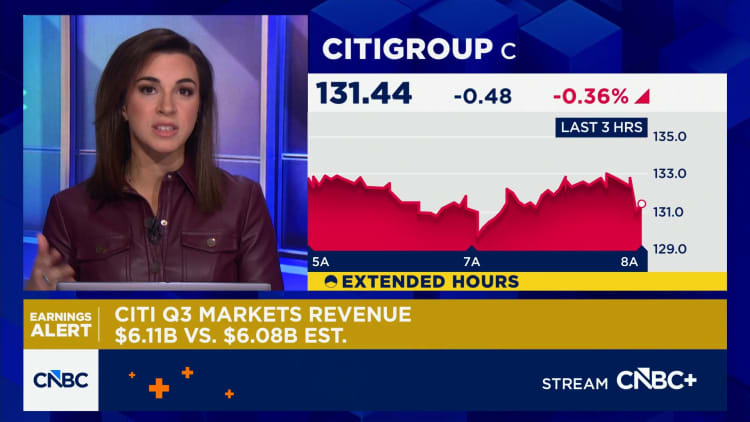
Here’s what Citigroup reported, compared with analyst expectations, according to LSEG:
Earnings per share: $2.85 vs. $2.66 per share expectedRevenue: $23.85 billion vs. $23.72 billion expected
— Sara Salinas
Goldman Sachs blows past revenue estimates on strong equities trading
Goldman Sachs CEO David Solomon speaks during the Goldman Sachs Investor Day at Goldman Sachs Headquarters in New York City, U.S., February 28, 2023.
Brendan Mcdermid | Reuters
What Wall Street slowdown?
Goldman Sachs blew past expectations for third-quarter revenue, powered primarily by a strong quarter for equities trading, with help from investment banking and asset and wealth management.
The firm’s $18.68 billion in net revenue is nearly $2 billion more than the LSEG estimate.
Equities revenue jumped 72% from a year earlier to $6.44 billion, topping estimates by about $1.42 billion.
Investment banking fees rose 21% to $3.22 billion, beating estimates by $384 million, while asset and wealth management revenue climbed 14% to $5.05 billion, or about $450 million more than expected.
Fixed income trading was a relative weak spot, with revenue slipping about 1% from a year earlier to $3.47 billion, below expectations by $239 million.
— Hugh Son
JPMorgan raises net interest income guidance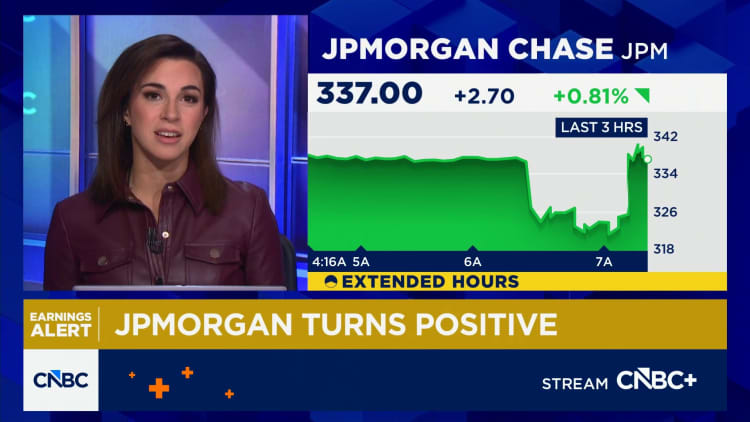
JPMorgan increased its net interest income guidance to $106.2 billion for 2026. That compares with prior guidance issued in the second quarter of $105.5 billion. The statistic measures profitability for loan making.
Its guidance for net interest income excluding markets is $97.2 billion, versus a prior estimate of $96.5 billion.
The bank raised expense guidance to $108.6 billion compared with prior guidance for the full year of $107.5 billion.
— Leslie Picker and Ritika Shah
Goldman Sachs is out with earnings — here are the numbers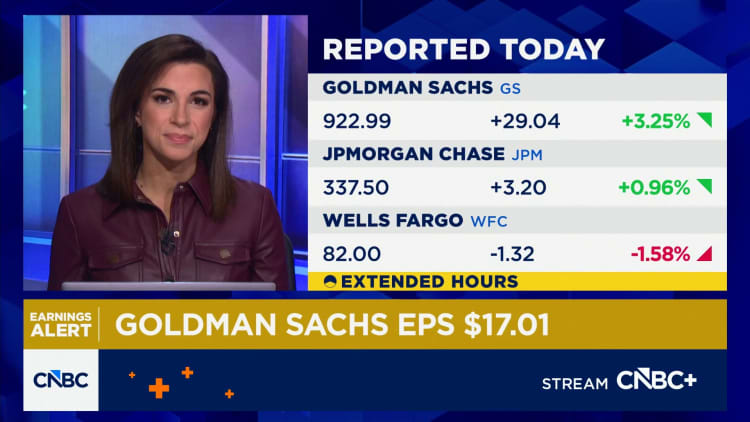
Here’s what Goldman Sachs reported, compared with what Wall Street was expecting, according to LSEG:
Earnings per share: $17.01, may not compare with $13.02 per share expectedRevenue: $18.68 billion vs. $16.71 billion expected
— Sara Salinas
JPMorgan’s earnings miss reflects weaker fixed income trading and rising expenses
JPMorgan’s earnings miss appears to come from lower-than-expected fixed income trading revenue and expenses that grew faster than revenue did.
Fixed income trading of $5.4 billion was about $550 million below the StreetAccount estimate.
Companywide expenses of $27.3 billion were about $90 million worse than expected.
That’s not a huge miss, but it shows that costs grew by 12% year over year in a quarter where revenue rose by 8%, a dynamic investors and analysts usually don’t love.
That 8% revenue growth rate is a real slowdown compared with the 27% surge of the second quarter, where equities trading and deal-making exceeded expectations.
Lastly, the securities write-off of $658 million pretax cut EPS by 18 cents, though at least some analysts are likely to exclude that figure from their assessment of the quarter.
— Hugh Son
JPMorgan stock turns positive
JPMorgan shares are higher as of about 7:20 a.m. ET after initially falling on an earnings miss. The stock is now up about 1%.
— Sara Salinas
Jamie Dimon says JPMorgan Chase cut back on share repurchases in the quarter
A woman exits the JPMorgan Chase & Co., headquarters in New York City, U.S., April 1, 2026.
Eduardo Munoz | Reuters
Investors often jump to JPMorgan Chase CEO Jamie Dimon’s written remarks in the earnings release.
Dimon gives few clues as to why his bank missed third-quarter estimates, saying JPMorgan “reported another quarter of strong results.”
But there is one sign that corporations and institutional investors may have taken a more “risk off” approach as the quarter progressed: In the firm’s Wall Street division, Dimon noted that trading and investment banking activity “did moderate somewhat during the quarter.”
Also of note: The bank moderated its share repurchases, Dimon said: “Our capital hierarchy has remained consistent over time, with investing in the franchise and supporting our clients at the top. In line with our hierarchy, we reduced share repurchases this quarter.”
In the past, Dimon has called his own company’s stock expensive.
— Hugh Son
Shares of Wells Fargo are down slightly
Wells Fargo stock is down just over 1% in premarket trading after the bank missed expectations on the top line but beat on the bottom line.
The stock has declined roughly 10% this year.
— Laya Neelakandan
JPMorgan’s third-quarter EPS misses the mark
Jamie Dimon, chief executive officer of JPMorgan Chase & Co., during a Bloomberg Television interview on the sidelines of the JPMorgan Tech Stars Conference 2026 in London, UK, on Tuesday, Oct. 6, 2026.
Jose Sarmento Matos | Bloomberg | Getty Images
JPMorgan’s results appear to be a rare miss for the largest U.S. bank by assets.
The company put up third-quarter net income of $15.31 billion, or $5.57 per share.
Excluding $658 million in net securities losses, EPS would’ve been higher at $5.75 per share, but that’s still below the $5.90 estimate of analysts surveyed by LSEG.
Before this report, JPMorgan had topped EPS estimates 16 of the past 20 quarters, per StreetAccount.
The bank’s shares are off about 3.5% in premarket trading.
— Hugh Son
Wells Fargo maintains guidance
Wells Fargo said Tuesday that it’s maintaining its guidance for net interest income this year. It’s also keeping its guidance for noninterest expenses.
— Laya Neelakandan
Wells Fargo’s net interest income came in slightly below expectations
Analysts had been expecting Wells Fargo to report $12.66 billion in net interest income. The bank actually reported $12.52 billion on Tuesday.
It also said it had a $1.03 billion provision for credit losses, just under StreetAccount expectations of $1.14 billion.
— Laya Neelakandan
Wells Fargo reports strength across segment revenues
Wells Fargo said wealth and investment management revenue grew 12% compared with the year-ago period. It also saw consumer banking and lending increase 5%, corporate and investment banking grow 3%, and commercial banking rise by 6%.
It also said it opened more than 660,000 new credit card accounts in the quarter.
— Laya Neelakandan
Wells Fargo says consumer remains resilient
Charles Scharf, chief executive officer of Wells Fargo & Co., during a Bloomberg Television interview in New York, US, on Wednesday, July 22, 2026.
Michael Nagle | Bloomberg | Getty Images
Wells Fargo reported that despite macroeconomic pressures and overall uncertainty, consumers remain resilient.
“Consumers are spending more, loan delinquencies are low, and deposit and investment balances have grown,” CEO Scharf said in a statement. “While higher interest rates, higher oil prices and persistent inflation create risks to the economy, strong positive forces such as the investment in AI infrastructure, high employment levels and consistent wage growth continue to outweigh the risks.”
— Laya Neelakandan
JPMorgan earnings are out — here are the numbers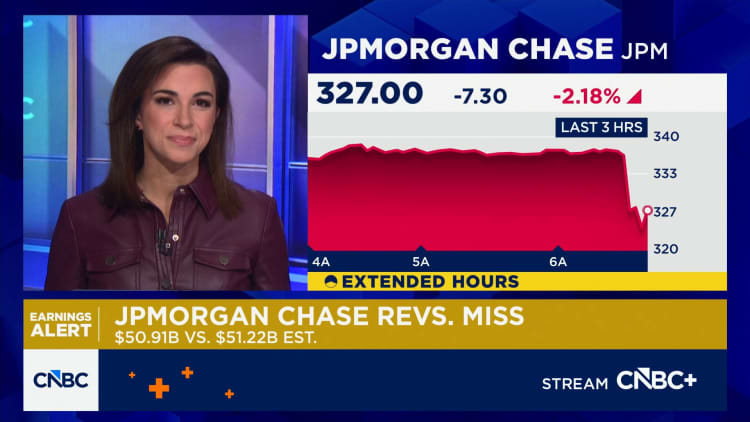
Here’s what JPMorgan reported compared with analysts’ consensus estimates, according to LSEG:
Earnings per share: $5.57 vs. $5.90 per share expected Revenue: $50.91 billion vs. $51.22 billion expected
— Sara Salinas
Wells Fargo earnings are out — here are the numbers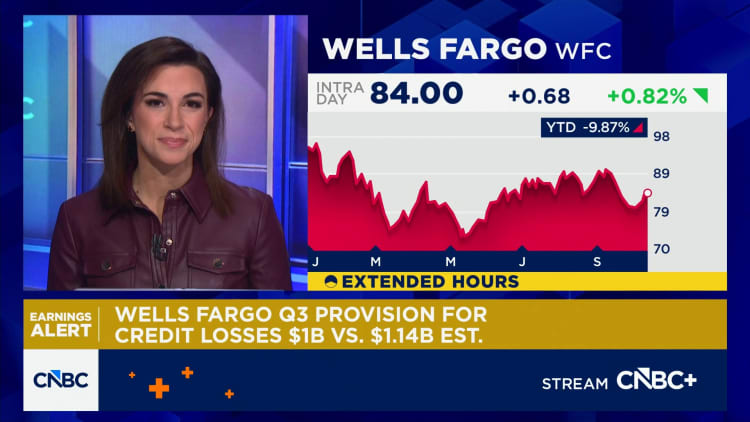
Here’s what Wells Fargo reported compared with analysts’ consensus estimates, according to LSEG:
Earnings per share: $1.87 vs. $1.85 per share expectedRevenue: $21.87 billion vs. $22.3 billion expected
— Sara Salinas
The Muse effect: Do banks face disruption risk from AI agents?
Mark Zuckerberg, CEO of the Facebook parent company Meta, takes the stage at the Meta Connect developer conference.
Andrej Sokolow | Picture Alliance | Getty Images
One likely topic for today’s analyst calls will be around whether banks aren’t just the beneficiary of AI, but at risk from it.
Specifically, AI agents like Meta’s Muse could make it easier for customers to move money from accounts that pay almost nothing to accounts with higher yields. Last month, Apollo Chief Economist Torsten Slok even outlined a possible bank run scenario caused by AI.
“If every household used AI agents to optimize the return on their cash balances, banks could lose a large share of the cheap deposits they rely on to make loans,” Slok wrote. That would “be a problem for the entire financial system.”
Some banks faced higher deposit costs last quarter, but that’s amid the backdrop of surging Treasury yields, according to StreetAccount.
Bank stocks were hit by concerns over AI agents last month, just as shares of Meta were rising as its Muse app topped the app download charts.
But over the longer term, banks will develop their own agent interfaces, insulating them from the threat, Bank of America analyst Ebrahim Poonawala said in an Oct. 4 note.
“Investors continue to inquire about the potential for agentic AI to disrupt banking deposits, fees, margins and customer acquisition,” Poonawala wrote. “While the timing and magnitude remain uncertain, one implication is becoming clearer: banks may increasingly need to build for the agent, not just the customer.”
— Hugh Son
Oura’s shelved IPO raises questions about Wall Street’s deal outlook
Tom Hale, chief executive officer of Oura Health Oy, wears an Oura Ring during an interview in San Francisco, California, US, on Friday, June 14, 2024.
David Paul Morris | Bloomberg | Getty Images
The booming deals and trading environment that powered Wall Street this year slowed down in the third quarter, but by how much, and for how long?
Those are the questions analysts will have for Goldman Sachs and JPMorgan Chase after a string of high-profile IPOs were put on hold in recent months, including the listing of smart ring maker Oura, which cited uncertain market conditions as its reason for delay.
Global investment banking revenue in the third quarter fell 6.6% from a year earlier to $27.2 billion, thanks to declines in closed mergers and debt issuance, according to Dealogic data.
But the slowdown is far from uniform across Wall Street.
Bank of America CEO Brian Moynihan warned in September that third-quarter investment banking fees were headed for a decline of more than 10%, while trading revenue will be roughly flat.
Citigroup expected to do a bit better: CFO Gonzalo Luchetti told analysts at the same conference that investment banking is tracking for “low-single-digit” revenue growth, while trading revenue was heading for “mid-single-digit” growth.
Meanwhile, JPMorgan co-President Doug Petno told analysts last month that both investment banking and trading revenue were headed for a percentage jump in the mid-to-high teens, showing that the boom continues at some banks.
— Hugh Son
The breakdown of segment revenues expected for Citigroup
According to consensus metrics from StreetAccount, Citigroup is expected to report $4.31 billion in revenue for its fixed income markets division. It’s also expected to post $1.76 billion in revenue in equity markets and $1.29 billion in investment banking fees.
Analysts are expecting Citi to report $2.41 billion in net credit losses and $2.62 billion in provisions for credit losses.
— Laya Neelakandan
Jamie Dimon’s warning on interest rates is coming into focus
Jamie Dimon, chief executive officer of JPMorgan Chase & Co., during the America Business Forum in Miami, Florida, US, on Thursday, Nov. 6, 2025.
Eva Marie Uzcategui | Bloomberg | Getty Images
For years, JPMorgan Chase CEO Jamie Dimon has warned that interest rates could climb higher than investors expect, fueled by persistent inflation and geopolitical conflicts.
Investors may get a fresh read on that outlook as the big banks report third-quarter results.
Bond markets sold off during the period amid renewed inflation concerns, rising oil prices and questions about how the growing wave of debt tied to artificial intelligence is impacting credit markets.
The 10-year Treasury yield — a benchmark that influences borrowing costs across the economy — jumped to about 5.3% by the end of September, the highest level in more than two decades. Bond prices fall as yields rise, pushing up financing costs for businesses and consumers.
For banks, higher rates are a double-edged sword.
Lenders may earn more on new loans, but they also face pressure to pay more to retain deposits as money market funds and Treasurys become enticing to investors. Higher borrowing costs may weigh on loan demand, while tighter financial conditions could complicate mergers and initial public offerings.
Ultimately, higher rates can strain borrowers’ finances, pushing some into default.
Those concerns weighed on bank stocks during the third quarter. The S&P 500 Banks Index fell 5.4%, while the broader S&P 500 gained about 2.3%.
— Hugh Son
Is the clock ticking on Goldman Sachs CEO David Solomon’s tenure?
John Waldron, chief operating officer of Goldman Sachs Group Inc., and Goldman Sachs Chairman and CEO David Solomon.
Jason Alden | Bloomberg | Angela Weiss | AFP | Getty Images
This will be the first chance that analysts have to directly ask Goldman Sachs CEO David Solomon about reports that he could be succeeded by his main deputy, John Waldron, as soon as next year.
If Waldron, who currently serves as Goldman president and chief operating officer, takes over as CEO, Solomon would likely remain as executive chairman for a period of time, an arrangement designed to engineer a smooth handoff.
But it’s unclear if Solomon, 64, is ready to release the reins of the top Wall Street investment bank, just as his company has hit its stride.
Solomon has gotten Goldman back on track after an ill-fated foray into consumer banking earlier in his tenure. With help from the artificial intelligence boom and a rebound in deals and trading, Goldman shares have outpaced rivals over the past year.
Goldman spokesman Tony Fratto has said there is “no definitive timeline for succession” at the bank.
Both Solomon and Waldron were awarded $80 million bonuses in 2025 to keep them at the bank through 2030.
— Hugh Son
Correction: Solomon and Waldron were awarded $80 million bonuses in 2025. An earlier version misstated the figure.
Wells Fargo is expected to report these segment revenues
Analysts are expecting Wells Fargo to post net interest income of $12.66 billion, according to consensus metrics from StreetAccount.
They’re also estimating the company will report a provision for credit losses of $1.14 billion.
Last quarter, CEO Charlie Scharf said the bank was “benefitting from the broad-based economic strength” in the U.S.
— Laya Neelakandan
Wells Fargo has a streak of beating revenue expectations
According to StreetAccount, Wells Fargo has beaten consensus expectations for revenue in 12 of the past 20 quarters.
The company has also topped consensus metrics for earnings per share in 16 of the past 20 quarters, with one report in line with expectations.
— Laya Neelakandan
Here’s what to expect from Citigroup
Citigroup is set to report its third-quarter results before the bell on Tuesday. Here’s what the company is expected to post, based on a survey of analysts by LSEG:
Earnings per share: $2.66 expectedRevenue: $23.72 billion expected
Company executives will hold a conference call with analysts at 11 a.m. ET.
— Laya Neelakandan
Here’s what analysts are expecting from Goldman Sachs
David Solomon, chief executive officer of Goldman Sachs Group Inc., speaks during the Qatar Economic Forum in New York, US, on Sunday, Sept. 20, 2026.
Michael Nagle | Bloomberg | Getty Images
Goldman Sachs, led by CEO David Solomon, has benefited from elevated investment banking and trading activity so far this year.
The main question: Will the Wall Street boom continue?
Here’s what Wall Street expects:
Earnings per share: $13.02, according to LSEGRevenue: $16.71 billion, according to LSEGTrading revenue: fixed income of $3.71 billion, equities of $5.02 billion, according to StreetAccountInvesting banking fees: $2.84 billion, according to StreetAccount
Solomon and CFO Denis Coleman will hold a conference call with analysts at 9:30 a.m. ET.
— Hugh Son
Here’s what Wall Street expects from JPMorgan
Jamie Dimon, CEO of JPMorgan Chase, departs the Capitol in Washington, Feb. 25, 2026.
Graeme Sloan | Bloomberg | Getty Images
JPMorgan Chase is scheduled to report third-quarter earnings before the opening bell Tuesday.
JPMorgan, led by longtime CEO Jamie Dimon, is the biggest U.S. bank by assets and the largest in the world by market capitalization.
Here’s what Wall Street expects:
Earnings per share: $5.90 according to LSEGRevenue: $51.22 billion, according to LSEGInvestment banking fees: $3.02 billion, according to StreetAccountTrading revenue: Fixed income of $5.95 billion, equities of $4.43 billion, per StreetAccount
Dimon and CFO Jeremy Barnum will hold a conference call with analysts at 8:30 a.m. ET.
— Hugh Son
Here’s what analysts are expecting from Wells Fargo
A Wells Fargo logo is displayed on a sign outside of a bank branch on June 6, 2026 in Washington, DC.
Kevin Carter | Getty Images
Wells Fargo is scheduled to report third-quarter earnings before the bell on Tuesday. Here’s what Wall Street is expecting from the company:
Earnings per share: $1.85 per share expected, according to LSEGRevenue: $22.3 billion expected, according to LSEG
Company executives will hold a conference call with analysts at 10 a.m. ET.
— Laya Neelakandan