
By Benjamin Steeves – Local Journalism Initiative Reporter
Oct 13, 2026
– Mississauga
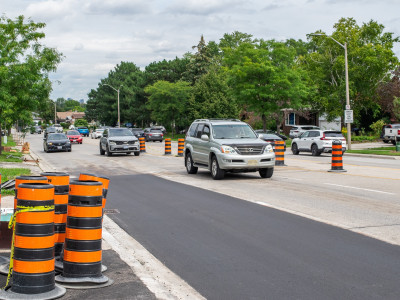
For Mississauga resident Zoran Subotic, the debate over the future of Bloor Street is more than a question of transportation policy or cycling infrastructure—it is the compass that has guided the rhythm and direction of his everyday life for the past three decades.
Since moving onto the busy thoroughfare in 1996, he has watched his children grow up and his neighbourhood transform around him.
Cities cannot remain frozen in time, he understands.
But when plans for a major redevelopment of Bloor Street began taking shape, he felt “angry and very displeased” like many residents who believed the outcome had been decided before they had a meaningful opportunity to make their voices heard.
“The bike lanes were a huge issue of contention for most of us here,” Subotic told The Pointer.
“You always believe that City Council would have more of a connection to the people and community of the area here, but they don’t. They give you a lot of mouth-to-mouth talk, but it doesn’t really serve anything well for us. It’s just basically the decision has been rendered, and it’s going to happen if we like it or not.”
City staff spent years studying how to redevelop Bloor Street, presenting residents with six alternatives before recommending a design that would reduce vehicle lanes, add cycling infrastructure and widen sidewalks. But for many Applewood Heights residents, their concerns became about more than bike lanes themselves, and whether public consultation meaningfully influenced a decision that would affect their homes and neighbourhood.
As confirmed by City staff, the project remains on hold following provincial legislation introduced in 2024 by Premier Doug Ford: Bill 212, the Reducing Gridlock, Saving You Time Act, requires municipalities to obtain provincial approval before installing new bike lanes that reduce motor vehicle traffic lanes, and allows the province to order the reconfiguration or removal of existing bike lanes. The province was later challenged in court earlier this year over its decision to rip up roughly 19 kilometres of bike lanes in Toronto, which resulted in the Superior Court’s approval that Ford could commence with its removal—prompting cyclists to organize a protest on October 13 evening.
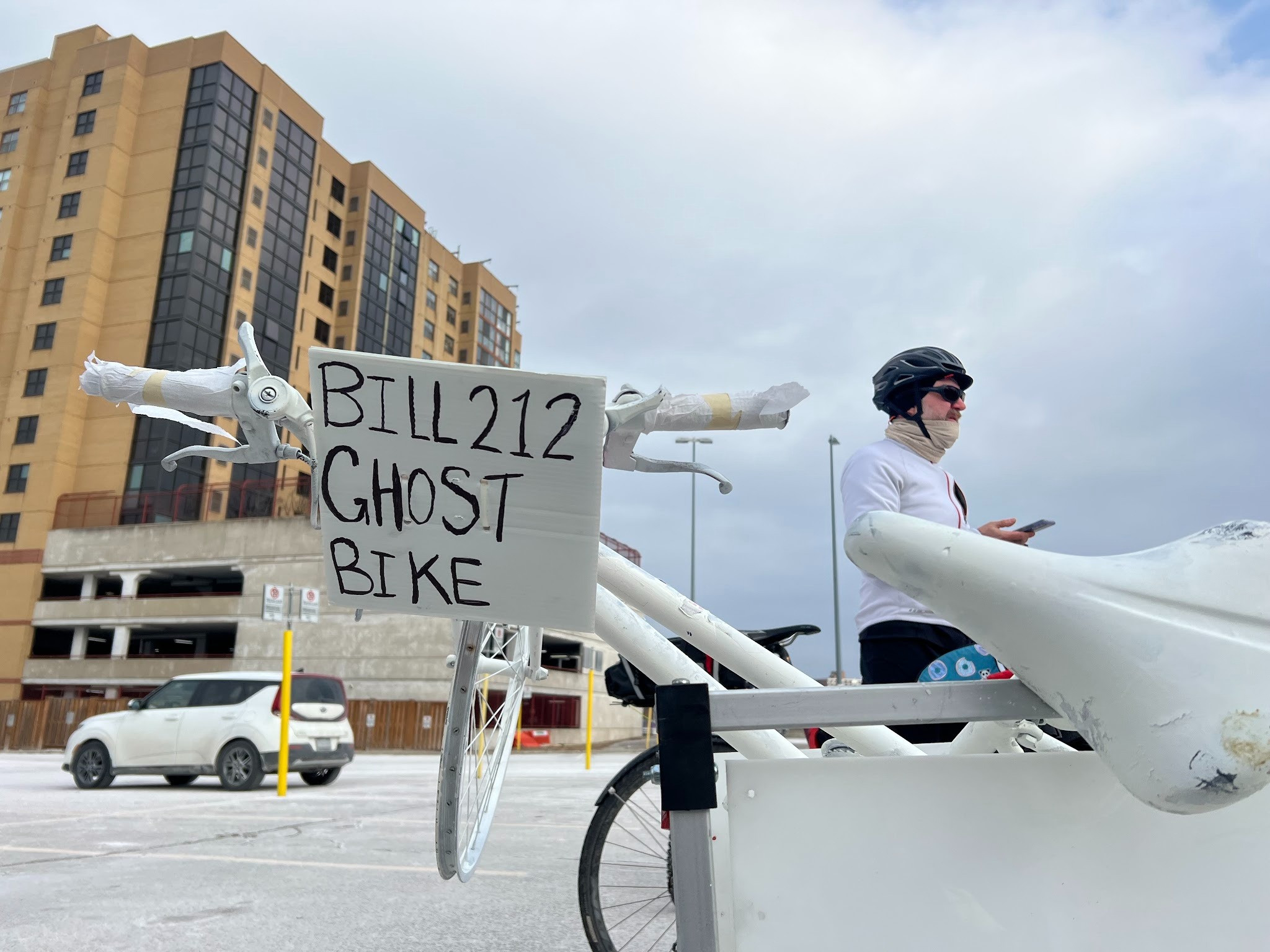
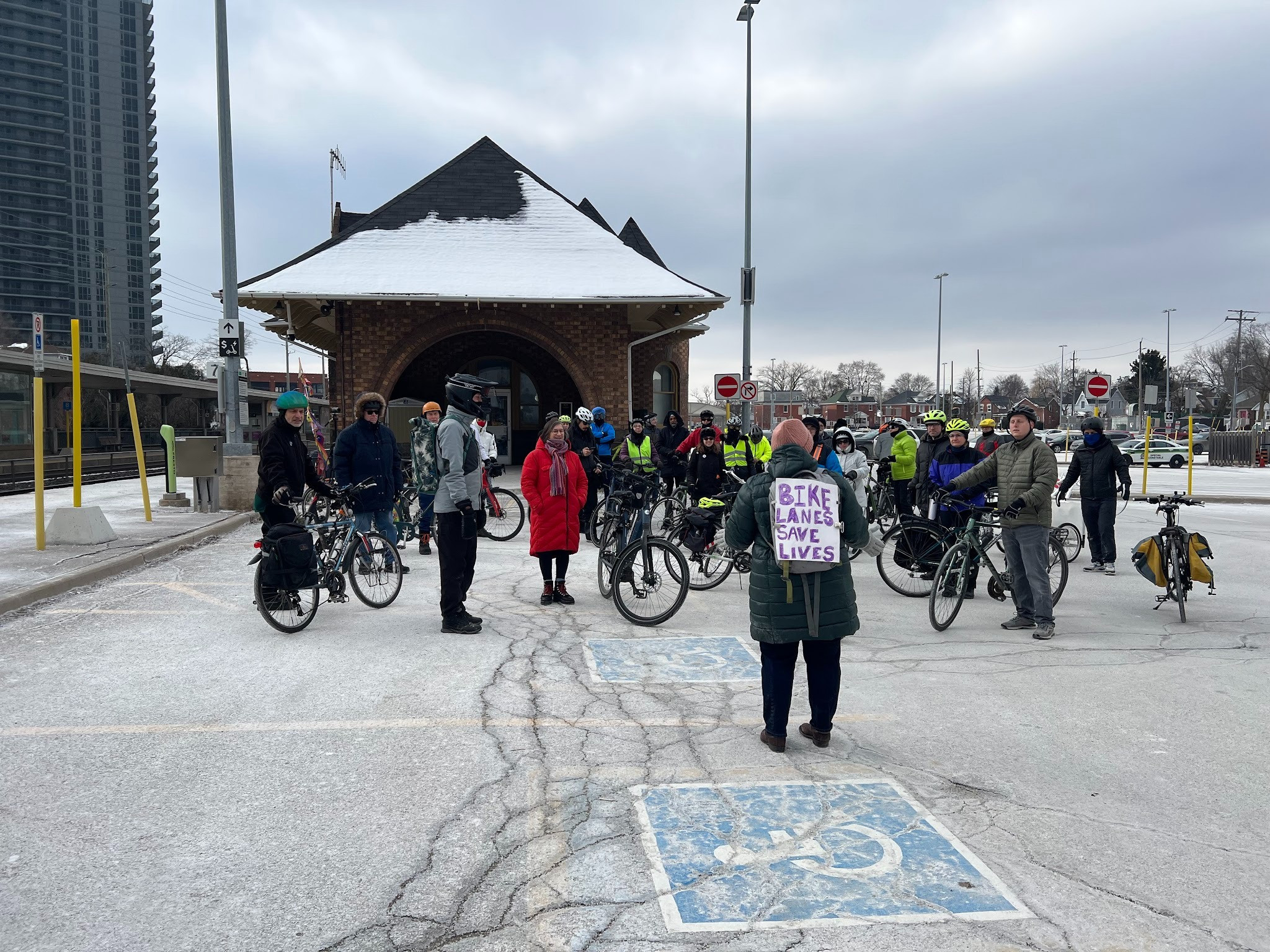
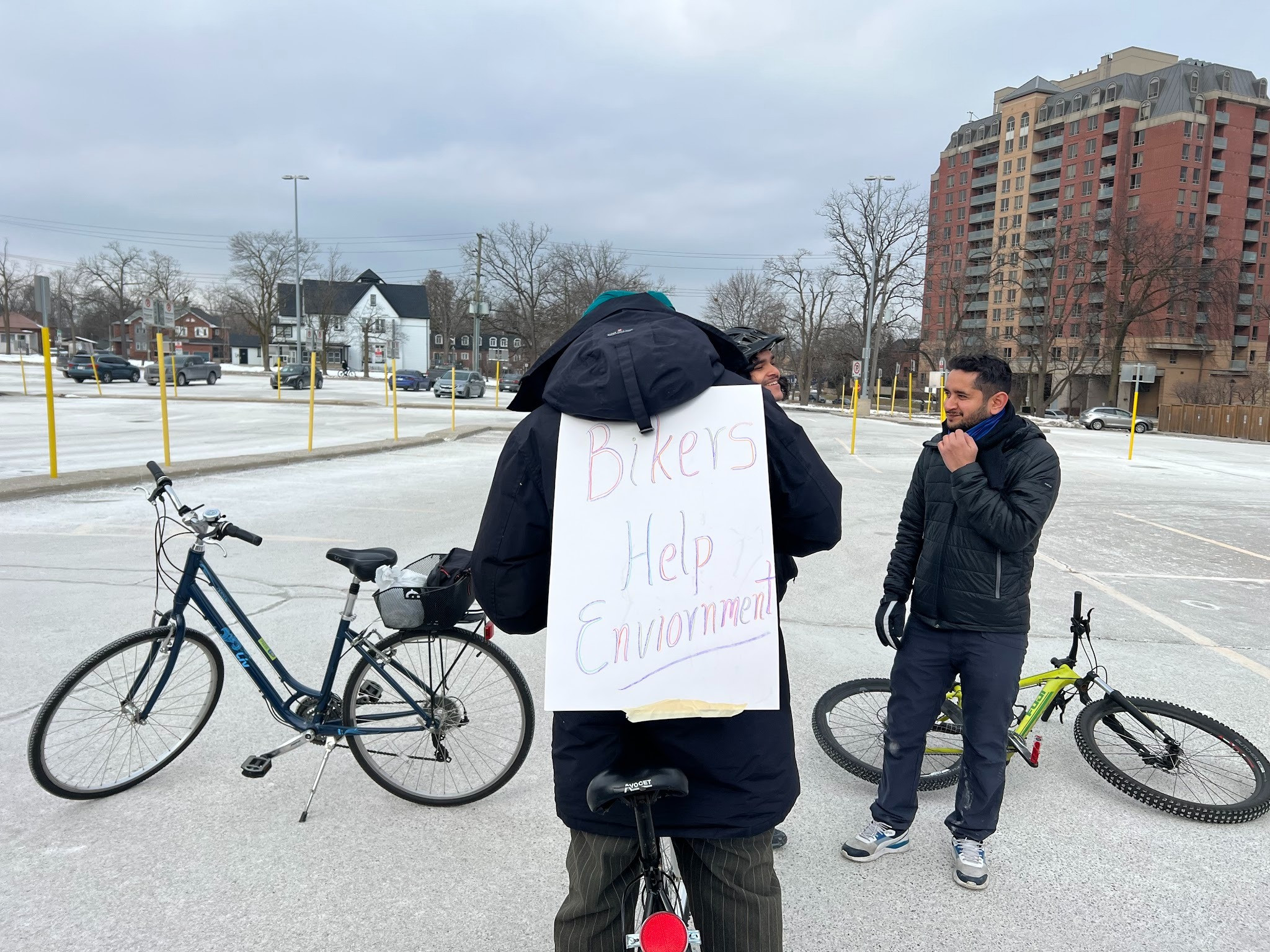
From its Toronto corridor to Mississauga’s Bloor Street section, opposing views on cycling infrastructure have intensified since Premier Doug Ford passed Bill 212 in 2024, setting the stage for a prolonged battle over road safety, traffic congestion and the province’s authority over municipal streets. On Tuesday, October 13, hundreds of cyclists gathered to protest the planned removal of bike lanes as work is slated to start later today. (Anushka Yadav/The Pointer)
The court’s decision left a void within Mississauga’s originally scheduled plans, forcing them to wait on the province and courts’ decision; consequently, leaving residents and cycling advocates divided over what should happen next.
After years of meetings from 2021 to 2024, petitions with thousands of signatures, political debate, and approximately $1.4 million in spending, the City has yet to determine when or how the redevelopment will proceed.
For residents who opposed the proposed design, the unresolved project has become a symbol of a wider divide between the City’s transportation vision and the concerns of people who live along the road.
According to a 2023 staff report, the Bloor Street redevelopment began because the road originally required pavement rehabilitation. Rather than simply resurfacing the street, staff saw an opportunity to combine the work with improvements to road safety, intersection controls, street lighting, active transportation and transit.
The project stretches from Central Parkway East to Etobicoke Creek, running through Applewood Heights and surrounding neighbourhoods, beginning its planning process in 2021 and involving public consultation, government and technical agencies, City departments, the Road Safety Committee and the Applewood Hills and Heights Resident Association. The same staff report says more than 9,100 postcards about the project were sent to local property owners between 2021 and 2023.
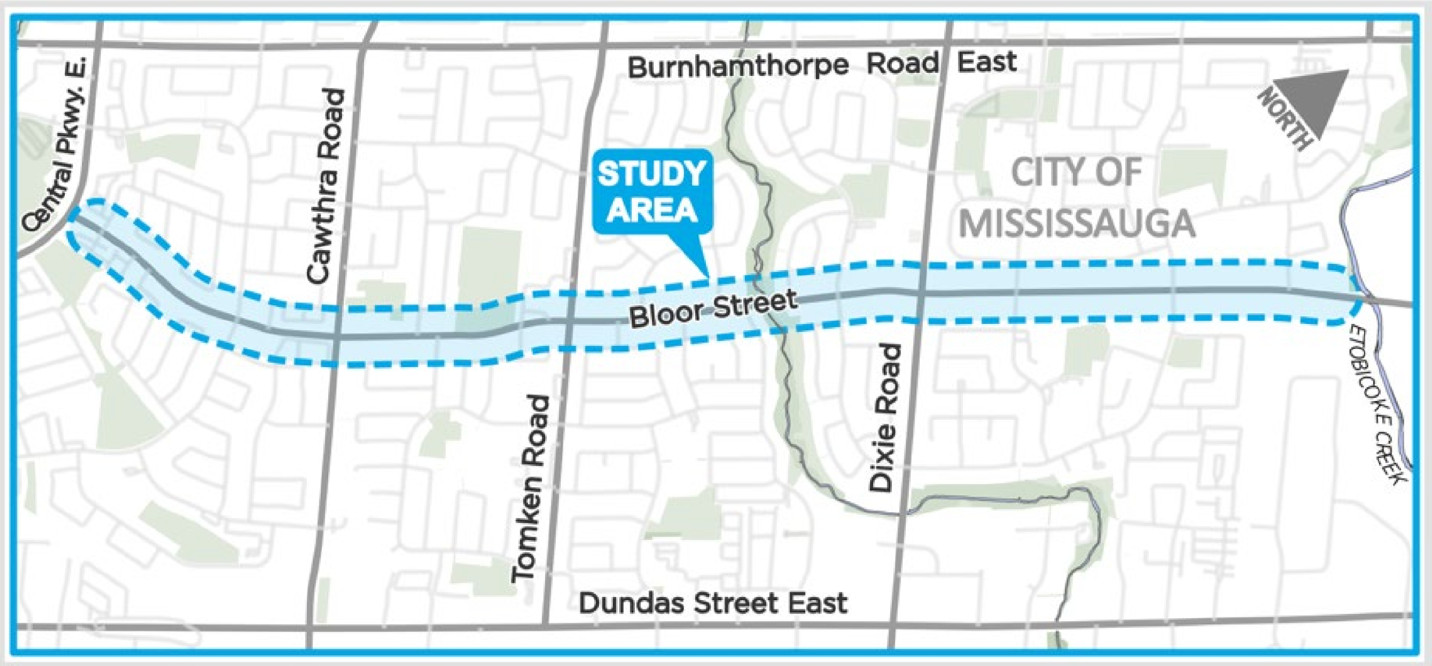
The City of Mississauga sought to redevelop Bloor Street at first to pave and update the road as part of an infrastructure update. After public consultation has repeatedly been criticized by residents and the province introduced legislation requiring permission to add additional bike lanes, and the removal of bike lanes in Toronto, the project has since been put on pause, leaving residents in the dark on what comes next. (City of Mississauga)
After studying six alternatives and holding a series of public meetings, staff recommended alternatives five and six for resident consideration. The City’s official project documentation says it went beyond the consultation normally required for this type of road project because of the high level of public interest.
Staff and residents eventually chose alternative six, a preliminary design that would reduce Bloor Street from four vehicle lanes to two, add a continuous two-way left-turn lane, widen sidewalks and place cycling facilities in the boulevard. The estimated cost at the time was approximately $27 million.
The preferred design also included a new signalized pedestrian crossing at Applewood Trail, intersection improvements, upgraded transit stops, improved lighting and additional opportunities for trees and landscaping. The posted speed limit would remain 50 kilometres per hour.
While City staff thought they could finally proceed, residents in the area felt their concerns about both alternatives presented to them were ignored. Multiple residents living along and around Bloor Street told The Pointer that the City proceeded with “what they wanted to do”.
City staff said the design aligned with Mississauga’s Vision Zero principles, Cycling Master Plan and Pedestrian Master Plan, and narrowing the travel lanes could reduce average vehicle speeds while creating continuous facilities for pedestrians and cyclists. The design would also maximize opportunities for boulevard trees, snow storage and waste and recycling collection.
For many residents who opposed alternative six, however, the central disagreement was the removal of two vehicle lanes to accommodate cycling infrastructure. Several residents interviewed by The Pointer recognized the value of cycling infrastructure but argued Bloor Street was the wrong location for it, or that the City should have explored other designs.
Marin Davis, an Applewood Heights resident who moved to the area in January 2021, said her opposition did not stem from a lack of support for cycling; she has two young children who ride bikes frequently.
“Even though I have kids, the cycle lane is good but this being in the residential area, having a bike lane, it’s more accident-prone,” she said.
Davis, a physiotherapist, said her concerns were shaped partly by her professional experience seeing accidents involving cyclists and electric bikes, believing the proposed infrastructure should have been considered along Burnhamthorpe Road instead.
“I know cycling is important, I’m not saying it’s not important, but people who live there deserve to be heard,” she noted.
Athina Tagidou, a member of the Applewood Heights Association, similarly questioned whether the design reflected how residents used the street.
“I’m not opposed to cycling lanes, but I think they need to be placed in areas that they make sense to have them,” Tagidou said.
“I also think they should require extensive community consultation because if the community is saying ‘yes we ride our bikes in this area all the time’ then that makes sense, but I can tell you we don’t have many cyclists in this area.”
The way the City presented the alternatives became a major source of frustration for residents who participated in the planning process.
Kim Pines, who is running for a Ward 3 council seat, noticed residents began losing confidence in the process when the options were narrowed.
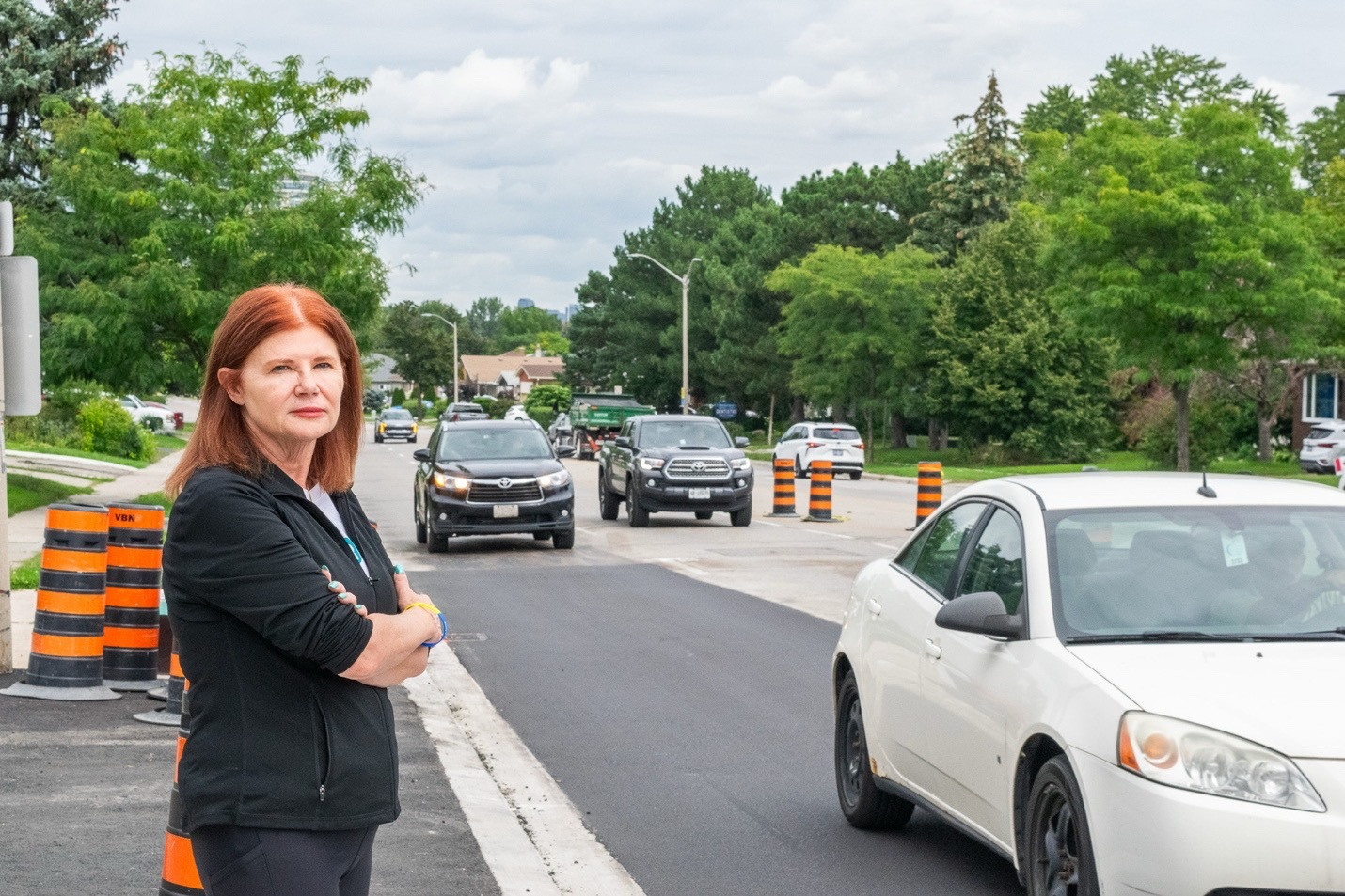
Applewood Heights resident Kim Pines, who is also running for city council in Ward 3, says the City of Mississauga has not been receptive to the concerns of residents with the ongoing changes along Bloor Street. (Alexis Wright/The Pointer)
“The public lost trust with the decision-making process because at meeting number four, there was an abrupt ‘you have option five and you have option six and bike lanes are not negotiable.’ This was the first time it was ever mentioned that bike lanes were non-negotiable. Why they never said that from the beginning, it might’ve made people deal with the whole situation differently,” Pines noted.
While the City ultimately landed on alternative six, alternative five would have maintained four vehicle lanes while placing cycling infrastructure in the boulevard; alternative six instead reduces the roadway to two vehicle lanes and provides cycle tracks along the boulevard.
Pines said residents believed they had been participating in a fruitful discussion about Bloor Street’s future, only to find themselves choosing between two options that did not reflect what many wanted: “We kind of feel like they had a preferred answer and then accumulated the information that supported that answer.”
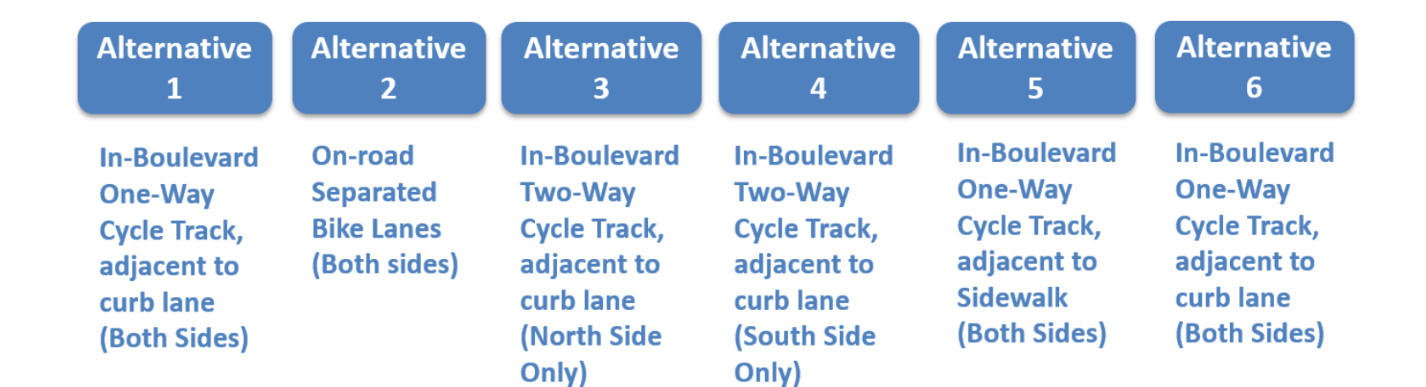
The six alternatives that were presented to residents by council and City staff in 2023 as possible redevelopment paths that would change the layout of Bloor Street, not seen in decades. The plans did not sit right with residents who preferred to see the area remain as is, unchanged and without bike lanes altogether. (City of Mississauga)
City staff said alternative six was selected following a technical evaluation and consideration of feedback from the public and stakeholders. But Tagidou observed concerns began at the earliest stages of the project, including how meetings were communicated to the community.
“What happened at the very beginning, which showed the lack of transparency [is] they did not put up any signs of any community meeting in the central section,” she said.
The central section between Dixie Road and Cawthra Road contains more than 100 residential properties. Tagidou argued that the messaging residents encountered did not make them feel the City was opening a discussion about what should happen: “They weren’t saying, ‘let’s have a meeting, or proposing this, let’s have a discussion ’; the signs from the city were saying it’s happening in the affirmative.”
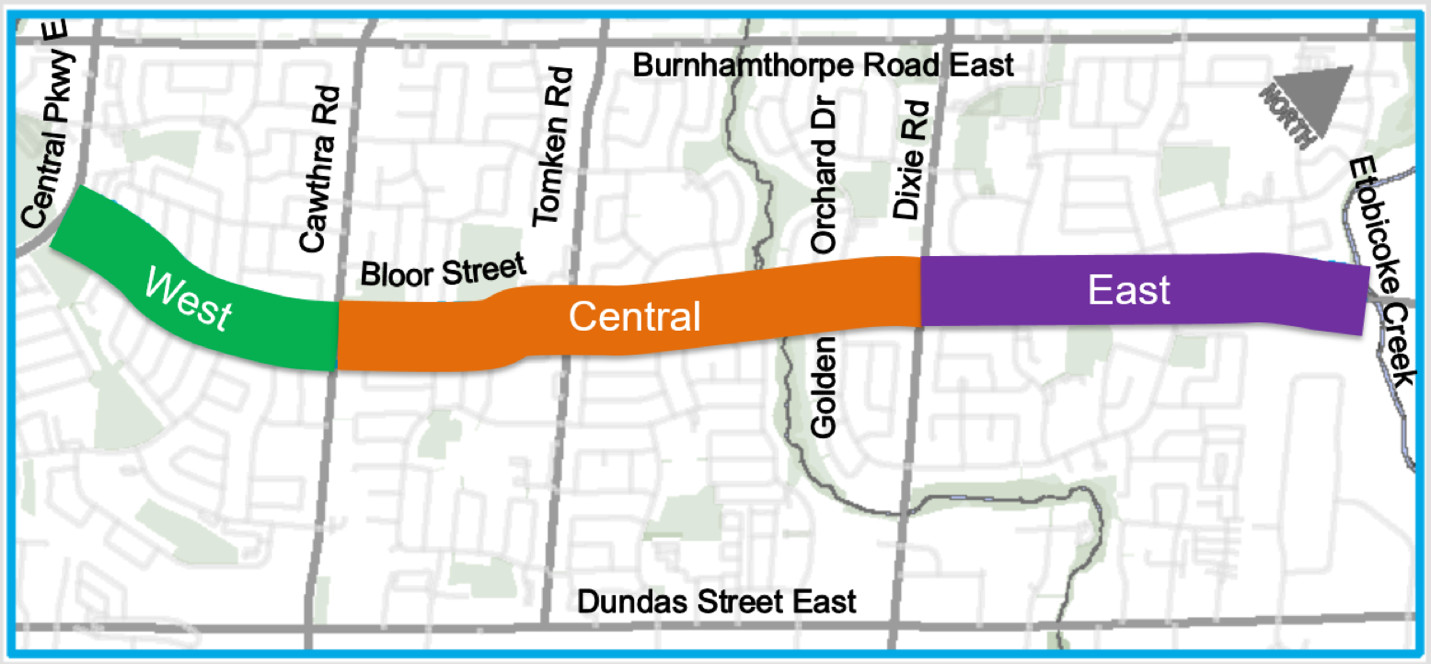
Broken up into three sections, the City communicated with the West, Central, and East sections of Bloor Street separately to find the best way to accommodate residents within the respective portion of the redevelopment plans. While the City first offered residents the option to vote on whether they wanted bike lanes, residents remember the City suddenly informing them that the option they collectively voted against was now on the horizon. (City of Mississauga)
The first public meeting took place in June 2021, while the project was still in its study phase. Early discussions focused on the broader opportunity to improve Bloor Street through repaving, trees, beautification and other upgrades. Tagidou said residents were initially receptive to those improvements, but cycling infrastructure became a more prominent issue by the second meeting, creating extensive confusion and opposition from residents.
Two petitions submitted by the Applewood Hills and Heights Resident Association, in December 2021 and September 2022, became prominent expressions of that opposition. The City’s staff report acknowledged the petitions and said residents within and adjacent to the Bloor Central section, between Cawthra Road and Dixie Road, opposed dedicated cycling infrastructure.
The petitions submitted to council had more than 4,000 signatures, mainly from Ward 3, objecting to the addition of Bike lanes along Bloor Street. According to Pines, when the petitions were brought forward to City Council, incumbent Ward 3 Councillor Chris Fonseca brushed them aside, claiming residents didn’t know what they were signing.
Tagidou believes the experience has undermined residents’ trust in the City and its officials.
“They have to rethink this whole plan, and community consultation is very important but only if it’s meaningful, not because it’s a checkmark,” she said.
“We feel that there’s a lot of checkmarks happening here and not actual meaningful consultations with the community.”
George Tavares, who is running for Ward 7 councillor, expressed a similar concern, arguing that the problem went beyond the bike lanes themselves, and the City only spoke to residents to say they did, but not to truly listen to them.
“I think the real issue is that public consultation has been considered just a checked box; it’s not an actual dialogue between the communities and a dialogue or communication between the City and the needs of the people,” he told The Pointer.
“I think the other issue is that they kind of came up with a design that they really liked, and then they just kind of pushed it.”
Tavares said the City should have been willing to develop another design rather than framing the decision as a choice between two alternatives. He believes an independent review could help move the discussion beyond the mistrust and political divisions that have developed.
“If you really want to make this simple, you hire a third-party non-partisan person to review the information and identify what the actual strategy can go through and go to arbitration,” he said.
The project’s early stages also unfolded during the COVID-19 pandemic, which brought its own unique set of challenges.
“This [started] during COVID, the original designs. So they were doing a lot of this stuff online and through video chat and it was all new and foreign and alien to us and to them, so I’m sure that there was a level of frustration that was a little higher than it should have been,” Tavares noted.
“And when it finally got to a certain point, I’m sure everybody was very tired of it and then they were very tired of seeing the same people doing the same thing.”
Pines questioned how the City defined the area most directly affected by the project and how its analysis accounted for people travelling from surrounding streets, considering the City only took into account houses just shy of over 100 feet away from Bloor Street while properties further away did not count as active users of the street.
“The study area was basically a house and a half from the middle of Bloor Street [or] only 114 feet from either side of Bloor Street or a maximum of two houses depth; anyone else then was considered not local,” she said.
“They said that their sensitivity analysis states that 66 percent of vehicles do not originate from or are going to a location within these 114 [feet] within the study area which [is] two houses North and two houses South of Bloor.”
A transportation analysis by the City considered traffic, transportation and safety conditions across the surrounding network, rather than focusing exclusively on homes directly fronting Bloor Street.
Staff noted that a large portion of traffic travelling along the road did not begin or end immediately within the local community—a rationale used for reducing the number of lanes and introducing cycling facilities.
The City expected alternative six to continue accommodating local traffic while making Bloor Street less attractive as a longer-distance through route. It acknowledged that some traffic could shift onto nearby roads but concluded that the affected network would continue operating at acceptable levels.
Pines contested whether diverting vehicles to surrounding streets could undermine the City’s safety objectives, particularly where schools and vulnerable road users are present.
“Ultimately what’s going to happen is cars are going to take diversion routes that are going North and South to get to Burnhamthorpe or to get to Dundas, and of the seven of these routes, they all have schools,” she predicts.
“In fact, they’re going against their own Vision Zero policies or what they’ve been trying to do by actually directing more cars into an area where you have more vulnerable citizens.”
Subotic already finds leaving his driveway cumbersome during rush hour; he sometimes waits several minutes for a brief opportunity to pull onto the road and worries that the redevelopment could add to traffic pressures.
Davis often wonders whether the proposed $27-million redesign would meaningfully resolve the gridlock or whether the money would be better spent on other measures to reduce traffic.
She is also concerned about potential conflicts between cyclists and vehicles entering or exiting residential properties. She noted that many people in the surrounding community are elderly and worried about the potential for accidents involving cyclists and vehicles backing out of driveways.
At the same time, cycling advocates argue that road safety cannot be considered solely from the perspective of motorists. Dorothy Tomiuk, who served on the Mississauga Cycling Advisory Committee until 2017 and helped create the cycling community rides program, said the debate should not be framed as drivers against cyclists.
“Just like drivers, cyclists want to get where they’re going,” she told The Pointer.
Tomiuk recognized that increasing congestion makes safe cycling infrastructure more important for people who want to travel to work or use bicycles for everyday transportation, noting that cycling routes should not require people to travel through parks and ravines that may be difficult to use during winter.
“All road users should be safe, and all road users should be able to get to where they’re going. Cycling is an alternate form of transportation that increasingly is going to be valuable as traffic congestion gets worse,” she added.
Describing alternative six as “the gold standard for a complete street”, she noted the project also represents an opportunity to make cycling safer for children who live in the neighbourhood while providing a less expensive transportation option for people struggling financially.
“I think there’s a misconception that A: they’ll [residents] be forced to ride bikes instead of driving or B: that the bikes will be in their way and it’ll slow them down when all it takes is one cyclist taking the lane to slow the whole lane down. If you get the bikes the hell off the road and into their own lane, suddenly driving is easier,” she said.
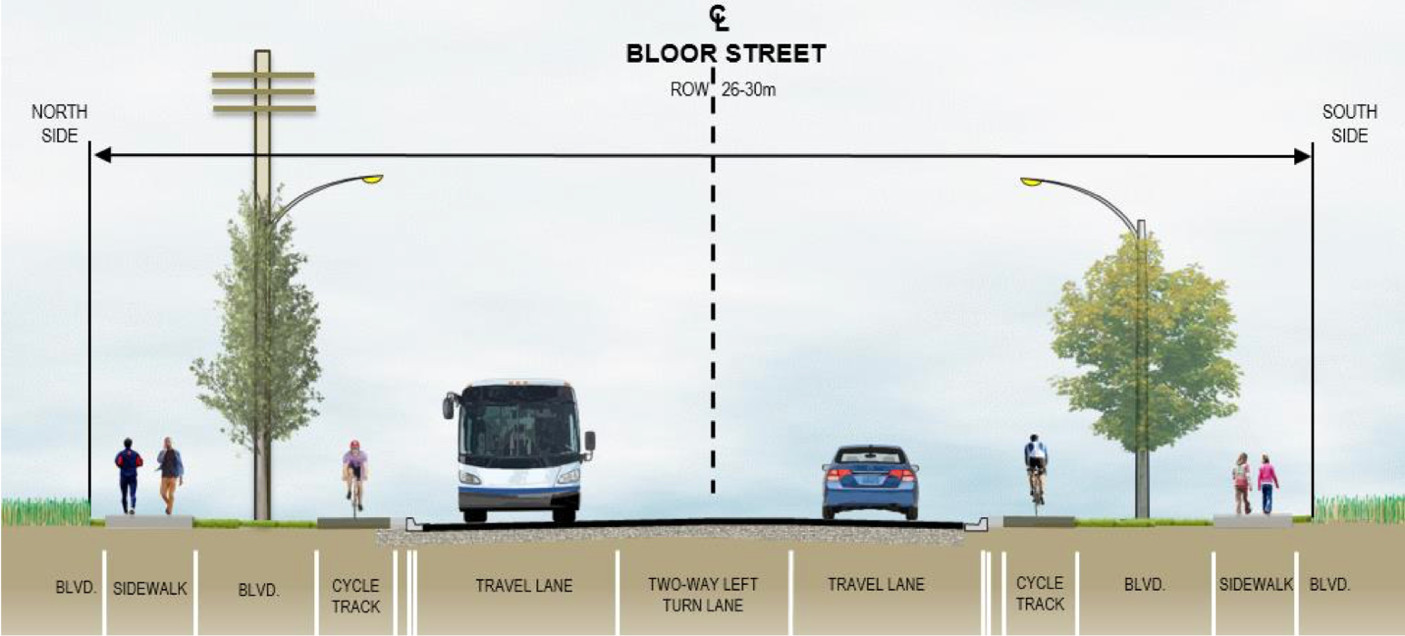
A graphic of alternative six shows how the road traffic would change should the option be implemented, showcasing the bike lanes placement at the end of residents’ driveways. (City of Mississauga)
A 2022 simulation-based study examining the effects of separated cycling lanes on residential streets in a Melbourne suburb in Australia found that, in the worst-case scenario studied, average car travel times increased by seven percent.
Despite its relevance for the community, residents became increasingly suspicious of the information used during the planning and development process, as the City relied on traffic and congestion data collected during the COVID-19 pandemic, when travel patterns had changed, and many people were staying home.
“They have to have a meeting, they need to get new traffic data and they have to be willing to share it. They never want to give us any information,” Pines said.
By 2024, Bloor Street had become a political issue in Mississauga, extending beyond the original planning process into the mayoral by-election and broader arguments about how the City should develop its transportation network.
During the campaign, Dipika Damerla opposed the approved design and publicly said she would work to stop it if elected mayor. Alvin Tedjo supported the project and defended the decision to move forward with alternative six, while Carolyn Parrish also opposed the design but maintained that Council had already approved it.
Tedjo framed the proposal as part of a transportation strategy rather than a debate over bike lanes alone.
“This isn’t about bike lanes specifically. This is about building a minimum viable network of transportation across the City of Mississauga to give people safe and viable options to get around the city,” he said.
For residents who opposed the design, the political debate provided another opportunity to demand reconsideration. But it also prolonged uncertainty over whether the project would proceed and under what conditions.
The decision to put the project on hold came after the Ontario government introduced Bill 212 in 2024, creating new requirements around certain municipal bike-lane projects. The Bloor Street redevelopment was subsequently paused while the City sought clarification about whether it could proceed.
In November 2024, the City had spent approximately $1.15 million on the project. The City has since confirmed that spending has increased to approximately $1.4 million, although it’s unclear what the additional $300,000 was spent on. The original spending covered planning, preliminary and detailed design, public meetings, internal staff work and external consultants. Staff said the money came from reserve funds and would not affect future property tax bills.
Sam Rogers, the City’s Commissioner of Transportation and Works, said staff was seeking clarification from the Ministry of Transportation before proceeding and discussed how significant work had been completed and that the City was prepared to submit technical studies and background information for consideration, but did not want to spend more money while the legislation remained unresolved.
“They didn’t need to spend all that money if they had listened to us from the beginning, if they listened to the residents. But they didn’t want to listen to the people, they wanted to do what they wanted to do,” Tagidou said with apprehension about the City spending money that would possibly go down the drain.
“I’d open it up right away for new company designs; if I get in, I would be on this; it would be one of my top projects to get the ball rolling. Why are we waiting? It still needs to be done.”
She envisions a new process involving updated traffic data, greater transparency and a willingness to consider different designs. Her position is that the road still needs improvements, but the City should not assume the existing proposal is the only acceptable solution.
Tavares also sees the delay as a lost opportunity to find a design that could address the competing concerns: “It was a weird situation because what they should have done is just listened to the people and come up with a better design. Now we’re waiting four years and that’s what they’re stuck doing anyway.”
He does not believe the project necessarily needs to be abandoned, but wants the City to reframe the discussion around the improvements Bloor Street requires, including infrastructure renewal, safety, sidewalks and other upgrades, while reconsidering how cycling facilities and traffic capacity could fit into a revised plan.
“This provincial overreach into what is, I think, strictly a municipal matter of where the bike lane should go, means that we’re all kind of stymied for the moment,” Tomiuk added.
The City of Mississauga has confirmed the project is currently in limbo. “The Bloor Street Redesign remains on hold and the City has not yet made a decision on the future implementation plans. The City has previously spent approximately $1.4 million on planning, preliminary design, detailed design, tender and pre-construction phases,” a spokesperson wrote in an email to The Pointer last month.
“We want to know, you can’t put the bike lanes in, so why is the project still on hold? We need a clear explanation of what specifically is holding them back from making a decision and proceeding,” Pines said, advocating for residents deserving a clear explanation for the holdup.
During a Ward 3 debate on October 5, residents repeatedly cheered Pines as she pressed Fonseca, Vice-Chair of the Mississauga Cycling Advisory Committee, on why little had been done for years. As Fonseca attempted to outline her plans if re-elected, residents heckled her—leaving her visibly flustered and unable to fully answer the question within the allotted time.
The prolonged uncertainty has affected how some residents view the neighbourhood’s future. Subotic said some people he knew sold their homes after the bike-lane debate began, and estimated that among the people he knew who sold their homes, 30 to 40 percent said the proposed bike lanes were the direct reason.
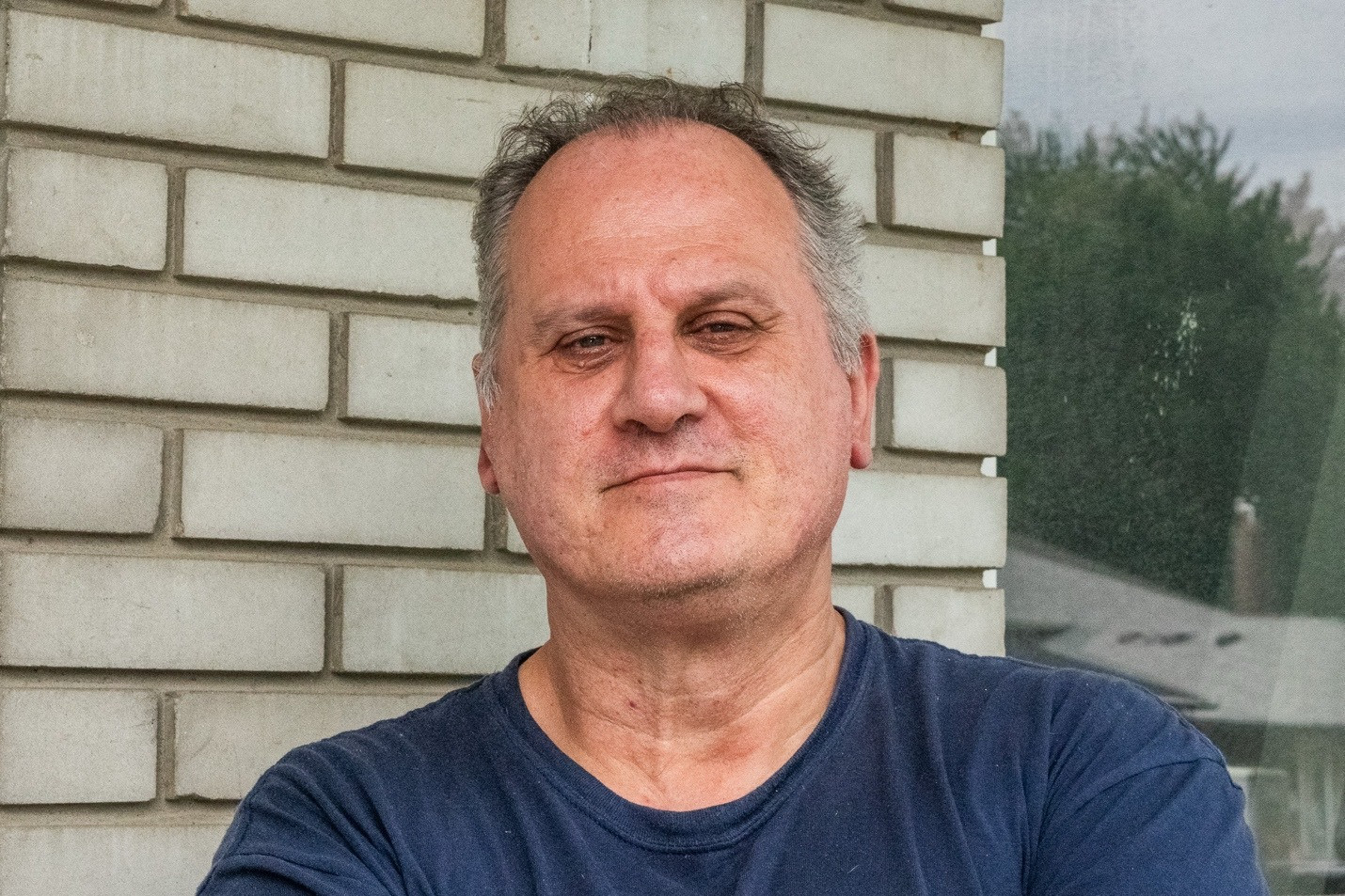
Zoran Subotic has lived on Bloor Street for 30 years, and has never thought about moving or leaving the community he’s called home to raise his kids and retire in. He said that, should the City go ahead with their redevelopment plans, he’s had thoughts about moving and knows people who decided to move once the bike lane discussion began but specifically has concerns over his property value depreciating if the redevelopment of the road in front of his residence should make the way of life of people less enjoyable and lead to a decrease in people seeking to call the fast-growing community home. (Alexis Wright/The Pointer)
Davis also considered moving after the discussion intensified; she found herself questioning why she had chosen the neighbourhood if the road’s character and function were going to drastically change in a way she did not support.
Subotic fears the revamp could diminish property value and make the area less enjoyable for residents and less attractive to prospective homeowners while sidelining the residents who ‘pay the taxes’ and will live with its consequences. “Change is good in some ways, but not in this specific way,” he added.
Construction was originally planned to begin in fall 2024, with completion anticipated in December 2025 and restoration work continuing into 2026. Those timelines have since been upended by the pause, and the City did not confirm when the project might proceed.
For residents who are exhausted from years of debate, however, the pressing question is whether the next decision will be made after a genuine reconsideration of the alternatives.
“Citizen fatigue is real, and some people just get tired of fighting if they view it as fighting but if you view it as advocacy, then you stay cheerful and you just keep pushing for what you know is ultimately the right solution,” Tomiuk said, determined to continue the fight for a better Mississauga.
Tavares believes the City must be willing to find a better way forward rather than escalating the dispute.
“It’s never the wrong time to do the right thing,” he said.
Email: [email protected]
At a time when vital public information is needed by everyone, The Pointer has taken down our paywall on all stories to ensure every resident of Brampton, Mississauga and Niagara has access to the facts. For those who are able, we encourage you to consider a subscription. This will help us report on important public interest issues the community needs to know about now more than ever. You can register for a 30-day free trial HERE. Thereafter, The Pointer will charge $10 a month and you can cancel any time right on the website. Thank you