
Editor’s Note
People across the province are heading to the polls on Oct. 17 to elect their local governments. The Ubyssey is covering Vancouver’s mayoral race, the city council and park board races, and mayoral races around the Metro Vancouver area. Click here to find the rest of our coverage.
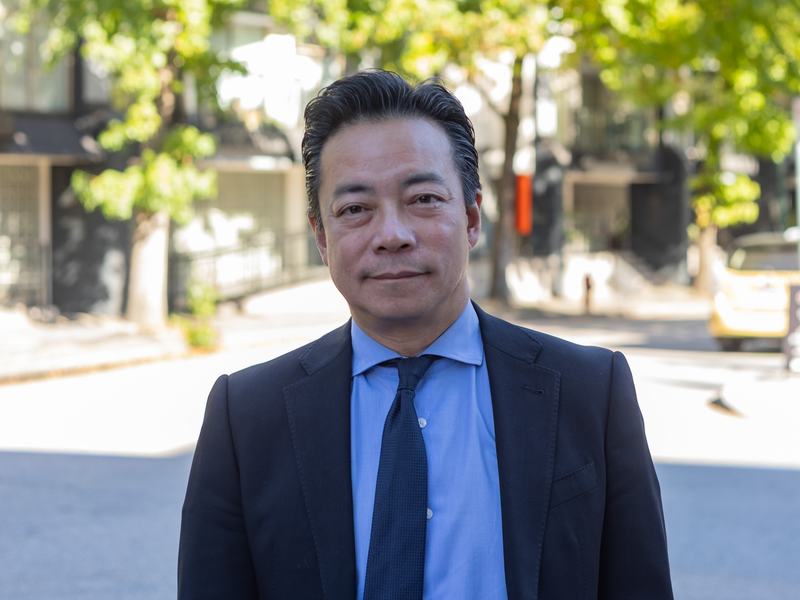
Mayor Ken Sim told The Ubyssey he is “not a career politician,” but rather “a super proud UBC alumni.” Yet he is doing what seasoned politicians do — trying to keep his elected office. Sim said he is running for re-election to build a future for his “four boys” where they don’t have to leave Vancouver.
“We want to create an environment where kids can and want to call Vancouver home.”
After four years in power, Sim is putting his name on the ballot for the third time, repeating last time’s winning formula by running under the banner of his party, A Better City (ABC) Vancouver.
This time around, ABC is promising to continue “achieving” for Vancouverites in “public safety & street disorder,” “affordability,” and the economy. Sim’s party promises a zero per cent property tax increase, making parking at beaches and community centres free, putting an end to residential parking fees, revitalizing Granville Street’s pedestrian zone, a ban on “open-air hard drug use in public spaces” — which is already illegal — and “fight[ing]” for 100 new involuntary care beds downtown.
These last two would come in the form of advocacy to the province and would be based on the results of a non-binding plebiscite, put forth by Sim himself. Without the province’s support, Sim would be unable to fulfil these promises, given that the municipal government does not have jurisdiction over health policy.
Vancouver Greens Councillor Pete Fry, one of Sim’s harshest critics and his main rival in this election cycle, called the plebiscite a “cynical election move,” arguing its only purpose is to create a “wedge issue” that drives people to the polls. Sim has said “this is about saving lives [and] making lives better.”
The race remains tight, with Sim polling one percentage point behind Fry. In a recent interview with The Ubyssey, Sim spoke about his plans for housing and transportation, as well as how the controversies of his time in office could impact his re-election efforts.
Sim said “many things affect housing prices” but, in his assessment, it “really is supply and demand” that impacts affordability the most. He said despite efforts to eliminate red tape during his term — on their website, ABC says that in 2022 they removed 1,200 rules and regulations that “streamlined permitting” — there’s “a lot of work to do” to “speed up the building and make it easier for homebuilders to build.”
“If we make it easier, there will be more homes for people to live in, for people to buy, [and] for people to rent.”
In 2025, Patrick Condon reported for Maclean’s that in roughly the last 50 years, Vancouver has tripled its supply by increasing density, while population has not even doubled in the same period. Cities like San Francisco and Los Angeles do not come close to Vancouver’s increase in stock during this period, yet a 2023 study found that Vancouver is the third-most expensive city across Canada and the United States — only behind New York City and Mississauga.
In 2017, the city introduced an Empty Homes Tax (EHT) to address such unaffordability. Under the policy, “properties deemed or declared empty” are subject to a 3 per cent tax on the property’s “assessed taxable value.” The 2023 EHT annual report found that the tax was having a “positive impact on housing availability … with the number of vacant properties decreasing by 58 per cent between 2017 … and 2023.” In 2025, the number of vacant homes in Vancouver fell under 1000 for the first time since 2017 — the city credits the EHT.
Early in his term, Sim and his ABC coalition successfully opposed increases to the EHT. Sim told The Ubyssey that even if all empty houses were to enter the rental market, “it wouldn’t have affected affordability at all. And I think it masks a bigger problem … we weren’t doing our job as a city … to actually make it easier to build homes, right? And so that’s been our focus. Let’s make sure we get rid of all the regulatory red tape, everything we can do to make it easier to build homes.”
The revenue collected by the EHT is meant to support the building of affordable housing. In 2025, the city reported that, since its inception, the EHT had “generated $194.3 million to support affordable housing in Vancouver.” Sim believes focusing on this type of housing is a mistake.
Under Sim’s leadership, council voted to halt the building of supportive housing, which is “subsidized housing with on-site supports for single adults, seniors, and people with disabilities at risk of or experiencing homelessness,” according to BC Housing.
“The difference between [ABC] and the other parties is [that] a lot of people will just focus on low-income housing. You need to focus on everything, and if you don’t focus on everything, then what happens is the low-income housing people will bid for that, and it won’t be low-income housing anymore,” the mayor said. “If you have 100 per cent low-income housing, our society fails. You have to have a balance.”
On transportation, Sim said ABC is committed to seeing the SkyTrain to UBC become a reality, however, The Ubyssey reported that some candidates believe UBCx is not a priority for ABC. Sim said that is “completely wrong.” For him, he said, the project is a “no-brainer.” He thinks what is missing is “support from senior levels of government.” He added that his conversations with Prime Minister Mark Carney have been fruitful.
Even disregarding the policy disagreements, Sim’s time in office has not been without controversy. In 2024, his decision to turn a room at City Hall into a personal gym came under fire. Eventually, the gym equipment was removed. Also during his term, his chief of staff Kareem Allam resigned and started his own party — now running against ABC. Similarly, Councillor Rebecca Bligh was kicked out of ABC’s caucus and is also now running for mayor under her own party, Vote Vancouver.
Perhaps most notably, Sim is facing a defamation trial in January 2027, after he repeated false claims made by his party colleague, Councillor Lenny Zhou, who accused COPE Councillor Sean Orr of selling “illegal drugs” during Christmas of 2025. Sim has apologized for the comments repeatedly.
Sim told The Ubyssey he is the first to admit he “hasn’t gotten everything right … and some things took a little longer,” but that he will “stand by [ABC’s] record.”
“We’ve accomplished some pretty cool things, and we truly believe that there’s more in the works,” Sim said. “When I think of what Vancouver can be … imagine [if] instead of people referring to Vancouver as the chaos of the Downtown Eastside … [it] became known for changing the course on street disorder … Imagine Vancouver being referred to as the city that actually has the best treatment and recovery services. It’s an incredible opportunity, and that’s one that we’re excited about achieving, and we think we can achieve it.”
The final day to vote in Vancouver’s municipal election is Oct. 17.
Standpoint Statement
This article is a profile, which tells the stories of individuals and their worldviews, written from a repoter’s perspective.
Extended Byline
Saba Majd was this story’s backfield editor. Saba Majd was the copy editor. Quyen Schroeder took the photos, which were edited by Aleah Kippan.
Apply for erasureSend a tipReport an error
Have something to say?Write an op-edWrite a letterRequest coverage