
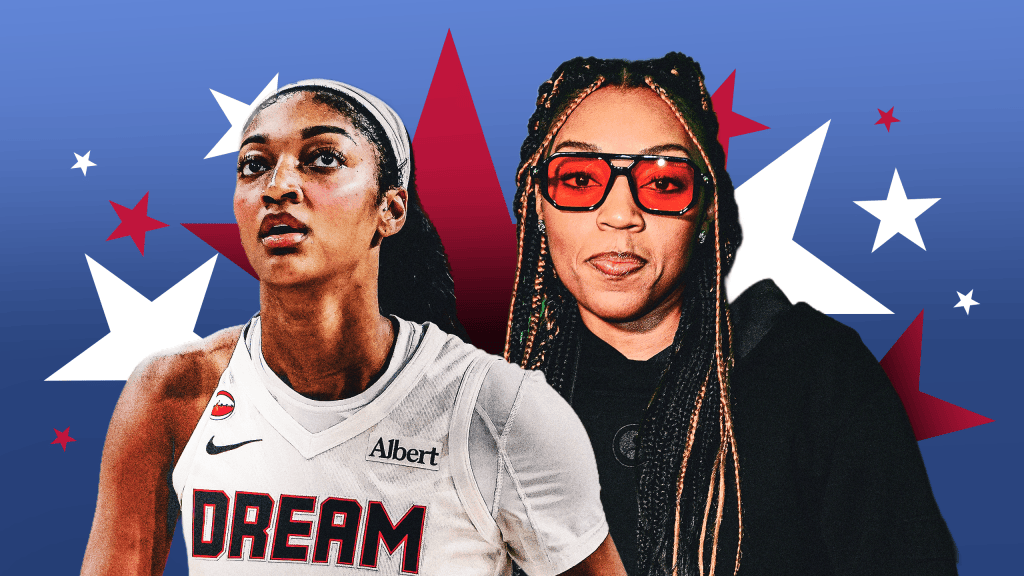
The Atlanta Dream will take the court this weekend for their first WNBA Finals game in 13 years, a pinnacle achievement for the franchise with the lowest valuation in the league still undergoing a massive turnaround.
Five years ago, the Dream made headlines for their political activism more than their on-court performance. In 2020 and 2021, players successfully campaigned to elect now-Sen. Raphael Warnock (D-Ga.) over then-team owner and incumbent Kelly Loeffler, who had opposed players’ support of the Black Lives Matter movement. The Dream players’ campaigning assisted Warnock’s election and contributed to the sale of the team to Larry Gottesdiener, Suzanne Abair and former Dream player Renee Montgomery.
Today, the Dream arguably represent the shortest and most direct bridge between the WNBA’s social justice roots and its present era of mainstream popularity and dynamic athleticism. They are led by Angel Reese, acquired in a preseason trade, who is the 2026 Defensive Player of the Year and a mainstream celebrity who has appeared at the Met Gala and in the Victoria’s Secret Fashion Show. The Dream’s front office has expanded tenfold from 2021 to the present, and the organization recently agreed to a deal with the NBA’s Atlanta Hawks to share State Farm Arena as the team’s permanent home venue beginning next season.
Getting there required a lot of investment and patience. In 2021, the Dream were “a team that had to be rebuilt. We were starting five years ago with a deficit,” Morgan Shaw Parker, Dream president and chief operating officer, said. “We had to, for four and a half years, build our franchise to be able to bring in someone like an Angel Reese.”

Despite the strides the team has made, there’s still a significant financial disparity between Atlanta and the team it will face in the WNBA Finals, the Golden State Valkyries. The Dream are valued at $280 million, according to Sportico’s WNBA valuations, and posted 2025 revenues of $16 million. The Valkyries, only in their second year in the WNBA, are worth $850 million and posted 2025 revenues of $78 million. This year, Golden State became the first women’s team to generate $100 million in revenue.
The gulf between the two 2026 Finals opponents was most apparent this week when the Dream scrambled to finalize an agreement with the Hawks to host Games 3 and 4 at State Farm Arena (capacity: 16,888) in Atlanta, rather than the Dream’s longtime home of the Gateway Center (capacity: 3,500) in suburban College Park, Ga. The Valkyries, meanwhile, have fostered one of the most intimidating home environments at San Francisco’s Chase Center, which the team shares with its sibling NBA franchise, the Golden State Warriors.
In 2020, stadium upgrades and All-Star trades were not even on the radar of the Dream, whose players that season assembled the “Vote Warnock” warmup campaign to protest against Loeffler. Meredith Geisler, assistant professor of sport management at George Washington University, said the Dream’s campaign that year built upon a tradition of progressive social justice that has been a hallmark of the WNBA since its inception.
What the Dream players achieved in 2021, Geisler said, “completely turned that election around. Without a doubt. I don’t think [Senator] Warnock would say anything different.”
Crucially, Geisler said, the team’s activism created an opportunity for Renee Montgomery, a player at the time who sat out the 2020 season to devote herself to activism, and as a result became the first former WNBA player to join ownership of a franchise when the Dream were sold in 2021.
“It was a beautiful illustration of what can happen if you are organized and have an important point of view. They affected change in the most wonderful way for them, and for the league itself, and turned [the team] over to people that may not have had this opportunity, certainly Renee,” Geisler said.
This season, political discourse around the league has mostly centered upon the issue of transgender women’s participation in sport. The debate ignited when Indiana Fever star Sophie Cunningham expressed she was opposed to trans women in women’s sports (currently, there are none in the WNBA) and has since become a firestorm among off-court talking heads.
“For hundreds of years, sport has always been a catalyst for social change,” Parker, the Dream’s COO, said. “We have the infrastructure, the platform to be able to tackle some of these issues. Do we have the answers for all of it? No, but I do think that some of the things come to surface that people want to talk about.”
Ultimately, she said, “The Atlanta Dream has really proven out that a small organization can create outsized impact.”