
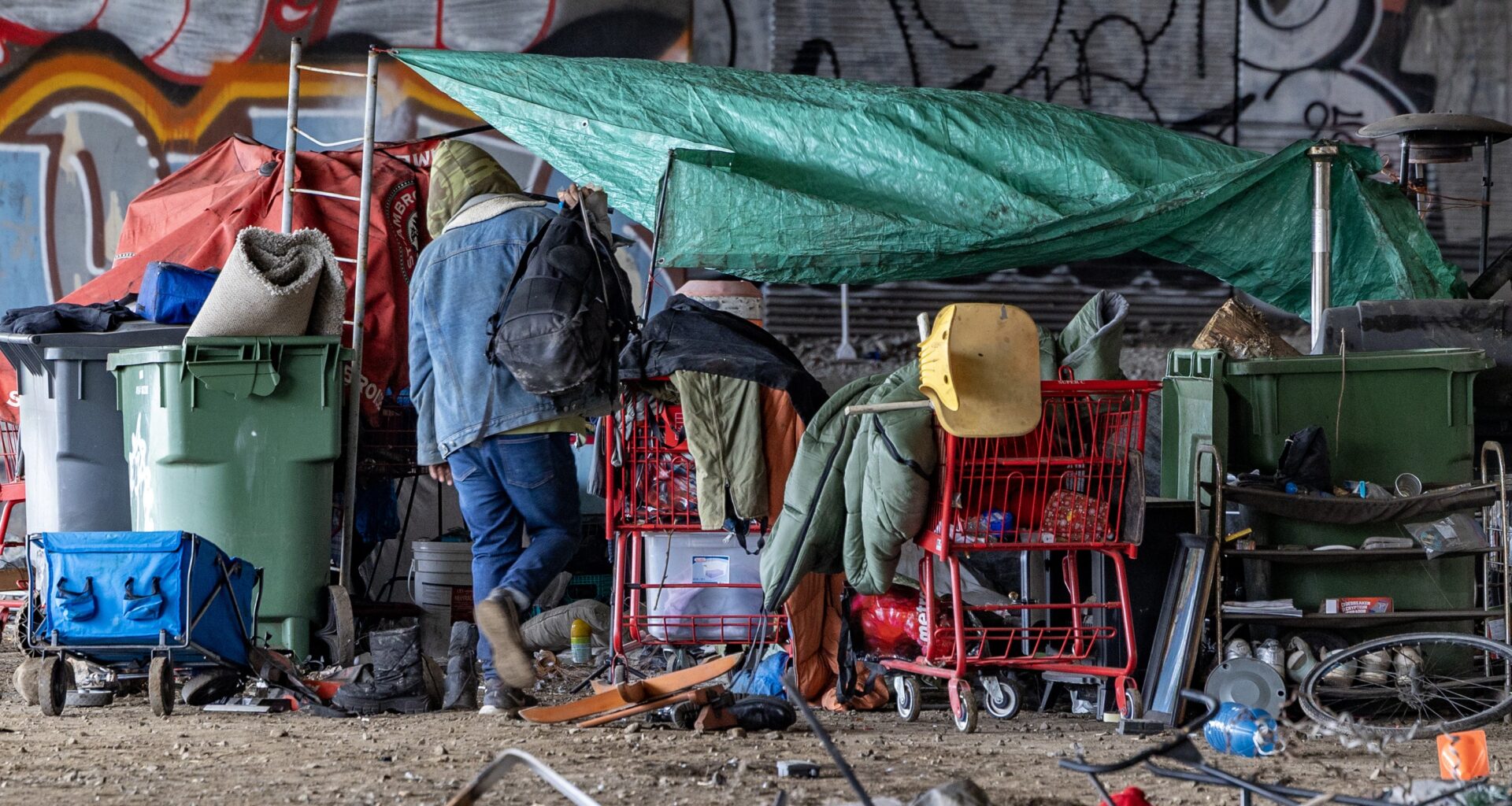
This is the first instalment in Fixing Montreal, a new series where Montreal Gazette journalists look for solutions to some of the major challenges facing our city.
In late March of this year, Julien Montreuil made his way to a park in Montreal’s east end where the mayor was set to announce new funding for L’Anonyme, the homeless organization he runs.
The money was intended to hire four employees who would provide support and help cleanup efforts at the city’s largest homeless encampment. But moments before the announcement, word spread of the death of two unhoused people.
The news led Montreal Mayor Soraya Martinez Ferrada to deliver a tearful plea for all levels of government to act on the homelessness crisis.
Montreuil added his own warning.
“Crises are multiplying — the overdose crisis, the housing crisis, the homelessness crisis,” he said. “Our society, right now, is a machine for creating homelessness.”
The deaths were a reminder of the toll homelessness takes in Montreal, where the need for housing is outpacing the response and, in some neighbourhoods, testing the city’s social fabric.
While Montreal has vowed to tackle the issue, it can’t solve it on its own. Solutions will require the Quebec government to act and rein in an emergency spreading far beyond its largest cities.
Now, as a new provincial government takes office, advocates, researchers and even a former premier are urging the Quebec government to prioritize — and fundamentally rethink — how it addresses homelessness.
‘These are our people, from right here’
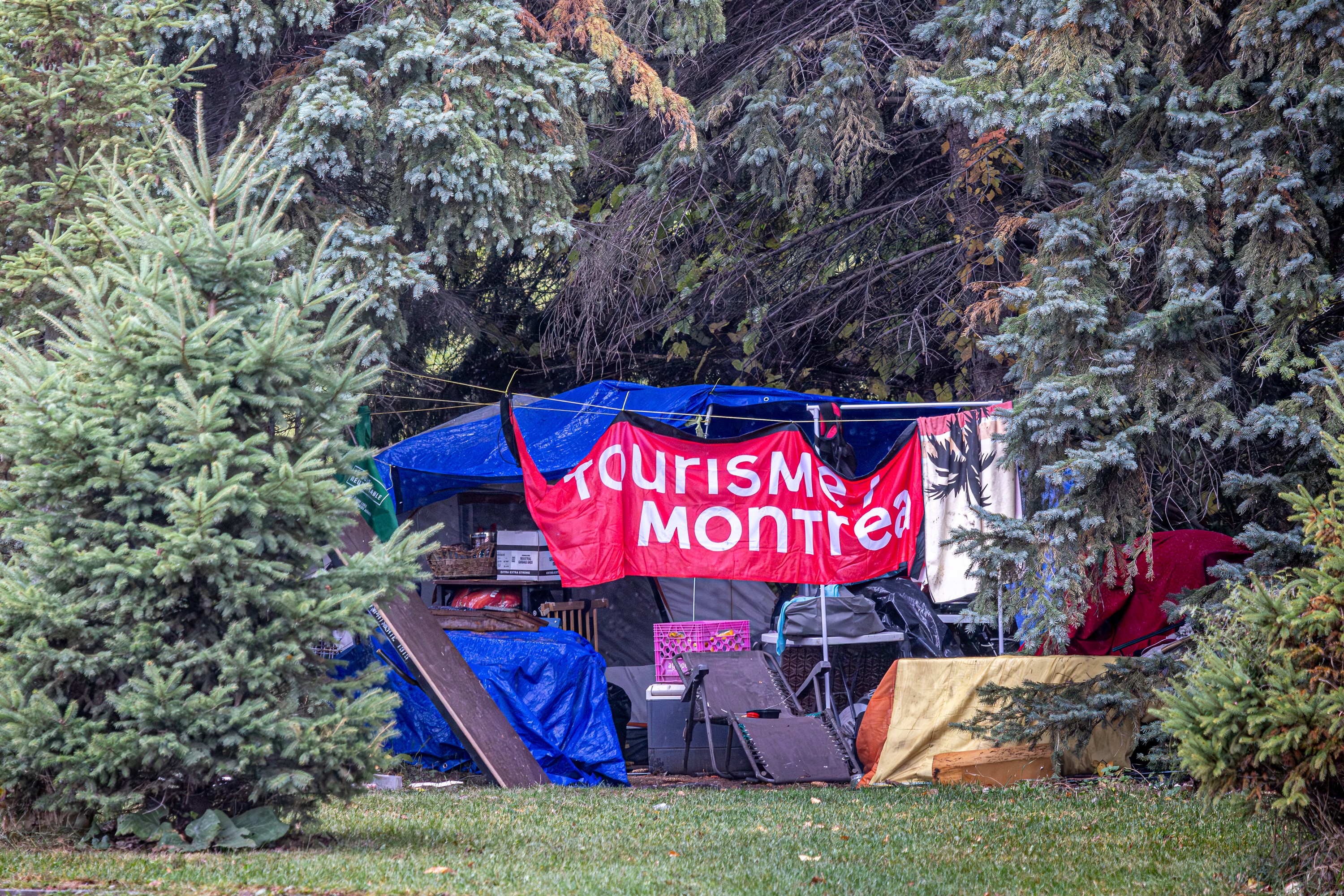 While Quebec regions and towns of all sizes are dealing with homelessness, Montreal continues to bear the brunt of the crisis. Dave Sidaway / Montreal Gazette
When homelessness first started ticking upward in Ville-Marie, a small city about 650 kilometres northwest of Montreal in Abitibi-Témiscamingue, a local organization that helps men in need added two beds to respond to the demand.
A decade later, Groupe Image now has a dozen beds available, yet still can’t keep up. Employees add cots when possible — or even allow people to sleep on the floor — but regularly turn people away.
The region’s dramatic rise in homelessness is shown in the organization’s numbers: Overnight stays, which totalled 165 four years ago, climbed to more than 1,500 last year.
“People assume it must be an influx spilling over from big cities, or people coming to the regions,” said general director Tommy Cousineau. “But it’s not; these are our people, from right here.”
The overflowing shelter is a reflection of how the crisis is playing out across Quebec. Per the latest count, conducted in 2025, homelessness rose by 20 per cent in the province since 2022, affecting more than 12,000 people.
While regions and small towns now also contend with the issue, Montreal continues to bear the brunt of the crisis. The same 2025 count found more than 5,000 people experiencing homelessness in the city, a number most believe is underestimated.
Montreal has struggled to keep pace. Despite the addition of emergency shelters and warming centres in the winter, the city’s shelter network, which has about 2,400 places, is regularly at capacity.
The result is vulnerable people pushed even further to the margins or forced to live in public spaces, leaving neighbours to confront poverty, open drug use and mental health crises daily.
Tensions have peaked in neighbourhoods with a concentration of front-line services, resulting in petitions, protests and even lawsuits from residents who say their quality of life has suffered.
Meanwhile, those who work in the sector point to an important paradox. Cohabitation issues occur because there aren’t enough shelters, but residents’ opposition makes it harder to open the very resources that could get people off the streets.
In February, Montreal adopted a protocol that ends the dismantling of encampments and, where appropriate, calls for basic services to be added. The policy aims to prevent the harm caused by displacing people, but the city has acknowledged it isn’t a sustainable solution.
The most visible example of the increase in homelessness is found along Notre-Dame St. in the city’s east end. A fixture of the crisis since the COVID-19 pandemic, the encampment there swelled to more than 150 people living in about 200 tents this summer.
Despite the growing concerns, homelessness didn’t factor prominently into the early stages of this fall’s provincial election campaign, overshadowed by the trade war and referendum question.
But the issue was thrust into the spotlight in mid-September, when police found a mother and her one-year-old child living in the encampment.
Martinez Ferrada, who has made homelessness her top priority since being elected mayor last year, called the discovery an important wake-up call.
She also pressed the province to act.
“If Quebec can’t resolve this national issue, Montreal will take action,” she said.
‘The current approach is not working’
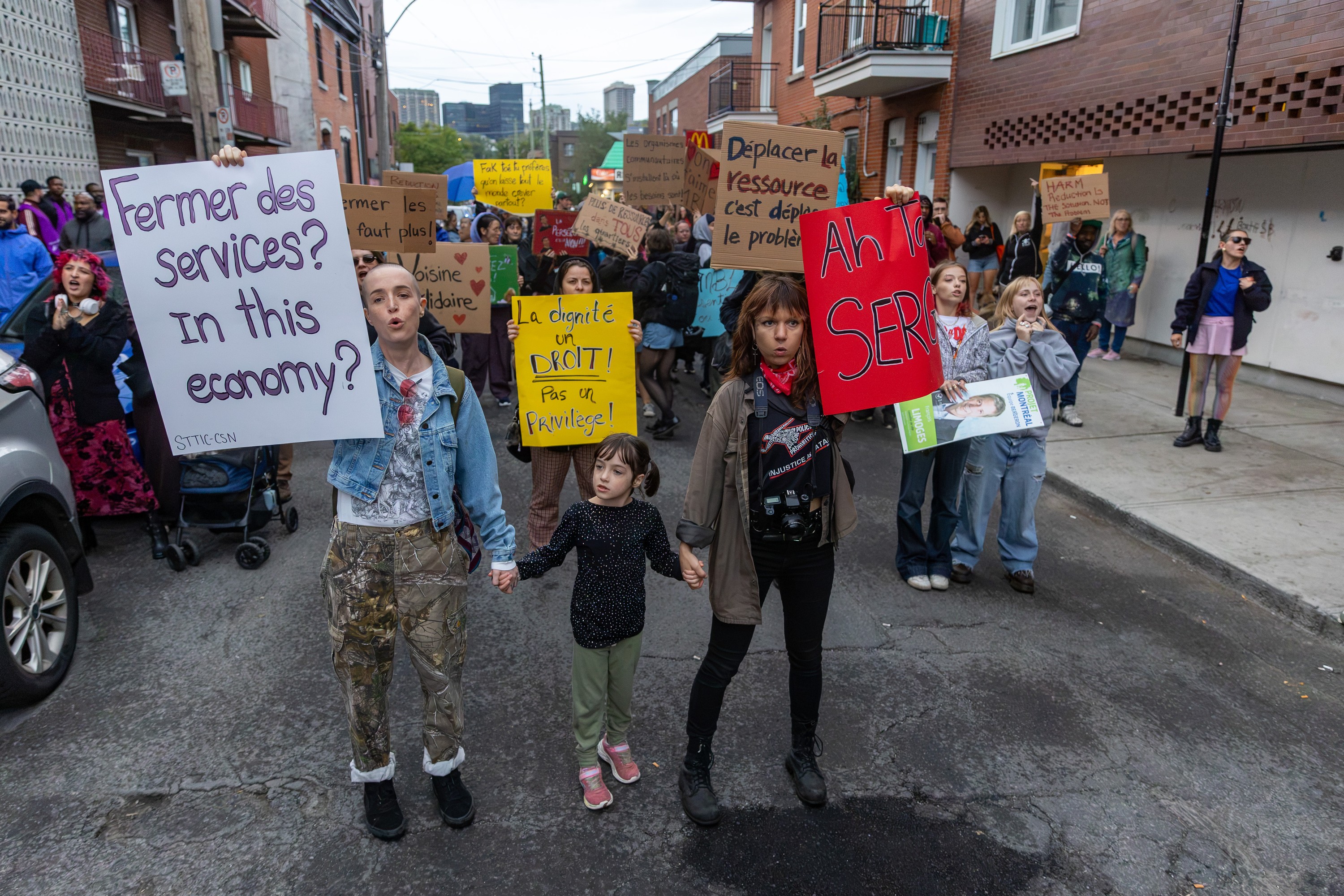 Counter-protesters attempt to disrupt a protest against the Benoît Labre safe injection site in St-Henri. Evan Buhler / Montreal Gazette
Pearl Eliadis has a blunt assessment of Quebec’s approach to the homelessness crisis and the results it has yielded: It’s failing.
“I don’t think disastrous is overstating it,” said Eliadis, a prominent human rights lawyer and associate professor at McGill University’s Max Bell School of Public Policy.
Eliadis recently co-authored a report by the Quebec Homelessness Prevention Collaborative, a collective that brings together resources, housing advocates and researchers from several universities.
The 72-page report urges Quebec to focus on prevention instead of reactive measures.
It’s built on four main themes: enshrining the right to housing in Quebec’s Charter of Human Rights and Freedoms; improving access to social housing; preventing evictions; and taking care of people leaving public institutions — such as hospitals and prisons — once they exit.
The report also notes that more than one-third of people aging out of Quebec’s youth protection system experience homelessness within a few years. Given this, it urges authorities to respect recent legislative changes that already call on the province to better support youths during the transition.
 “I don’t think disastrous is overstating it,” Pearl Eliadis, chair of the Quebec Homelessness Prevention Collaborative at McGill, says of the homelessness crisis. John Mahoney / Montreal Gazette
Taken together, the recommendations amount to a major shift in the province’s approach. Eliadis feels it’s long overdue.
“The current approach is not working,” she said. “The key things are to prevent homelessness before it happens, and to put in place legal requirements so there are transparent obligations on the government.”
The report also puts forward such recommendations as banning short-term rentals like Airbnbs and implementing a public, provincial lease registry to further prevent illegal rent hikes.
Its core idea, however, is to make housing a right.
It points to Finland as a leading example. Over the course of nearly four decades, the Nordic country has managed to reduce homelessness by 80 per cent, in part by enshrining the right to housing in its constitution.
As part of the project, Eliadis and researchers spoke with municipalities across Quebec to understand how they’re experiencing the crisis. In many cases, municipal leaders were understandably looking for a quick fix.
But Eliadis cautioned against thinking a silver bullet exists.
“We need a structural change in the way we come at this problem, and that’s going to take a long time,” she said. “It’s a big ship, and it needs to be turned around.”
A potential turning point
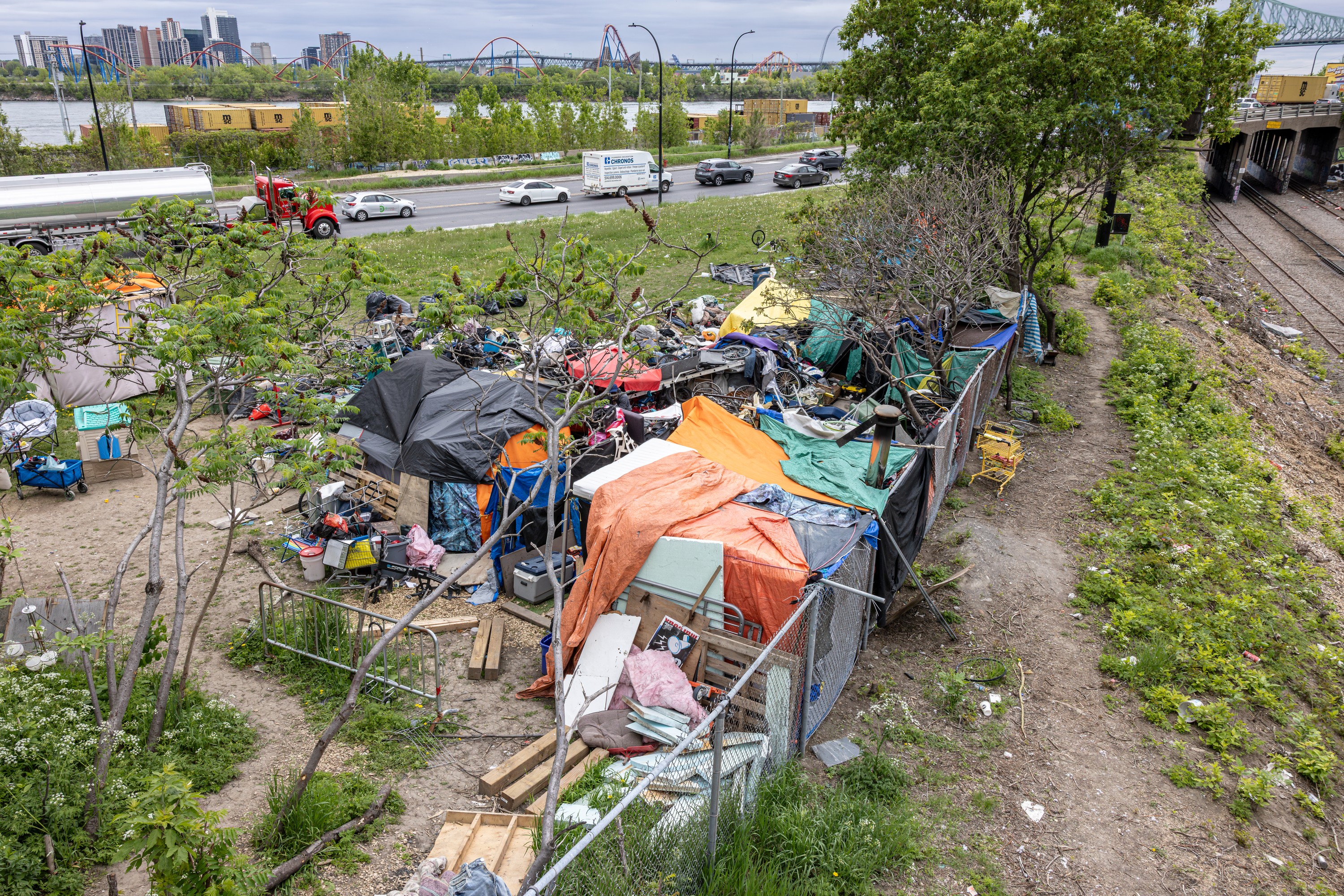 There were more than 150 people living in about 200 tents in Montreal’s Notre-Dame St. encampment this summer. Dave Sidaway / Montreal Gazette
Whether Quebec makes homelessness a priority may come down to political will. But one former premier wanted to make sure it wouldn’t depend on who formed government this fall.
Pauline Marois has largely stayed out of public life since leaving office in 2014, but she emerged this summer with a new mission: convincing every provincial party to act on the crisis.
“Can a wealthy society like ours accept that people are sleeping on the streets?” Marois told The Gazette. “It makes no sense — absolutely no sense.”
Marois says homelessness is the one issue people kept raising with her after leaving politics. After debating what she could do, in late May, she penned an open letter calling for a provincial summit on the issue.
Ultimately, she convinced each party leader at the National Assembly to support the idea, including now premier-designate Paul St-Pierre Plamondon.
St-Pierre Plamondon, who led the Parti Québécois to a minority win, has pledged to make homelessness his personal responsibility at the National Assembly.
He plans to commit $1 billion over four years to reduce homelessness by half and has promised to hold the summit this year, bringing together other political parties and key stakeholders.
Marois hopes it can serve as a turning point.
“For me, it was fundamental that it be non-partisan,” Marois said. “And that it culminates in a plan for concrete action with objectives, performance requirements, budgets and accountability.”
While Marois’s push to champion the cause has been welcomed, it hasn’t been without criticism. People working in the sector have countered that Quebec doesn’t need more consultations or ideas but rather political resolve.
Community groups have long argued the solution lies in stable, predictable funding for front-line organizations, along with concrete action on public housing and poverty reduction.
Marois understands the criticism but insists her proposal goes beyond another consultation.
She also believes the process itself can lead to progress.
“People will be forced to talk to one another,” she said. “They’ll be forced to look each other in the eyes and really consider what we can do better and differently.”
‘It’s just so detrimental to your soul’
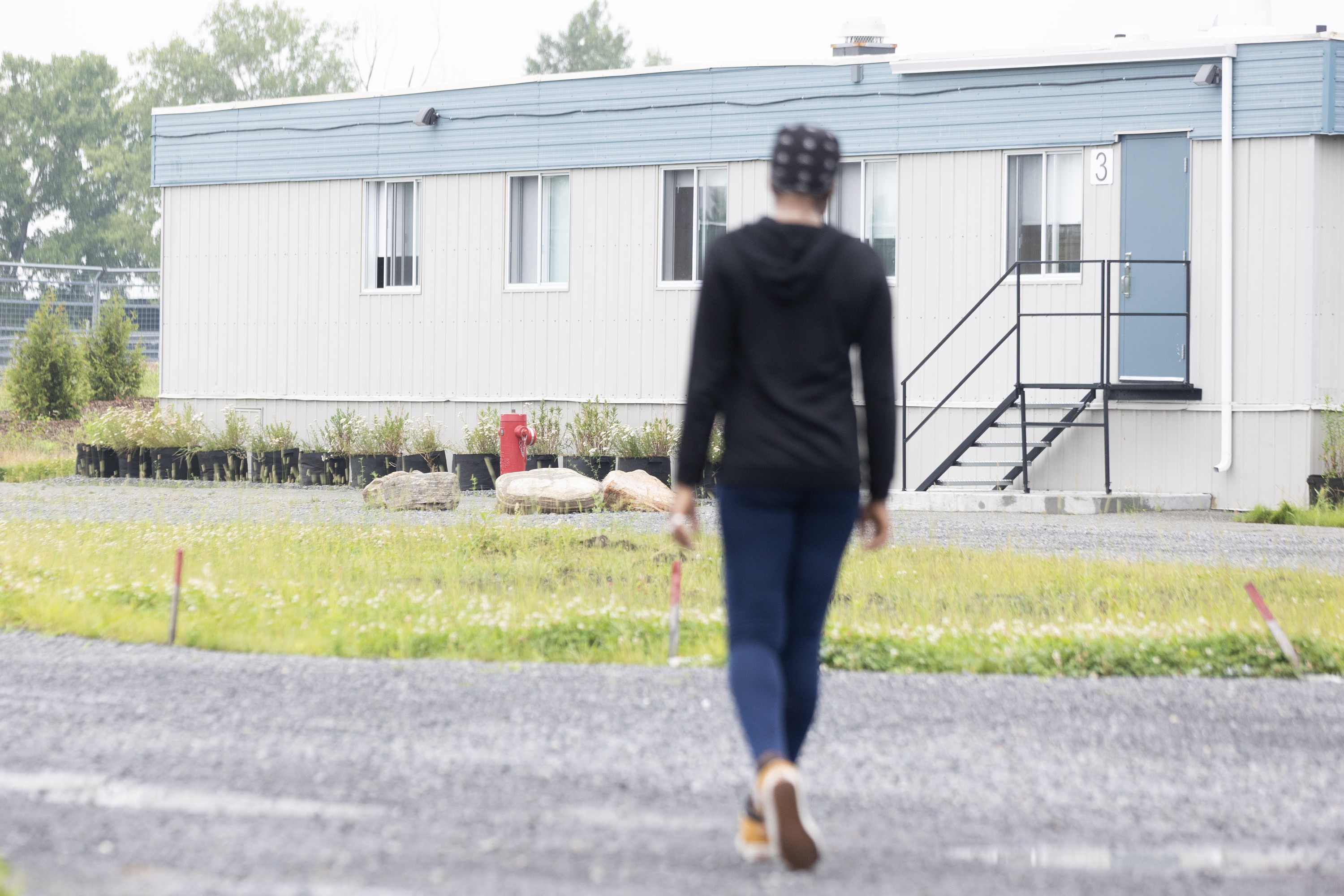 Sophie, who had been staying in shelters for months, now lives in one of the modular units the city installed on the former Hippodrome grounds to serve as temporary residences. Tim Snow / Montreal Gazette
For people living through the crisis today, provincial summits and political promises feel distant from the daily realities they face.
After a fallout with her ex-partner two years ago, Sophie, 42, lost her apartment and couldn’t afford another. She spent the following months jumping from shelter to shelter, unsure where she would sleep next.
A year ago in September, she was among the first to move into new modular housing provided by the City of Montreal. The units offer people a place to live while looking for housing, with support available on site.
Sitting outside the trailer-like units in Côte-des-Neiges on a recent afternoon, Sophie questioned whether people understand how easy it is to fall into homelessness — and how difficult it is to climb back out.
“It traumatizes you at a certain point,” she said. “Because you think that if you work on yourself, you’ll find a job and an apartment and get your life back on track … but with inflation and the rising cost of housing, it’s just so detrimental to your soul.”
The modular housing project is one of Montreal’s more innovative responses to the crisis, but it too has shown its limits. After opening two 30-unit sites in different boroughs, the city axed a planned third over cost concerns.
Asked what Quebec and Montreal could do better, Sophie first pointed to rent control. When she lost her apartment, she was paying $800 a month. Only months later, she saw it relisted for $1,400.
But there was one other issue she wanted to stress.
If she’s back on her feet today, ready to look for her next apartment, it’s largely because of the front-line workers she met along the way. If there’s a solution, she believes it starts with them.
“None of them are paid enough, but they take this job because they truly care,” she said. “That has always affected me, and inspired me to keep pushing to better my situation.”
Editor’s Picks