

“Necklaces” of ultracold atoms have provided new evidence to support a nearly 100-year-old quantum theory.
In 1931, physicists were trying to use quantum mechanics to explain why some materials are magnetic. Then, a young physicist named Hans Bethe looked at a single row of electrons. Each electron’s spin can point up or down. Bethe worked out the math for how such a row behaves and found that if a few spins in the row flip, they can stick together and travel down the row as a single unit.
Latest Videos FromLive Science
You may like
A “necklace” of atoms
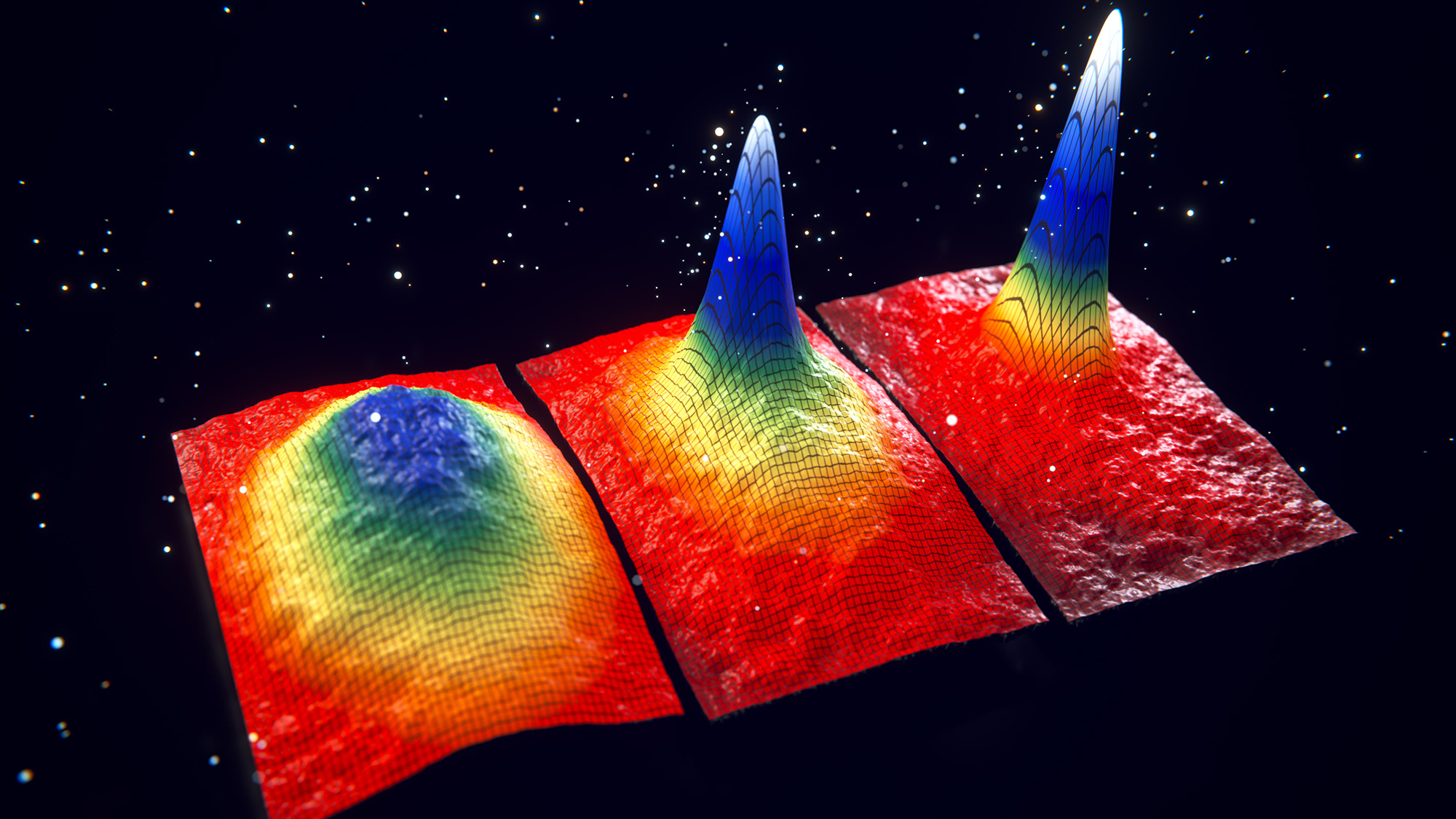
To make the “necklace” the researchers had to create a Bose-Einstein condensate, a special phase of matter.
(Image credit: blackdovfx via Getty Images)
What to read next
A short-lived state
Horvath, M., Bastianello, A., Dhar, S., Koch, R., Guo, Y., Caux, J.-S., Landini, M., & Nägerl, H.-C. (2026). Probing Bethe strings in an attractive one-dimensional Bose gas. Nature Communications, 17, 10330. https://doi.org/10.1038/s41467-026-76018-0