
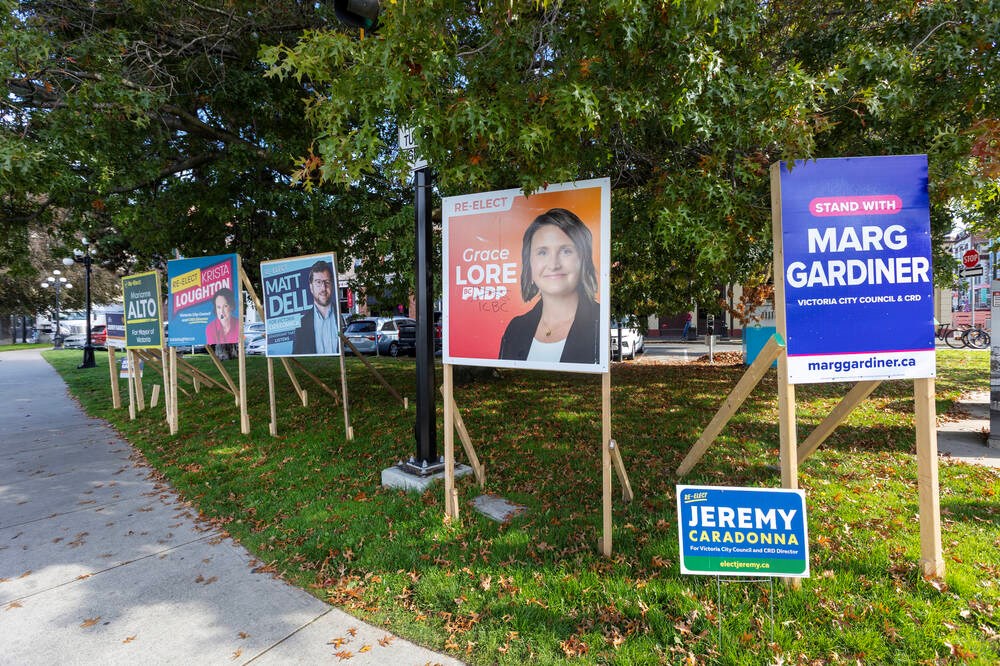
Several Greater Victoria municipalities saw a big increase in advance voting, while candidates report an uptick in online personal attacks.
Despite concerns that a competing provincial election campaign would draw away voter attention, interest in the municipal race appears to be high.
On the eve of municipal election day Saturday, several municipalities in Greater Victoria reported a significant surge in advance voting and big increases in mail-in ballots.
The early high turnout has been a surprise, said political scientist and Royal Roads professor David Black.
“There’s a lot of advance voting going on, and generally we’re seeing an uptick in interest across the province to some degree,” he said.
Saanich saw a big jump in advance voting, with 10,031 ballots cast this time compared with 6,528 in 2022, while in Sidney, 1,384 votes were cast in advance polls, up from 840 four years ago.
The City of Victoria said 4,013 votes were cast in the first two days of advance polling, compared with 3,946 over three advance polling days in 2022.
Oak Bay’s advance polls counted 2,878 votes cast, up from 1,199 in 2022.
Theories for the surge range from a desire for change to heightened awareness of politics due to the two elections currently underway and the separation referendum looming in Alberta.
“We often think a better turnout at advance polls is going to mean a better turnout in general, but that’s not always the case,” said Black. “Advance polls have changed the culture of voting, and that’s great. It’s made it more convenient and allowed people to fit it into their busy schedules.
“But it doesn’t necessarily drive more turnout. It just makes it easier to turn out.”
Victoria Mayor Marianne Alto, who has run in several elections and managed the campaigns of other politicians, said high advance turnout can mean people are “really anxious to cast their vote,” or excited about the opportunity if they’re new voters.
“It could also be an indication that people want something different — that’s possible as well. Or they don’t, and they just want to make sure they have a chance to be supportive of whatever the current situation is.
“It’s all of those things. It’s a fun conversation to have, but I think it’s fairly inconclusive in advance.”
Saanich mayoral candidate Rishi Sharma said it’s been great to see the number of people engaged and voting early, suggesting it could be because of the dual elections. “I thought it was going to cause mass confusion, but maybe it’s getting people engaged.”
Black agreed, saying “there’s so much politics in the air that people just feel that civic urgency, the burden of their civic duty a little more than usual.”
Other factors driving voters to the polls could be specific to the municipality, he said. In View Royal and Langford, for example, former mayors have come back to try to reclaim their seats after defeats in 2022, which may have increased interest.
“When you’ve got a real race and you’ve got real choices, that’s going to drive turnout.”
According to several candidates who spoke to the Times Colonist, that heightened interest has been accompanied by a darker tone.
From the social media rants that all politicians have come to expect to more personal — and in some cases threatening — text and email messages, some candidates say it’s been a marked change from previous campaigns.
Alto said there has been a lot more invective in the comments she sees online.
“This campaign has had a particular tone of ugliness which I haven’t observed before,” she said. “When you move away from the one-on-one, in person, there’s a lot more personal attack, a lot more animosity.”
“You can disagree, but you have to be respectful. If we can’t demonstrate civility, then what can we expect from others?”
For his part, Bruce McGuigan, who is challenging Alto for the mayor’s seat, says he’s been surprised by how unhappy people in the community are.
“It’s actually kind of overwhelming that there are so many people, at all levels of life, people who are running businesses, large businesses, very large businesses, all the way down to somebody who’s just bought their retirement condo after working all their lives. They’re very anxious, very concerned, and sometimes very angry,” he said.
Saanich mayoral candidate Zac de Vries said negative politics and jabs only raise people’s fears and anxieties and drive division.
“I think campaigns should be about ideas and about solutions and about how can we best work together to try to improve people’s quality of life,” he said. “I would’ve liked to have seen more ideas. I would’ve liked to see more positive discourse.”
As for Sharma, he admits there have been some challenges with online hate and messages sent to his phone, but said overall, it has been mainly positive.
Black said if he had to single out one issue for the 2026 campaign, it would be governance, as many candidates and countless residents have expressed their dissatisfaction with how their councils have conducted business.
Concerns have been raised in many districts about what they see as less public consultation when it comes to big decisions, while some don’t like to see councils wading into areas like health care and social services, which are the responsibility of the province.
Black said that has given rise to local political slates — and in Saanich, to a “break the slate” movement.
“Slates represent a kind of interruption in the Force, to quote Star Wars, with respect to how civic elections function, raising the question of the independence of mayors and councillors,” he said.