
Tourism operators and marine experts are raising concerns that increased Hudson Bay shipping and a proposed offshore LNG platform could disrupt belugas and the region’s ecotourism brand
No one locks their car doors; the bears may be thereabouts.
Not many very small, remote communities have embraced tourism.
It may change here (?). That’s the question this week.
Last week I profiled one of the premier ecotourism destinations in the world. You may wish to review part one of this travelogue.
There was so much to talk about Churchill, Manitoba — it was warranted. In part one, I started describing the setting and highlighted the Prince of Wales Fort, Indigenous culture, birds, belugas, birds and the northern lights.
In fact, I think Churchill should adopt this marketing formula of – Birds, Belugas, Bears and Northern Lights – ‘3 B’s and N.’
There’s more, though. Learning vacations, tundra buggies, unusual points of interest, snowflake earrings, and then what might happen to all of this.
Churchill Northern Studies Centre
There’s another way to visit Churchill with a link to nature through a learning vacation.
The rocket range became the Churchill Northern Studies Centre. Founded in 1976, the Churchill Northern Studies Centre is an independent, non-profit field station focused on research and education in the subarctic and is located 23 km east of the town (another reason for the car rental).
I met Dylan McCart, the centre’s executive director. (He turned out to be the partner of one of my former students, Shea Henderson, at Nipissing University. Shea now delivers land-based educational programs in remote northern Manitoba communities. Small world.)
“I have loved Churchill since my first visit here. The atmosphere is vibrant, and it’s such an inspiring place. I feel privileged to join the community.”
Dylan began at Churchill Northern Studies Centre in 2022 after spending over a decade studying polar bears, including the Polar Bear Habitat in Cochrane.
He said, “Our unrivalled learning vacations feature scientific and cultural activities led by a friendly expert.
It is an opportunity to gain a deep understanding and appreciation of Churchill’s rich natural and cultural heritage and breathtaking natural surroundings.
And because your itinerary, accommodations, and food are taken care of, the only thing you have to worry about is when you’re going to visit!
You will be part of the Rocket Greens program, a hydroponic food production project operated by the Churchill Northern Studies Centre.
“Using the Growcer’s hydroponic growing technology, we distribute fresh, locally-grown leafy greens to our community every week of the year — yes, even in subarctic winters.”
Other
When you’re exploring, you eventually come upon more stories on the tundra.
One is a plane crash site in the heart of polar bear territory, which has become a beloved local landmark.
The wreckage of the cargo plane is just off the road along the bay, between the Churchill municipal airport and town.
Miss Piggy is a Curtiss C-46 Commando plane operated by Lamb Air as a cargo plane after the aircraft retired from service in World War II. It was nicknamed “Miss Piggy” because of the tremendous capacity of its cargo load as it hauled goods and supplies to and from remote areas of Northern Manitoba. It was also rumored to have once transported a cargo of pigs. It crashed moments after leaving Churchill Airport on Nov. 13, 1979; the crew survived.
In June 2017, Miss Piggy’s exterior became the canvas for a mural as part of the ‘SeaWalls’ Churchill project.
This art initiative featured outdoor murals placed throughout Churchill by 16 international artists. It was an effort to beautify the struggling Arctic port town, lift the spirits of the locals, and bring attention to the unique environmental issues. Miss Piggy’s mural is appropriately entitled “Mayday – EMERGENCY TRANSMISSION: 58°45’37” N 94°5’11” W.” It is worthy of a stop. The other murals you literally run into as you walk about the town.
Two, the beached abandoned ship from a distance looks rusty because it is.
It is bad luck to change the name of a ship; any sailor will say so.
SS Ithaka is another local landmark, a wrecked steam freighter seen on the coast road about 15 kilometres (9.3 mi) from town.
Originally built as the lake freighter Frank A. Augsbury for the Canadian George Hall Coal & Shipping Corporation in 1922, she went on to sail for a variety of different owners in different locations, being renamed to Granby in 1927, Parita II in 1948, Valbruna in 1951, Lawrencecliffe Hall in 1952, Federal Explorer in 1955 and finally Ithaka in 1960, before being wrecked later that year.
What happened. She had delivered her first shipment of 3,000 short tons (2,700 tonnes) of ore to Churchill, and had loaded a small amount of mining equipment and building supplies for a return trip to Rankin Inlet. A fall storm with 80-mile-per-hour (130-kilometre-per-hour) winds came along.
The captain turned back to the safety of the port, but the weather was so bad that he decided to drop anchor. The anchor chain broke, and her rudder was beaten off. Completely out of control, the vessel was driven into Bird Cove, running onto a shallow gravel bank 750 metres (820 yd) offshore where it has sat ever since. At low tide you can walk right out to the vessel.
Three, from a distance, what look like two enormous golf balls.
It is really an abandoned building overlooking Hudson Bay; it was a radar station in the 1960s, used to track launches from the nearby rocket range. Its exterior was painted in 2017 again as part of the SeaWalls Churchill project.
Which leads me to say again about all the murals in and out of town. The murals span 30 kilometres along the shore of Hudson Bay. Reaching as far as the drivable road, each piece was inspired by the artist’s own interaction with the community.
It is the only art festival in the world that requires armed “bear guards” for the participating artists. My favourite is the ’Power of Nature.’ It is located on the corner of Bernier Street and La Vérendrye Avenue, across the street from the Churchill Town Centre Complex.
The Town Centre Complex is worth a visit in itself. It is a hub model for northern communities.
It houses the Churchill Health Centre, Pre-Kindergarten to Grade 12 school, library, swimming pool, indoor playground, curling rink, theatre, hockey arena, gymnasium, fitness centre, and several multi-use spaces. Interior walkways are lit by overhead skylights, lined with brightly colored Inuit wall hangings and prints.
And a big carved-wood polar bear invites children to slide through his benign mouth. Inviting. See the photos.
More the reason for the car rental.
Earrings
Right beside the Churchill latitude sign is one town’s boutique stores, Fifty-Eight North.
Never seen before, but here they are – authentic snowflake earrings, one-of-a-kind Arctic snow crystals, handmade in Churchill by artisan Brie.
Brie is also a massage therapist and, like most others, came to Churchill for a different experience, fell in love with the place, and stayed.
Each of these earrings features a naturally formed snowflake, collected during an active snowfall,
She says, “Where Arctic conditions create some of the most intricate snow crystals on Earth.”
The snowflakes are captured in freezing temperatures and stabilized using a specialized preservation process (reactive polymerization) that protects their structure long after they would have melted. “No molds, no replicas, no engraving — every detail you see was created by nature itself.”
The sale was consummated when it became apparent, “No two snowflakes are ever alike; this pair is truly one of a kind.”
All jewelry comes with a collection date card, and they were expensive, worth finding out about, and a gift for daughter Ali.
Tundra buggy
Apart from the bears, the “tundra buggy” or polar rover is the single image most travellers associate with Churchill.
By the grain terminal, you will see a large yard fleet of tundra buggies and at the various outfitters’ tundra locations outside of town. The original “tundra buggy” is a copyrighted term of Frontiers North Adventures.
Buggies are the reason this kind of polar bear safari is possible at all.
Their design was the brainchild of Len Smith. The first Tundra Buggy was built to explore abandoned military trails east of the town of Churchill, formerly used by the Churchill Rocket Research Range in the 1950s and 1960s, and to travel to Cape Churchill in an area that would later become Wapusk National Park.
Smith first converted an old school bus, combining it with parts of a gravel truck, a snowplow, a front-end loader, and the tires from a crop sprayer to thrust the homemade wide-body cab far enough into the air, safely out of reach of curious bears.
They have high ground clearance — typically around 1.5 m between the tire and chassis, enough to clear willow hummocks, small boulders, and partially frozen ponds of the tundra environment.
They feature the enormous low-pressure tires — roughly 160 cm in diameter — run at very low pressure to spread vehicle weight across the fragile tundra.
No one seems to know or wants to see how much these unique machines cost to manufacture — there is an electric vehicle prototype that will further the ecotourism image of the wildlife tundra excursions.
Present Tense
Back in the day, we had to learn the tenses of verbs when we sat in the rows of desks. Verb tenses describe when an action or state takes place relative to the present moment. Churchill is the title and the subject for all the sentences.
Two recent summer headlines about a proposed mega project.
On Tuesday, August 25, Prime Minister Mark Carney announced that the federal government would soon unveil a series of massive infrastructure investments — including the development of new port facilities in Churchill – as part of a $500 billion national strategy.
At the same time, Manitoba’s Premier Rob Kinew is promoting a Port of Churchill expansion that would include a floating, offshore liquefied natural gas platform. This version of the project would cost $70 billion to $80 billion.
It may be a small town of just 900 residents, but its impact on the provincial economy is enormous, with tourism contributing an estimated $99.8 million directly and indirectly to Manitoba’s GDP in 2023.
The polar bears, beluga whales, and the sought-after northern lights have become global attractions, drawing more than 25,000 per year, part of a booming tourism industry that supports 1,395 direct and indirect jobs.
There are Canadian tourists, but international visitors from the US, UK, and Australia play a vital role, positioning Manitoba as a world-class travel destination.
“Churchill is becoming more and more of a year-round destination. It’s long been known as the Polar Bear Capital of the World, but the summer season of beluga whale watching has really taken off, and now the third season of northern lights viewing is attracting worldwide attention,” said Colin Ferguson, President and CEO of Travel Manitoba.
He also said, “Those visitors stay longer and spend more than domestic visitors,” he said. “They’re looking for the bucket list experiences that are hard to get anywhere in the world other than Churchill.”
True. But Churchill has a capacity with the number of “bums in beds.” You cannot just get off the plane or train and find a place to stay.
Future Tense
But there are changes a brewin’ from the traditional storyline of the four main types of conflict – one – “Man versus Nature.”
So, you have local tourism operators noting the difficulty of balancing expanded industrial shipping with Churchill’s world-renowned ecotourism theme. Marine experts are raising concerns over ship noise and increased industrial traffic impacting local wildlife, particularly belugas.
And there’s a series of studies commissioned by the Port of Churchill owner Arctic Gateway Group saying year-round shipping through Hudson Bay might be feasible without the use of the most expensive icebreakers amid shrinking sea ice.
That’s a future setting.
If you’re hoping for a real shot at watching polar bears migrate along the Hudson Bay shoreline in autumn, Churchill is the spot. It makes the proverbial “bucket list.”
Just think about that reputation. Again, as I looked around…900 residents, and they were not transitory.
In fact, in all interviews, it’s the same. “I came for a while to make some money in a different place; I ended up staying.” It has a stable population.
Canada does not have too many destinations as such: Tofino and Ucluelet, Bella Coola; some are areas like Haida Gwaii and the Bay of Fundy. In the world, places include the Galapagos Islands (Ecuador), Costa Rica, the Okavango Delta (Botswana), Bhutan, Borneo (Malaysia), the Amazon Rainforest (Brazil), Palau, the Serengeti (Tanzania), New Zealand, and Iceland. Those are countries with specific sites; I have been to the Galapagos, Iceland, Costa Rica, and Botswana and experienced ecotourism – how it is presented and provided.
I have also created and taught an ecotourism course at Canadore College, so I was thinking in terms of a case study.
I dissected what is now and towards the maybe.
Why?
Why did I want to visit Churchill?
It became on the radar because of Dr. Larry Dyke. Retired from the Geological Survey of Canada and Queen’s University, his career focus was on permafrost research.
I met Larry at the Canadian Ecology Centre (CEC) when he lived on Talon Lake near Bonfield and the CEC. He contacted me to ask if he could volunteer. He did, and we became friends. He would later relocate to North Vancouver.
But he was persistent: “Bill, you have to go to Churchill.” For all these reasons, in two stories and more.
He had again gone to Churchill earlier this year to train Churchill Northern Studies Centre and Parks Canada on how to use the Winkie drill to install sensors into the permafrost.
Because of a changing climate, “the permafrost is also changing.”
He said, “Permafrost plays an important role in the ecological integrity of Parks Canada’s northern jurisdictions by influencing biological, hydrological and geomorphological processes.”
Larry’s advice was, “If you can’t get to the Canadian Arctic, Churchill is the alternative.”
Travel Tips
Some travel tips.
First off though, it is not only about the polar bears in Churchill.
There are so many things to see and do, a great deal of natural and cultural heritage, diversified experiences.
Take binoculars.
In town, stop by the Polar Bear International House. It is the place to learn everything about the bears. Made up of a small group of passionate conservationists, scientists, and volunteers, it exists to help secure a future for polar bears across the Arctic
You read about renting a car above. I am glad we did, as we covered all the back roads several times over to increase our chances of polar bear sightings; we were able to get out and take photos with no time restrictions. Best times to see wildlife are dawn and dusk. Contact the O’Connors.
Far fewer people in the community at the transitional periods from the peak-to-peak times. We were glad of this. We were told it is like a beehive or anthill at times.
But now, at the cusp of the season, there are fewer polar bears as well, as their migration to the coast is just starting. The tundra buggy tours were not operating yet; the peak is October/November, then July/August. Accommodation prices dip, just like everywhere else in the world. Most people come through a packaged tour, so pick-up and ferrying around is included. Tours are pricey.
If you have lots of cash, take the helicopter tours that actually fly over Wapusk National Park in October/November and February/March.
But the bears were there anyway.
If you want a northern tour of Manitoba, don’t take the two-day train ride through Manitoba (two nights on the train), and get on in Thompson or Gillam. Not much accommodation between Winnipeg and Thompson. You can fly and save time, not money.
Finally
Wapusk in Cree means white bear.
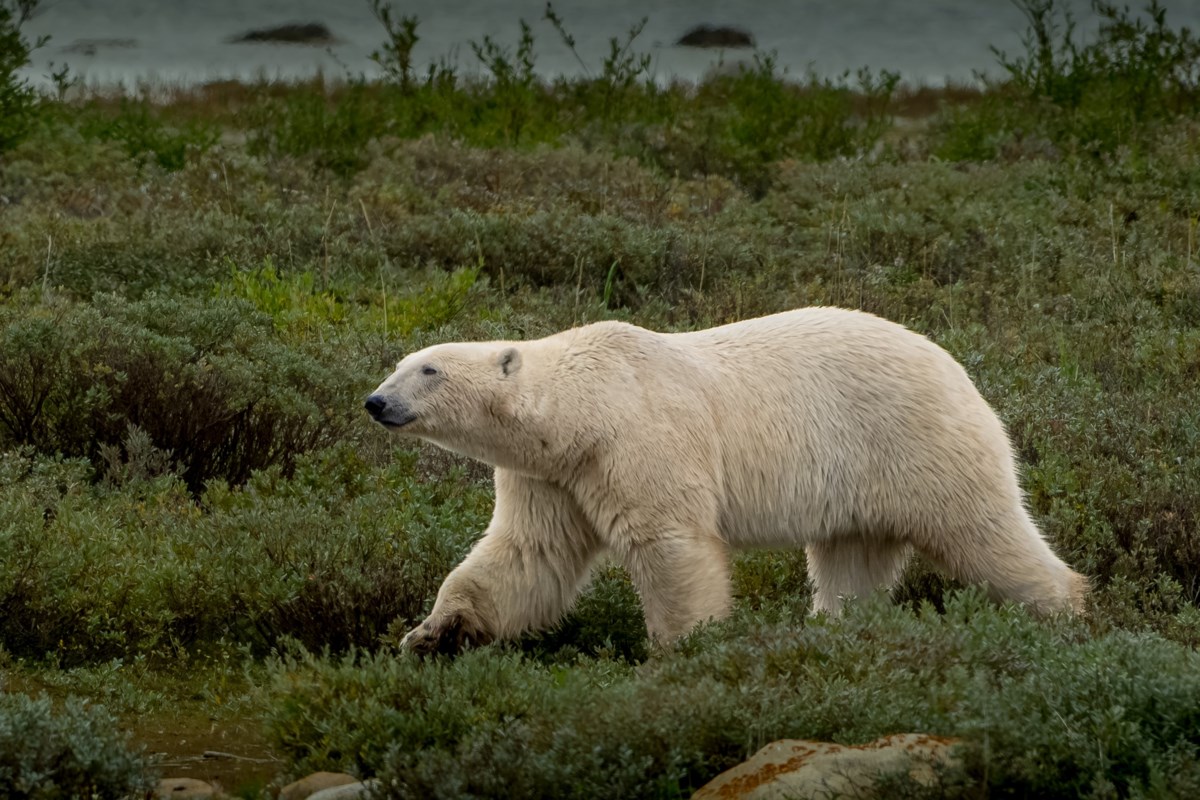
Yes, we got close and saw the polar bears. We had to drive around, but there they were east of town near the coastal road. They are truly massive and majestic beasts. You are awestruck.
There were so many other things to do in three days, two nights, that was dictated by the train; we returned to our car in Gillam, then to Thompson. You can stay longer.
A few years back it was thought Churchill might suffer from ‘last chance tourism.’ The term was coined, linking the demand to travel to the north with a desire to see these animals ‘before they are gone.’
This is because there has been an increase in temperatures and related reductions in sea ice, which has the real potential to negatively impact the health of polar bears in western Hudson Bay.
For more than 50 years, Churchill has provided visitors with this opportunity to see polar bears in their natural environment. At the same time, though, it has created a paradox as tourists require energy-intensive modes of transportation to reach the subarctic, thereby contributing to greenhouse gas emissions.
(For the record, on another adventure, there were more polar bear sightings north of Washaho First Nation (Fort Severn), Ontario. See the October 2022 story; more than 24. I wonder if the community will develop their own ecotourism opportunity. More difficult to get to, though.)
Because of Trump and tariffs, Canada is redefining itself economically, with some proposed mega projects; that’s what is happening. Even when this President departs, it will take years to return to our “invisible border” and our free trade-like neighbours. The damage is now being done.
For Churchill, if there is a mega project, there will be impacts, one way or the other.
This place right now might be like Goldilocks and the Three Bears: she went for a walk in the forest. The smaller bowl was just right, not too hot or cold.
I was thinking as I finished off this diversified piece. Of all the places I have been to around the world, Churchill is kind of naturally special, in our own backyard. Hmmm…something to ponder.
Plan a trip.
The present visit was worth it. The northern lights won’t change.