
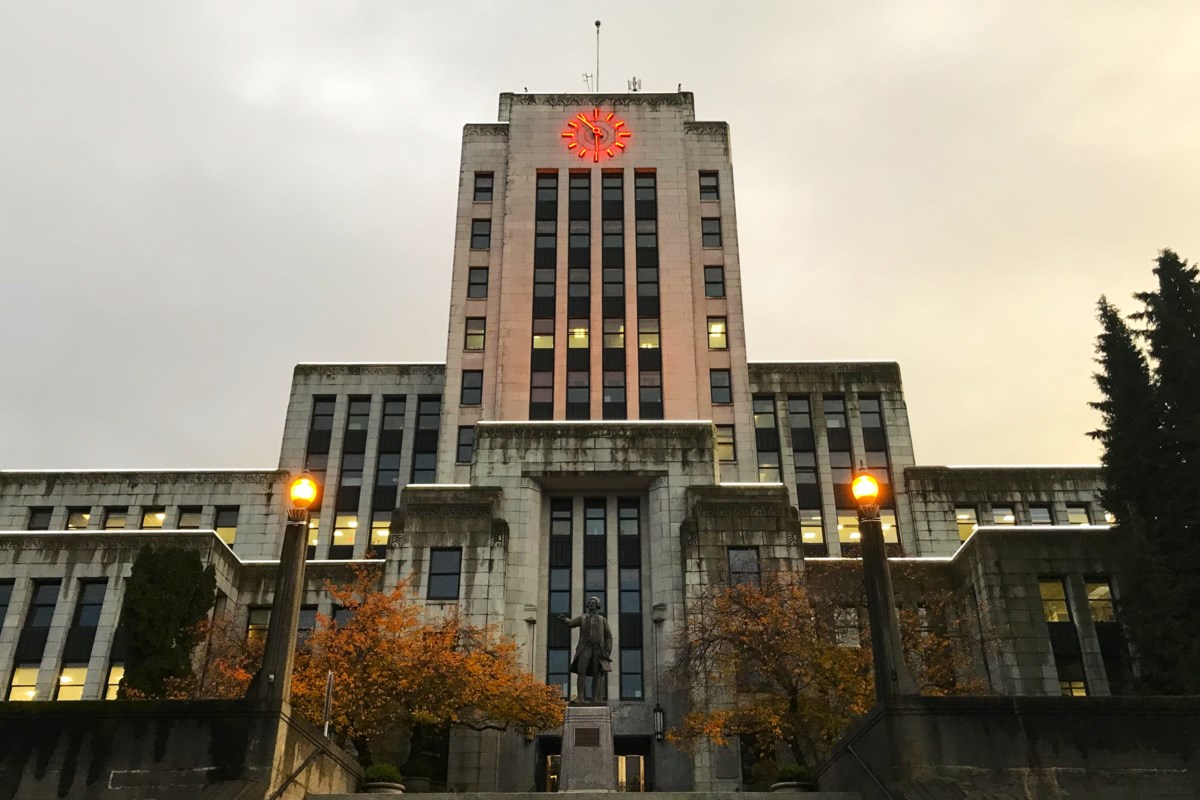
Vancouver once again has a new mayor.
This election cycle saw a fairly typical campaign play out, though it may have been overshadowed a bit by the provincial election, American midterms, or the Alberta referendum. There’s a whole lot of democracy going on these days.
Vancouver’s local politics isn’t always the most normal, though, with plenty of myths, legendary figures, and odd moments (if municipal politics is your thing).
The first mayoral election was very ad hoc
Vancouver had its first local election in 1886, the year it was founded.
At the time, it was a tiny town based around the Hastings mill and Gastown.
As such there wasn’t much infrastructure in place for the first vote. In fact, there wasn’t even a voters list.
“The list of those who voted at the first election was made up with a pen, while the election balloting was in process, from those who voted, and was being added to even up to within ten minutes of the close of the poll,” said former Alderman W.H. Gallagher in an interview with archivist J.S. Matthews.
He goes on to describe a situation where those voting (all men) walked up to city staff and were asked where they lived (with some living in hotels), before casting a ballot.
During the process, a paddle wheeler arrived in the area and started playing a celebratory song in honour of who they assumed was winning. He did not.
The woodpecker incident
The 1923 mayoral election might have turned out differently, if it weren’t for a meddling woodpecker.
At least, that’s the claim of former mayor LD Taylor.
The longtime on-and-off-again mayor was up for the job in 1923, facing off with Charles Tisdall (among others).
On the day of the vote, there was a fair amount of snow, slowing voters. And then the city’s power went off, and the city’s electric streetcar network was affected with stalls on some lines.
Taylor claimed that if the streetcars were working, his supporters would have made it to the polls, and he’d have won.
“If my supporters working in the West End could have got home to their ward in time to vote, I would have won,” he told the Vancouver Province.
He lost by 500 votes.
After the outage, it was discovered a single woodpecker had caused the chaos when it flew into a transformer, shorting out the system.
However, for years Taylor claimed it wasn’t nature, but sabotage, and the woodpecker was just the fall guy.
The first alderwoman
It took Vancouver 50 years to elect the first female alderman (there still hasn’t been a woman in the mayor’s seat).
Helena Gutteridge was a feminist and socialist activist who moved to Vancouver from London, England in 1911.
Known for fighting for women’s rights, especially working women, she was elected in a 1937 by-election.
“Helena R. Gutteridge First of Sex to Gain Honour,” reads a subhead in the Vancouver Province announcing her victory.
Movies on Sunday
Up until the 1960s, one couldn’t go see a film on a Sunday.
Citing the Sabbath, the city didn’t allow cinemas to open on Sundays until there was a push in the early 1960s.
The issue ended up going to a plebiscite, with the public voting in favour in December of 1962.
It took a few months for council to get that bylaw written up, but in April movie theatres were allowed to open seven days a week.
However, it didn’t start off big.
“It’s a big hum for Sunday movies,” reads an April 29 headline from the Vancouver Province.
A whole two theatres opened up, and only a couple of dozen folks showed up.
Quebec separatists threatened to kidnap the Vancouver mayor
The October Crisis is generally thought to be an Eastern Canadian thing, with the focal point being Quebec separatism.
However, the issue reached across the country in a very palpable way for the mayor of Vancouver.
Mayor Tom Campbell had two bodyguards assigned to him after supporters of the Front de Liberation du Quebec made threats.
Nothing came of the threat, but Campbell, who wasn’t one to dodge drama, played up the threat and told media that if he was kidnapped, he’d left instructions not to cut a deal.