

Listen to this article
Estimated 4 minutes
The audio version of this article is generated by AI-based technology. Mispronunciations can occur. We are working with our partners to continually review and improve the results.
If you’ve been searching for a home in Ontario, you may have come across a listing where the furniture doesn’t look quite right or where the size of the rooms is noticeably different in person than online.
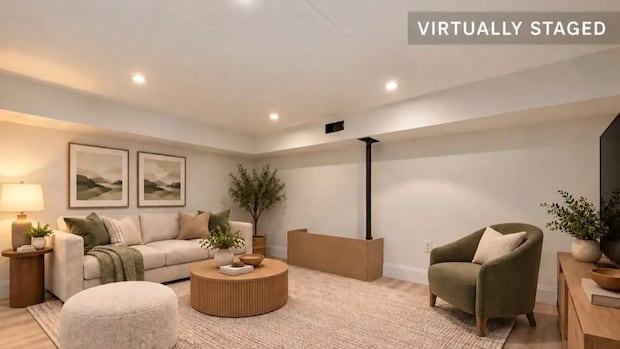
Artificial intelligence is making it increasingly easy for real estate agents and sellers to virtually stage properties — adding furniture, artwork and decor to listing photos without physically moving a single item.
The technology offers an affordable way to help prospective buyers envision how they might use an empty space, and there are advertising rules in place to protect them. But real estate experts warn altered images could mislead buyers in some cases.
“The biggest challenge with AI staging is space,” said Ravi Singh, a real estate agent with RE/MAX Hallmark Realty.
“You might take a look at a photo and think ‘OK, that easily fits a love seat, sofa, coffee table and end tables.’ And then you walk into an empty space, and you say, ‘Wait a second, how on earth did all that fit?’” Singh said.
“It’s easy to do online, it’s different to stage in person.”

Ravi Singh, a real estate agent at REMAX Hallmark Realty Ltd., says virtual staging offers a privacy solution for rental properties, for example if a tenant prefers not to have their personal belongings visible in public listing photos. (Talia Ricci/CBC)
Beyond furniture, differences between original and virtually staged images can change fundamental room characteristics, Singh said, as AI tools can alter wall moldings, room proportions and lighting.
Singh says those kinds of discrepancies can create unmet expectations during viewings and wasted time for both home seekers and agents.
Regulatory rules and transparency requirements
The Real Estate Council of Ontario (RECO) said in a statement that while AI is increasingly used in property marketing, its use must not alter a registrant’s obligations under the Trust in Real Estate Services Act. The act says “advertising must never be false, misleading, or deceptive.”
RECO said consumers must be able to clearly identify when images have been virtually altered or AI-generated.
“That typically involves including a clear disclosure on the image itself or within the property listing,” said a statement from Tess Lin, director of communications and stakeholder relations at RECO.
WATCH | CBC’s Fact Check team looks at real estate listings using AI-generated images: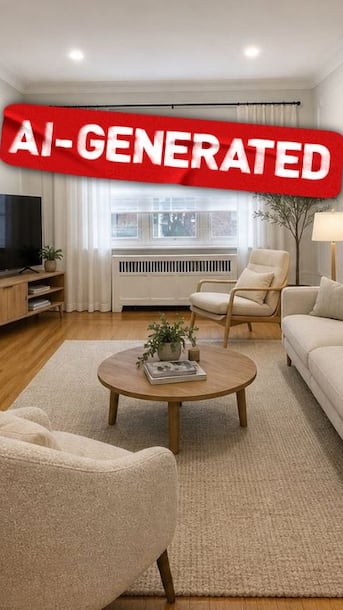
Fact check: Canadian real estate listings use AI-generated images
Whether you’re looking to rent or buy a home, you might come across AI-generated photos in real estate listings. CBC’s Fact Check team takes a look at some recent examples — and what rules realtors are supposed to follow.
John DiMichele, CEO of the Toronto Regional Real Estate Board (TRREB), also stressed that virtual staging must maintain factual integrity.
“For instance, don’t put lamps in a room that doesn’t have outlets, unless you clearly say there are no outlets there,” DiMichele said.
CBC Toronto was able to find a number of active property listings in recent weeks that weren’t clearly labelled on Realtor.ca. Such listings are then picked up on other real estate sites.
But DiMichele said that the majority of agents are following the guidelines.
Where AI staging is headed
The Ontario Real Estate Association said in a statement that as AI tools continue to develop, real estate organizations across Canada are actively establishing updated standards for usage.
Singh suggested those standards may need to expand beyond simple image labels.
“I do think that disclosure is a starting point. I think the next step might be even mentioning what tools were being used,” he said.
For prospective buyers navigating current listings, he recommends being proactive.
“Buyers need to pay attention to the details, read the dimensions and the client remarks in the listings,” he said.
Singh adds that if you’re unsure whether a listing features virtual staging or how accurately it reflects the space, ask your real estate agent for clarification before booking an in-person viewing appointment.