
The growing convergence of textile engineering, robotics and human-machine interaction is opening new possibilities for wearable technologies, with knitted structures playing an increasingly important role in the development of lightweight, flexible and functional robotic systems.
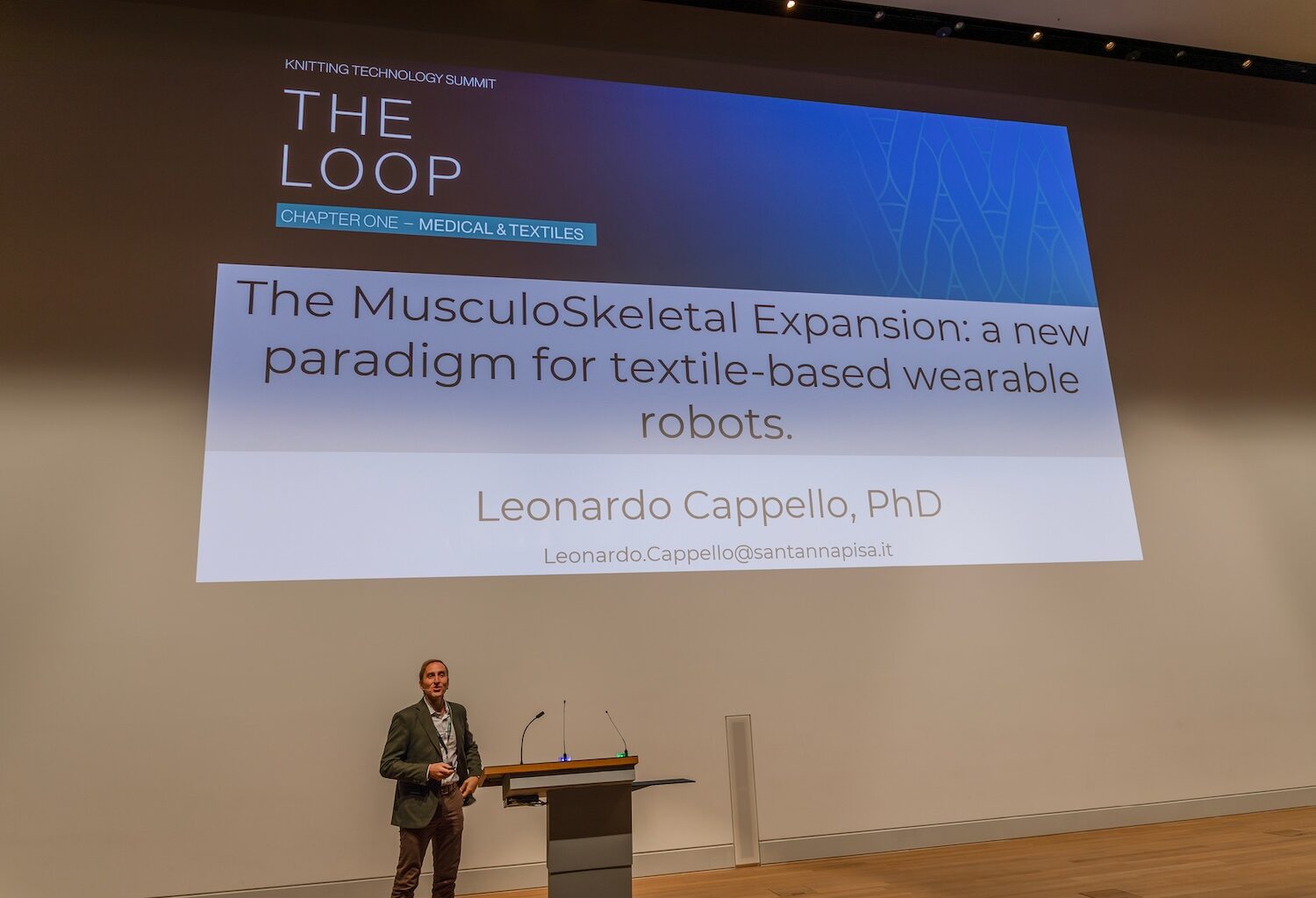
Leonardo Cappello, Assistant Professor at the BioRobotics Institute of Scuola Superiore Sant’Anna in Pisa, Italy, outlined developments in textile robotics and wearable assistive technologies during a technical presentation at the recent The Loop – Chapter One: Medical Textiles event (7-8 October, Albstadt, Germany), examining how advanced materials and robotic systems can be integrated to support human movement, rehabilitation and physical performance.
The presentation highlighted the potential of soft robotic technologies to move beyond conventional rigid mechanical systems, using compliant materials and textile-based structures to create devices that interact more naturally with the human body.
Applications range from robotic gloves and movement-assistance systems to wearable devices designed for rehabilitation, gripping and reaching, thermal regulation, haptic feedback and therapeutic compression.
Integration
A central theme was the integration of structural, functional and programmed properties within textile systems. Rather than treating fabrics simply as passive materials, researchers are investigating how textile structures can provide mechanical functionality and contribute directly to the operation of wearable robotic devices.
Knitted fabrics are particularly relevant because of their inherent flexibility, stretchability and ability to conform to complex body shapes. Both warp knitted and weft knitted structures were identified within a wider classification of textile architectures, alongside nonwovens, woven fabrics, braided structures and non-crimp fabrics.
The choice of textile architecture can influence the mechanical behaviour, flexibility and integration potential of a wearable system. This creates opportunities for textile manufacturers and knitting technology developers to contribute to the next generation of soft robotic products.
Among the technologies demonstrated was a compact, lightweight and soft robotic mechanism capable of bidirectional movement through straightening and bending. The presentation illustrated how flexible structures can be engineered to perform controlled movements, potentially providing an alternative to more conventional mechanical actuation systems.
Soft robotic grip glove
A further example involved a soft robotic grip glove operated using pneumatic actuation. The glove demonstrated how air-powered mechanisms can assist hand movement and gripping, with potential applications in rehabilitation and support for individuals with reduced hand function.
Such technologies could eventually contribute to more comfortable and adaptable wearable devices, although practical challenges remain in reducing weight and bulk while improving complexity, usability and overall system performance.
The presentation also examined developments in wearable robotics for the lower body, including exoskeleton concepts intended to assist movement and walking. These systems illustrate the broader challenge of developing technologies that combine mechanical assistance with comfort, flexibility and compatibility with natural human movement.
Another research area presented was musculoskeletal expansion, including advanced human-machine interfaces designed to connect robotic technologies more directly with the body’s sensory and motor systems.
Visualisations showed concepts involving osseointegrated interfaces and bone conduction stimulation, exploring ways of providing sensory feedback and improving interaction between the human body and assistive devices.
These developments reflect a wider ambition within robotics research to create systems that not only assist movement but also provide more intuitive interaction and feedback.
BioRobotics Institute
The BioRobotics Institute combines advanced education, frontier research and technological innovation, with activities spanning robotics, engineering, materials science and biological systems.
Its research infrastructure includes mechanical workshops, microscopy equipment, chemical and biological laboratories, silicone and polymer prototyping facilities, measurement and testing equipment, additive manufacturing technologies and cleanroom facilities.
The institute’s mission encompasses both the development of technologies inspired by biological systems and the application of robotics to rehabilitation, assistance and the enhancement of human capabilities.
For the textile industry, the research points towards opportunities to develop functional fabrics that act as integral components of robotic systems rather than simply providing coverings or support structures.
This could involve the development of engineered knitted structures with controlled elasticity, integrated actuation, sensing capabilities and mechanical properties tailored to specific wearable applications.
Knowledge transfer and education
The institute is also supporting knowledge transfer and education through its Robot Power seasonal school, entitled Textile Robotics for Human Empowerment.
The second edition is scheduled for February 2027 and will focus on the relationship between textile technologies and robotics, bringing together expertise from disciplines involved in the development of wearable robotic systems.

© Groz-Beckert
As research into soft robotics progresses, the ability to combine textile manufacturing techniques with advanced materials, actuation systems and human-centred engineering could create new opportunities for technical textiles and knitting technology suppliers.
The work presented by Cappello illustrates how the traditional characteristics of knitted textiles, including flexibility, adaptability and comfort, could become increasingly valuable in the development of sophisticated wearable robotic technologies.