
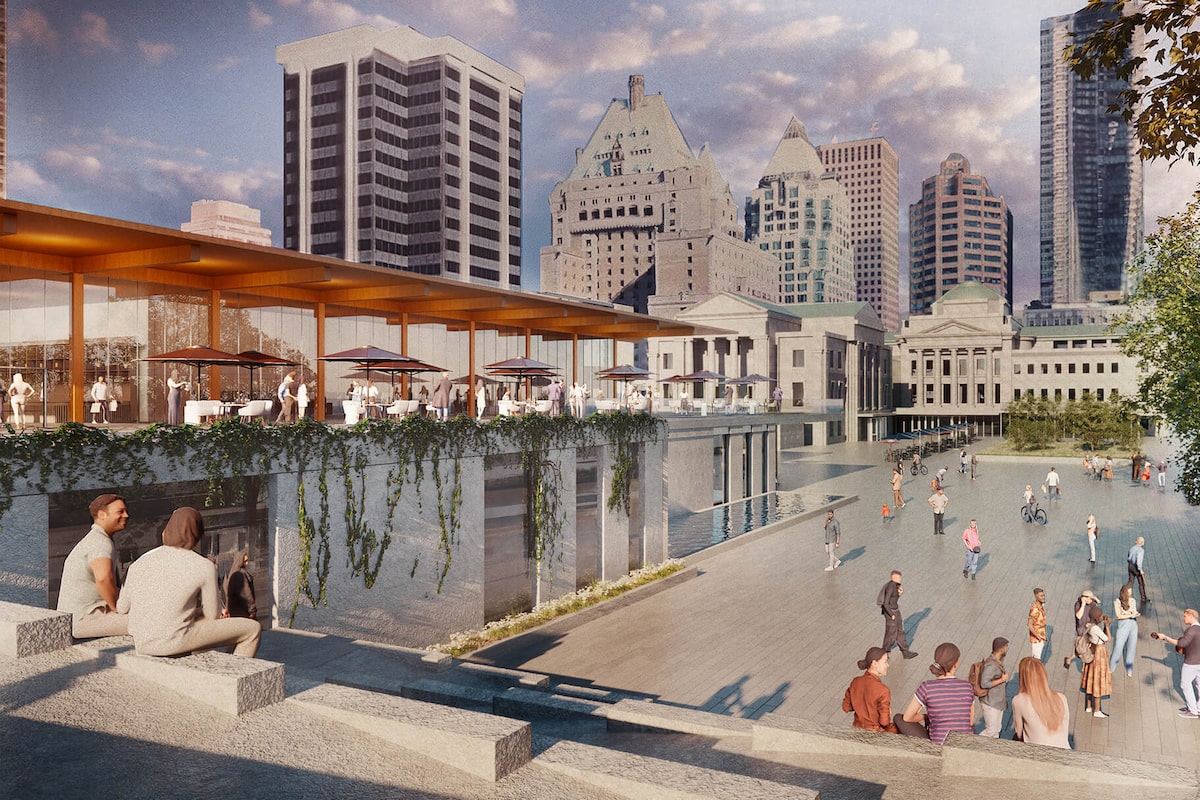
A new proposed cultural area in Vancouver is slated to include four new performance halls, including one small and one medium theatre that are proposed to be developed at the downtown’s Robson Square.Supplied/Diamond Schmitt Architects
Thirty-two performing arts groups have banded together to pitch the creation of a new area in Vancouver that will be home to several performance halls, dubbed a ‘cultural precinct’, as the city experiences a pressing need for venues where more artforms can be staged.
The alliance associations, led by the Vancouver Concert Hall and Theatre Society and including organizations such as the Vancouver Symphony Orchestra and Vancouver Youth Choir, have spent the last two years developing a plan, which will include a total of 5,000 seats across four halls.
“This is absolutely the biggest cultural project that has ever been imagined in Vancouver,” says Suzanne Anton, chair of the Vancouver Cultural Precinct’s (VCP) steering committee and former B.C. attorney-general and Vancouver city councillor. “It’s been tried before, and for one reason or another, didn’t get off the ground. But now we’re finally ready to go beyond talking.”
The alliance’s formation and its plan for a new cultural area comes as Canada’s arts and culture sector contributed $65-billion in direct gross domestic product to the Canadian economy in 2024, according to a report from the Canadian Chamber of Commerce. Since 2011, the sector has experienced significant growth, outpacing that of other key industries such as oil and gas, manufacturing and wholesale trade, the report found.
Plans for the city’s new performance area include the creation of a Large Proscenium Hall (concept pictured above), a 2,000-seat auditorium for opera, ballet and other large-scale performances that require theatrical staging and an orchestra pit.Supplied/Diamond Schmitt Architects
Filling a need for more theatre space
In extensive consultations, the 32 arts groups agreed that there is an immediate need for more purpose-built theatres in Vancouver, says Donald Schmitt, founding principal at Diamond Schmitt, the project’s lead architect.
At just 0.52 seats per 1,000 residents, Vancouver has the lowest per capita cultural performance capacity of any major Canadian city or a comparable international one, according to data from Diamond Schmitt. For comparison, Toronto has 1.03 seats per 1,000 residents, while Melbourne, Australia, has 1.44.
Another 2018 study from consultant AMS Planning and Research assessed the current discrepancies in Vancouver’s cultural infrastructure, finding that the city has a major gap between its largest venues and those under 1,000 seats. Statistics Canada data has also reported that British Columbia saw average attendance per performance rise from 249 in 2016 to 272 in 2024, despite the number of performances declining from 7,208 to 6,223.
The new spaces’ future design proposes: a 400-seat small hall for recitals, chamber music, storytelling and performances; an 850-seat medium-sized hall for chamber music, recitals, dance, choral works and small-scale orchestral performances; a 1,750-seat concert hall for large-scale orchestral and choral performances; and a 2,000-seat large proscenium hall for opera, ballet and other large-scale performances that require theatrical staging and an orchestra pit.
The VCP and Diamond Schmitt have also identified three possible downtown locations for the forthcoming area: Robson Square in the downtown’s centre, the vacant Larwill Park on the eastern side of downtown, and the northeast edge of False Creek, a former Expo 86 site.
These sites were chosen due to their accessibility to transit and because of the opportunities available to create public amenities and connections to surrounding neighbourhoods.
The vacant Larwill Park at Dunsmuir and Cambie streets on the eastern side of downtown Vancouver is another proposed location for a concert hall (concept pictured above).Supplied/Diamond Schmitt Architects
Vancouver’s cultural history
While the population of the Vancouver region has grown in recent decades, the newest cultural venues date back half a century. The Queen Elizabeth Theatre opened in 1959, while the Vancouver Playhouse opened in 1962.
The Vancouver Symphony Orchestra that performs in the city’s 99-year old Orpheum Theatre is leading the push for a purpose-built concert hall within the cultural precinct. The theatre, located at Smithe and Granville streets, was built as a vaudeville house in 1927 and later used as a multiplex cinema. It was restored as the symphony’s home in 1977.
“The Orpheum is iconic, it’s gorgeous and it’s beloved, but it was not built with a symphony in mind,” says Angela Elster, president and CEO of the VSO, adding that it has issues with acoustics, sightlines, accessibility and a lack of storage space for instruments.
At 2,700 seats, it’s also too large for some types of performances, Ms. Elster says. “Even with the biggest concerts, there are generally empty seats, which isn’t ideal for the musicians or the audience,” she adds.
And because Vancouver’s orchestra uses the space 160 nights per year, it‘s not available for other performances that could better utilize it, she says.
The design plan for the precinct is also exploring the option of renovating the former courthouse, known as the Rattenbury Building, adjacent to Robson Square to accommodate the 1,750-seat concert hall. The building is the current home of the Vancouver Art Gallery, which eventually plans to move to a new building.
The importance of public spaces
In addition to new performance venues, the vision for the VCP includes creating public spaces around the theatres.
“We realized in the consultations that we can do more than just meet the musical, artistic and theatrical needs. We can help transform the city,” says Matthew Lella, principal at Diamond Schmitt leading the VCP’s design-project team and specializing in performance spaces.
Studies show arts and culture have positive economic impacts on communities. In 2024, the Canadian Chamber of Commerce reported the sector generated more than $16-billion in tax revenue and created more than 1.1 million jobs.
Other cultural districts around the world have proven successful, too. A recent example includes the Southbank Centre in London, U.K., which is home to concert and performance halls, galleries and pedestrian zones that host thousands of events per year, Mr. Lella notes.
Other recent cultural district developments in Copenhagen and Oslo have also given new identities to neighbourhoods.
Project feasibility
There is still no estimate for the VCP’s total budget. But funding for cultural projects like this typically comes from a mix of government, corporate and private donations, Mr. Schmitt says.
The 32 arts organizations have made annual contributions to fund the project’s feasibility phase. Additional support has come from the Department of Canadian Heritage, the City of Vancouver, the BC Arts Council, Creative BC and other private donors.
“It’s a very ambitious long-term plan that’s not going to happen overnight, and we are being very careful to make sure we get the right analysis every step of the way,” Ms. Anton says.
Additional feasibility investigations are important since past efforts to build new cultural spaces in Vancouver have stumbled.
A 2005 design by late Vancouver architect Bing Thom envisioned a multi-use arts complex: the Pacific Exchange, at Larwill Park. It was supposed to include two concert halls and several galleries, but it never moved forward due to a shift in political agendas and divisions within the city’s arts community over the proposed venue.
A 2012 plan for a new Vancouver Art Gallery also stalled, though a new effort is underway, led by firms Formline Architecture + Urbanism and KPMB Architects.
“The momentum for this cultural precinct approach is unprecedented,” Ms. Anton says. “There are 32 groups who have all agreed that there is a desperate demand and the audience is there, and they are very keen to be working together on this. It’s not if the Vancouver Cultural Precinct will happen – it’s about how fast it can happen.”