
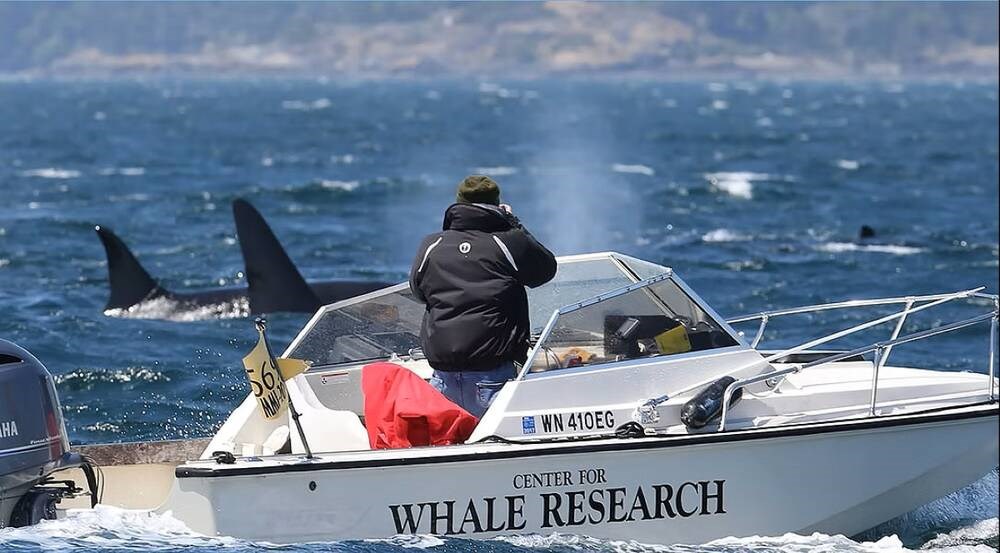
The latest census of the critically endangered orcas found 76 as of July 1, up from 74 during the same period a year ago.
The latest count of southern resident killer whales shows the population remains low, despite a second year of slight growth.
The census of the critically endangered orcas found 76 as of July 1, up from 74 during the same period a year ago, and from 73 in 2024, according to the Center for Whale Research in Friday Harbour, Washington.
The centre’s researchers track the orcas in J, K and L pods using photographs taken from boats and drones for its annual census in the Salish Sea.
Although four calves were born during the census period, only two survived.
A female, K47, and L130, whose sex is not yet determined, appear to be in “normal health,” researchers said this week.
Two other calves, J64 and L129, were born during the survey period, but did not survive to the July 1 census date. The calf known as J64 survived for less than a month, while L129 was only photographed during a single encounter and was declared dead.
No other southern residents died during the July-to-July census period.
K pod now stands at 15 orcas, while L pod gained one, for a total of 34 surviving animals, and J pod was unchanged at 27.
The Center for Whale Research said although the population increase is encouraging, periods of growth have often been followed by steep declines.
The centre says its data show that the southern resident population is still not reproducing at the rates necessary to recover the population.
It said the low birth rate and calf survivals are likely tied to the impact of pollutants often passed from mother to offspring and a lack of Chinook salmon prey.
Michael Weiss, the centre’s research director, said that for the southern resident population to grow more consistently, the threats they face have to be addressed.
He cited human-caused noise disturbance from boats and ships, which interferes with the orcas’ ability to find fish using echo-location, and “most critically” a lack of large, fatty Chinook salmon, their primary prey.
Unlike the more populous transient, or Bigg’s killer whales, which eat seals and sea lions, southern residents only hunt for salmon.
“Saving these whales means restoring Chinook salmon habitat, improving fisheries management and addressing the sources of noise and toxicants in their environment,” said Weiss.
The census was released a week after the southern residents suffered the loss of another calf, this time in J pod.
Researcher Mark Malleson saw J31, also known as Tsuchi, swimming with the dead calf and immediate family members in J pod.
The Center for Whale Research said it was unclear whether the newborn was a male or female, if it had been carried to full term and died after birth, or if it was a stillbirth.
It was the fifth time in the past decade that a female member of the southern resident killer whales has been found pushing and carrying a dead calf in the Salish Sea, in what observers view as an act of grief.