
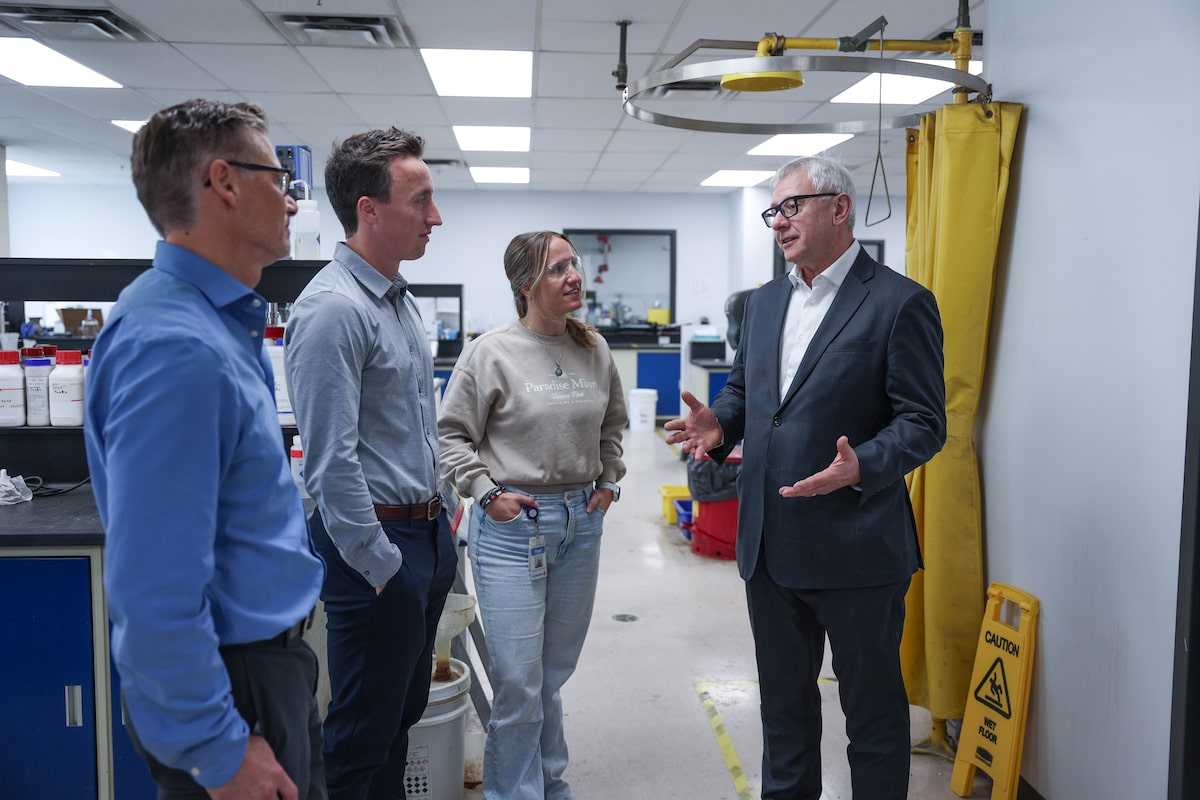
Ron Hoffmann, right, vice-president of SixRing Inc., speaks with colleagues at the company’s lab in Calgary, on Tuesday.AHMED ZAKOT/The Globe and Mail
When Ron Hoffmann awoke Tuesday morning to news that Alberta had chosen to stay in Canada, he knew it was good for business.
Mr. Hoffmann is vice-president of SixRing Inc., an agricultural technology startup that develops molecules to increase crop yields and decrease fertilizer use. The company is weeks away from finishing its latest investment round, with a target of $36-million. It also plans to spend $2.5-million on upgrading a facility outside Calgary.
A changing Canadian business environment is helping the company realize its ambitions, Mr. Hoffmann said. Prime Minister Mark Carney’s focus on the resource sector and on thawing relations with Alberta pleased investors; this wasn’t the time to consider leaving Canada, he explained.
“We have bigger issues, and I think the bigger issues are evolving quite positively,” he said.
Business leaders optimistic about Alberta referendum result
Many in Alberta’s agricultural sector also look forward to putting the question of separation behind them, not least because the industry is particularly exposed to trade. For example, 80 per cent of its canola – the province’s No. 1 crop – is exported, and in the past two years, farmers have faced trade disruptions in their top two markets, the United States and China.
“We don’t need anything else to disrupt our exports and our living,” said Andre Harpe, an Albertan farmer and chair of the Canadian Canola Growers Association.
But the idea of staying in Canada, especially without the threat of a full, binding referendum, also raises concerns about whether Ottawa will return to a state of politics perceived by many as prioritizing Central Canada to the detriment of the West.
While roughly 76 per cent of Albertans participating in Monday’s vote opted to remain in Canada, this number was significantly lower in rural areas. As of mid-Tuesday, roughly 86 per cent of voters in Edmonton and 83 per cent of voters in Calgary sided with federalists. In the rest of the province, just 66 per cent of voters did so.
These results reflect long-held rural grievances, said Chevy Johnston, chief executive of Johnston’s Grain Ltd., a multigenerational brokerage firm that buys crops from farmers across Western Canada.
Opinion: The pro-Canada side won in Alberta. That’s not an endorsement of the status quo
He said Canadian politics will always prioritize the votes of Ontario and Quebec over the western provinces, adding that policies implemented under former prime minister Justin Trudeau only served to prove this.
Mr. Johnston pointed to the carbon price and fertilizer reduction targets. While his company advocates for regenerative farming practices, he said those federal policies, among others, were harmful to farmers. He called them a “dictate without any sort of consultation or logic.”
“When you need fertilizer shouldn’t be determined by Ottawa. … It’s got to be by science and reason.”
Mr. Carney’s decision to end some of those policies has helped soothe grievances, Mr. Johnston said, but he nevertheless worries that a return to the old ways is only a matter of time.
“It wasn’t a vote against Carney,” he said. “It’s a vote against ever having a third Trudeau come in and essentially abuse Western Canada to purchase votes in the East.”
Roger Chevraux is a director with Grain Growers of Canada and Alberta Canola. His family has farmed in Killam for more than a century. While he agrees that continued uncertainty would have been bad for Albertan agriculture (and a vote to separate would have been worse), he also fears that the strong vote to remain takes the pressure off Ottawa.
Alberta is an important part of Canada economically but has very little political influence, he said, adding that Ottawa has a “long history of ignoring the issues here in the West.”
Five takeaways from Alberta’s separation referendum
For example, Mr. Chevraux pointed to Mr. Trudeau’s decision to impose a 100-per-cent tariff on Chinese-made electric vehicles in a bid to protect the auto manufacturing sector in Ontario. Beijing responded with tariffs on canola products, which severed western canola farmers from a crucial market for 12 months.
In January, Mr. Carney inked a deal with Beijing to permit a select number of Chinese-made EVs to enter Canada at a reduced tariff rate, in exchange for lowered levies on Canadian canola exports.
“I think Carney made that deal because he was worried about Alberta,” said Mr. Chevraux, who added he wonders whether the Prime Minister would make the same decision now. “How long will Carney continue to support western issues?”
Bianca Parsons, executive director of the Alberta Food Processors Association, said Ottawa needs to take this moment to lean into the sectors where Alberta excels. The province is a major player in the food and beverage manufacturing space, hosting multinationals such as Cargill, JBS, McCain, Cavendish Farms and PepsiCo. The sector needs more attention from both levels of government, she said.
The Canadian food and beverage manufacturing sector contributes $35.1-billion to gross domestic product and supports 318,000 jobs, higher than the GDP contributions and jobs of the Central Canadian industries of automotive assembly, auto parts and aerospace manufacturing, according to a report published by Food and Beverage Canada on Tuesday. An additional $75-billion in national GDP could be unlocked by 2035 via increased capital investment and regulatory reform, the report said.
“Alberta has strong agricultural roots and businesses ready to grow,” Ms. Parsons said. “By working together, both governments can help turn that potential into more investment, jobs and value staying in our communities.”