
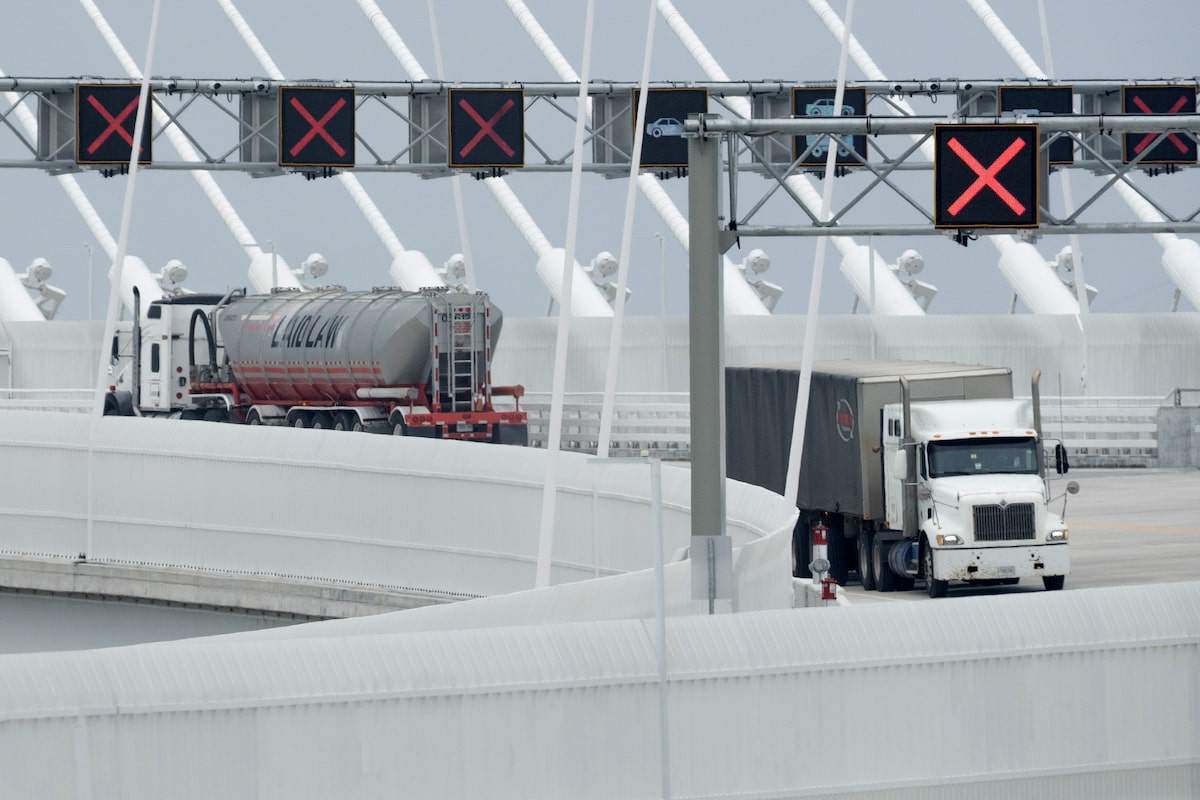
Transports trucks use the Gordie Howe International Bridge in Windsor, Ont. Gellert Global Group says the Trump administration’s tariffs on a range of Canadian goods could cost it an estimated US$40-million per year.Dax Melmer/The Canadian Press
A lawsuit challenging Donald Trump’s latest tariffs on Canadian goods was filed Tuesday, setting up a legal battle over a 96-year-old law that was used for the first time this summer after trade talks between Ottawa and Washington broke down.
The lawsuit was filed to the U.S. Court of International Trade by the non-profit Liberty Justice Center on behalf of New Jersey-based food importer Gellert Global Group.
It challenges Section 338 of the Depression-era Smoot–Hawley Tariff Act, which the Trump administration used in August to impose 50-per-cent tariffs on some US$20-billion worth of Canadian goods, including dairy products, electronics and furniture.
Gellert is a major importer of Canadian cheese, bringing in roughly US$71-million worth in 2025. The lawsuit claims the company has been “directly and irreparably” harmed by the new tariffs, which could cost it an estimated US$40-million per year. The lawyers are also seeking class-action certification to represent other companies.
Section 338 of the Tariff Act gives Trump an easy – but untested – way to impose new levies
Section 338 had never been used before, so this will be the first time it is tested in court. However, the lawsuit is the latest in a string of legal challenges to executive powers Mr. Trump has relied on to impose sweeping tariffs on trading partners.
Liberty Justice Center, which was involved in an earlier, successful case to strike down Mr. Trump’s “Liberation Day” tariffs on some 180 countries and territories, argues that the President is once again overstepping his legal authority.
“The Section 338 Tariffs are the Administration’s latest attempt to exercise, through a statute never designed for the purpose, the tariff power that the Constitution assigns to Congress,” the lawyers write.
They also argue that the administration is misapplying the law, which supposedly gives the President power to retaliate against other countries that discriminate against U.S. companies.
In August, the Trump administration took aim at three separate Canadian measures that it said amounted to discrimination: Canada’s dairy supply management system, Ottawa’s countertariffs on U.S. automobiles and provincial bans on U.S. liquor sales.
Idea of partnering with U.S. is ‘under attack’ in Canada, Hoekstra says
“The Canadian measures they cite do not discriminate against the United States,” the lawsuit argues.
“Two are Canada’s responses to the President’s own tariffs, including tariffs the Supreme Court has held unlawful, and retaliation is not discrimination. The third concerns dairy quota terms that the United States itself negotiated in the United States-Mexico-Canada Agreement . . . that Congress approved, and that give American cheese better access to Canada than the cheese of most of the world receives.”
So far, Canada is the only country that has been hit with Section 338 tariffs.
When Mr. Trump first threatened to use them in late July, it was widely seen as an attempt to get Ottawa to come to the negotiating table to discuss removing Canadian countermeasures in return for some limited U.S. tariff relief.
The threat initially appeared to work. Canadian trade negotiators spent much of August trying to hash out some sort of interim trade deal with the United States. However, when Prime Minister Mark Carney walked away from the negotiating table at the last minute, the Section 338 tariffs came into force.
Ottawa has since retaliated with its own countertariffs on some $27-billion worth of U.S. goods.
U.S. businesses think looming countertariffs will inflict pain, but not misery
The lawsuit does not challenge other U.S. tariffs on Canadian goods, which include sectoral tariffs on metals, cars and wood products imposed under Section 232 of the Trade Expansion Act of 1962 and tariffs on a range of goods imposed under Section 301 of the Trade Act of 1974.
The Section 301 tariffs are being challenged in other lawsuits. However, the Section 232 tariffs are seen by legal experts as being on a legally secure footing, having been unsuccessfully litigated during the first Trump administration.
Multiple U.S. courts have ruled against the Trump administration’s use of tariff authorities over the past year and a half.
The most significant blow came in February, when the U.S. Supreme Court ruled against Mr. Trump’s baseline levies on most trading partners, forcing the administration to reconstruct its tariff wall using other authorities.
That case also started at the Court of International Trade and made it through various appeal courts over a period of 10 months.