
The BC NDP have announced plans to provide funding to bring an MRI to Chilliwack if they form government in the upcoming election.
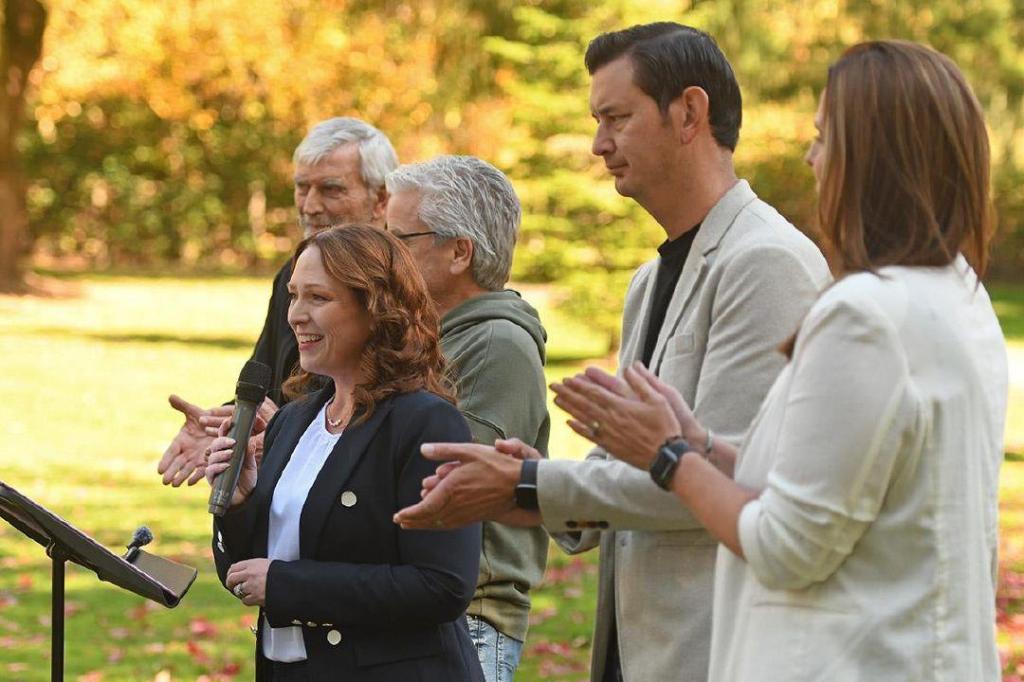
The announcement was made by Kelli Paddon, MLA candidate for Chilliwack-Cultus Lake, during a press conference on Wednesday (Oct. 21) at Sardis Park.
“A BC NDP government has committed $8 million to making sure that Chilliwack is going to get its MRI,” Paddon said. “This is just one piece of the partnership. This work started locally with donors, with incredible work by the city and foundations to advocate, to make sure that this happened and to make sure that people could access this health care close to home.
“Anybody who has ever needed to have a diagnostic appointment and drive outside of Chilliwack knows that there’s a wait. There’s a lot of logistics to work on. Maybe you have to arrange for family care, maybe you don’t drive yourself and you have to arrange transportation, but even in the event that the trip itself is not a huge barrier, there’s still the wait. There’s the time and the worry and the fact that your whole family, it’s not just you, is waiting for the answer, what’s next, what’s coming.
“Having an MRI in Chilliwack is critical and I am so proud to be part of a team that’s making that investment and that has committed to Chilliwack being on that list to receive that MRI.”
Paddon was joined in the announcement by Mayor Ken Popove; mayor-elect Jason Lum; Leanna Kemp, executive director of the Fraser Valley Health Care Foundation; and Harry Geddes, a director for the Chilliwack Hospital Foundation.
Popove said that the “community stepped up to the table to get the ball rolling” on bringing the MRI to the city. He said that transportation between cities for those who might need an MRI is a big roadblock.
“Back in 2021 and 2025, when we had our floods, people couldn’t get to the Abbotsford Hospital, so it’s vitally important to have this piece of technology in our backyard,” Popove said.
Lum, who also serves as liaison for the Chilliwack Hospital Foundation, said he had a “first-hand look” at the work that has been done by the foundation and private donors to fund the project.
“That speaks to what we know to be true about this community, about how charitable the community is, about how when there’s a need, they step up. They don’t wait for the government to step in. They step up and help fill that need,” Lum said.
He said he and other advocates for the project were concerned that it was not a priority when they received no response from inquiries.
“The work is being done here. I know the health authority has done a lot of work. I know our private donors have helped drive that along as well, the hospital foundations have helped drive that along,” Lum said. “So to see the province come up and step up as a partner, I think this is really important.”
Lum emphasized that he wants to see construction begin on the project before the end of the year.
“The longer we delay, the longer we have challenges with supply chain, or with construction costs escalating, or it getting caught up in cabinet or one ministry or another … That’s not fair to the donors. It’s not fair to the people who have committed money,” Lum said. “In fact, the thing that I’m concerned about is that these donors were very patient and very generous, but their patience has a limit. So, when they’re putting millions of dollars on the table, to make them wait three, four, five years is unacceptable.
“So, I want to really key in on the timeline that we’re hoping to see this completed in. A lot of the work has been completed. They’ve got a location at the hospital. They’ve done the study. They’ve done the work. The next piece is the bureaucratic piece and that’s the piece where I’m confident that seeing this amount of money put on the table, the money from the donors, the money from the foundations, that they’ll find a way to grease the wheels and get this thing moving much faster than you traditionally would. So, that’s the challenge that we put out to anyone who forms government, quite frankly.”
Kemp said the work on the project first began a couple of years earlier, when she was director and then chair of the Chilliwack Hospital Foundation.
“Jason said it best, when the community comes together and we want to do something, we get it done. When the Chilliwack Hospital Foundation approached the Fraser Valley Health Care Foundation, it was a no-brainer,” Kemp said.
She said this project was also brought together through partnerships with the Fraser Valley Regional District and Fraser Health.
“Dr. Kevin Enns, the director of Medical Imaging (at Fraser Health), was a big part of this project,” Kemp said. “When it was first presented to us, it was three phases, and he was extremely helpful in getting us through phase one and phase two in a very timely and efficient manner. So that piece was crucial.
“We’ve been stuck on phase three for a little bit. So, this is extremely exciting that this is happening today. I’m just incredibly grateful to be able to stand here in all of the roles that I’ve held to this date, but the foundations do great work for our community and this is just a testament to that.”
Geddes thanked Paddon for the promise and provided background information on how the private donors approached the Chilliwack Hospital Foundation to offer the funding.
He said one donor said they would donate the funds for an MRI in May of 2024 and 12 months later a second individual did the same. He said neither of the donors knew each other or had heard about the plans.
“It’s just unbelievable how all of a sudden we have a good portion of our funds already raised … the funds, as far as we’re concerned are there,” Geddes said. “We just need the ability of the Fraser Health and government to say ‘Yes, we’re going to go ahead with this thing because using the lack of funds as an excuse is not an excuse.”
In a statement sent to the press, Todd Harvey, chair of the Chilliwack Hospital Foundation said, “An MRI at home means people won’t have to travel out of town for a scan they need, often while they are sick and worried. An MRI in Chilliwack will also benefit the whole region by easing the pressure on other facilities, so more patients across the valley can be seen sooner.”
Speaking to the delays of the project by the BC NDP, Paddon said that a lot of the work she had done was when she was MLA, from 2020 to 2024.
“In 2024 I was not re-elected. We were still engaged in the work to push this forward and make it happen. Unfortunately our local representation wasn’t able to move the ball forward at all,” Paddon said. “For my own part, part of the reason that I’m running again right now is because I know how much we can get done. We brought in hundreds of millions of dollars worth of investment to Chilliwack, while I was serving as MLA. Not because of me, because of the collective and the work we were able to do together with a strong representative that shows up and fights for us.”
At the end of her statement, Paddon said, “It’s really important to remember that we’re talking about a machine, but actually we’re talking about people. We’re talking about the people whose lives and access to health care here in our community will improve. We’re talking about the people that will work the machine to support the diagnostics right here in Chilliwack and we’re talking about all the incredible people who came together and to push.
“I am so proud to be a part of a government that understand that we have to make these investments in health care. We cannot help our communities and we can’t make things better by cutting health care.
“It is critical to my mind that you don’t just have this announcement, that the follow through is there. Announcements don’t help, but a commitment of this $8 million for an MRI in Chilliwack can change things for the seniors, for people who need it right here.”
Provincial election day is Oct. 24.