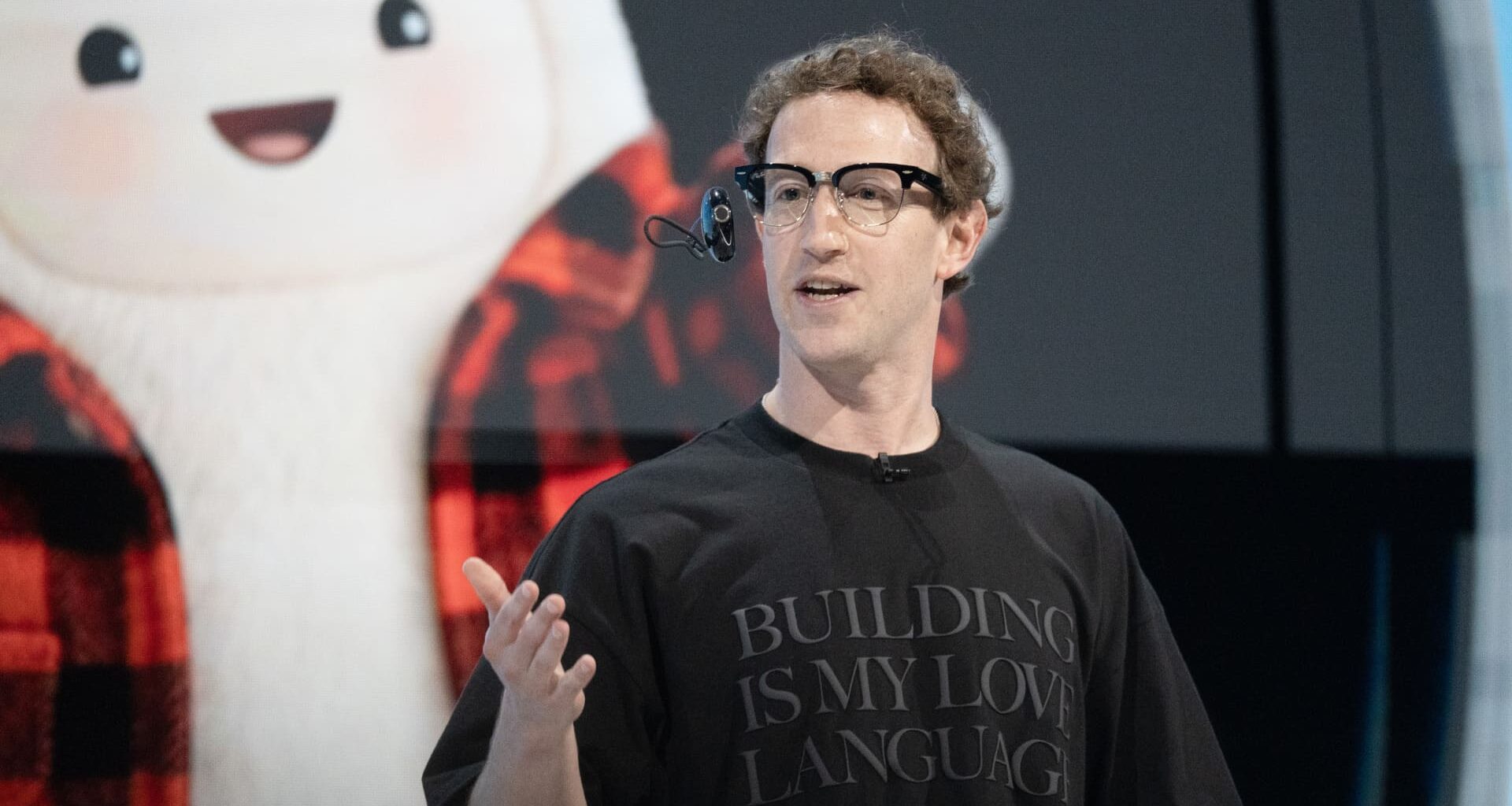
Meta Platforms on Wednesday evening delivered a strong, albeit somewhat noisy, quarter in its first reporting period since the release of its viral Muse AI agent. Investors liked what they saw. Revenue in the third quarter rose 26% year over year to $64.6 billion, more than $1 billion ahead of the analyst consensus estimate of $63.37 billion compiled by LSEG. Earnings per share (EPS) is where things got a bit complicated. Diluted EPS was $3.83. Excluding a $9.89 billion, or $3.57 per share, legal settlement charge to resolve teen addiction litigation with state attorneys general, diluted EPS would have been $7.40. We are not comparing earnings to the consensus estimate. The wide range of EPS estimates from $2.61 to $7.57 would seem to indicate that some analysts included the settlement charge in their calculations while others may have excluded it. META YTD mountain Meta Platforms YTD Judging by how Wall Street reacted, the noisy EPS number did not deter buyers. A strong guide and tame capital expenditure forecast certainly helped. Club stock Meta rose 2% in after-hours trading. Shares, which soared since Muse was launched on Sept. 8, closed at a 52-week high of nearly $780 on Sept. 24. We trimmed some Meta two days before that — just under $750 — because of the swift rally. While currently off those highs, Meta is still way up from pre-Muse levels. Bottom line It should come as no surprise that the focus of the earnings conference call was Muse — and from what we heard, the product is off to a great start and has an exciting runaway towards monetization ahead. CEO Mark Zuckerberg said, “In just a month and a half, more than 10 million people in the U.S. and Canada have set up Muse personal agents.” That’s great, but as we said previously, it’s not about the high-water mark for downloads. It’s about how many people use it. So, we were pleased to hear that Muse didn’t only see strong download trends but is also realizing relatively solid retention rates. Of those who set up Muse, Zuckberg said that about 25% use it on any given day. “For our earliest adopters, the longer that they use Muse, the better that retention seems to get. To put this in perspective, this is more than twice the level that Threads started at, or where we believe that other AI apps started at.” He added that the primary use case thus far has been shopping, with over 25% of Muse users engaging in agent-led shopping endeavors. In fact, the trend has been so strong that Zuckerberg said, “Plaid told us that they hadn’t seen activity like they’re seeing with their connector on any other service before, and in the first week we had to work with Stripe to raise credit limits since the volumes were above what any of us expected.” Plaid and Stripe are fintechs that facilitate online payments. While a strong Muse start is great, Meta now has a lot of work to do if it wants to fully capitalize on the viral nature of the launch, such as scaling up the product to serve billions of users, grow revenue, and optimize compute costs. To drive the revenue potential of Muse, Zuckerberg said the team needs to create a network of Muse agents as fast as possible, believing this is the best way to help more people do more with the agent. That makes sense because the more real-world experience Muse can get interacting with users, connectors, and the online world, the more capable it stands to become. Muse monetization is expected to be a multi-pronged approach, which we love because it means there is a plan for everyone. For most users, Zuckerberg expects the free Muse tier to be sufficient. To monetize this core cohort, Meta is building e-commerce tools to get a cut of each transaction it helps to facilitate. Then, there are the paid tiers for power users that need the latest models and a higher token budget. Lastly, there is the business angle, aimed at those who require additional features to help grow their business or empower employees to be more productive. On the cost side, Zuckerberg did acknowledge that Muse is currently very compute-intensive. However, he expects a greater than 10-fold improvement in cost-efficiency over the next year. This speaks to the advantage that Meta has over the pure-play AI labs, such as OpenAI and ChatGPT or Anthropic and Claude. Meta can run at full speed, building its agentic offerings before profitability is realized, taking comfort in that it has an extremely profitable core advertising business in place that not only supports the spending but also benefits from AI investments and innovation. “If compute efficiency continues improving quickly for another few years, which we think is highly likely, then Muse will be highly profitable over multiple years. In the near term, the strength of our core business enables us to scale the Muse network before then, and we believe that we are the best positioned company to pursue this strategy,” Zuckerberg said. Given the Muse success, one of our causes for caution coming into the print was the related increase in costs needed to get the AI agent to full ramp. For that reason, we were actually relieved to see that while the team increased the lower end of its capital expenditure range for the full year, the upper end was left unchanged. Importantly, Zuckerberg is clearly focused on converting costs into revenue as fast as possible. That is where the Meta Enterprise Platform comes in. “One other note on compute economics is that since training is a large fixed cost, now that we have leading models, we want to serve as much high-margin inference demand as possible. That is why we are building the Meta Enterprise Platform led by CJ Desai [formerly CEO of MongoDB].” Zuckerberg added, “Muse Wonder and even more advanced models that we’re training can serve additional high-margin services beyond the Muse network, including our API, Muse Code and other enterprise services. A fundamental feature of our business is that we have many good uses for this compute.” Muse Wonder is a new AI model. “It is difficult to forecast the exact growth rates for the Muse network, for our enterprise platform and for how Muse, Wonder and beyond will accelerate our core business. But through building up multiple ways to deploy these advanced models, we increase the chances that one or more of them significantly outperforms our expectations,” the CEO stressed. In addition to the various ways Meta can monetize its AI investments externally, Zuckerberg noted that the company has yet to reach the limits of what AI can do internally. As a result, he expects even greater levels of efficiency internally as models advance. Quarterly commentary Looking at Meta’s Family of Apps , the bread and butter that currently drives most of the revenue via digital ads, we’re pleased to hear that both Facebook and Instagram realized record engagement in the quarter thanks to increased video content consumption. Zuckerberg said that Threads, the newest addition to the Family of Apps, has now overtaken X (formerly Twitter) in monthly active users, while WhatsApp is seeing all-time highs for messages sent. Global Average Price Per Ad increased 14% year over year, an acceleration from the 12% increase last quarter. Ad impressions delivered across the family of apps increased 10%, a sequential deceleration. Daily Active People (DAP) missed expectations; however, that was offset by better-than-expected Family average revenue per person results. Perennial money-loser Reality Labs — which houses Meta’s virtual and augmented reality efforts and its smart glasses — lost $4.13 billion in the quarter. While less red-ink than expected, the loss was greater than the year-ago period. Zuckerberg said Reality Labs will only release new products when true breakthroughs are achieved. He forecasted $15 billion in operating losses in the year ahead, and then “trending to profitability from there.” Alongside earnings, Meta announced its intention to create a new class of non-voting common stock, Class C, effective January 2027. This new class of shares will be used “for capital raising, employee compensation, [and] potential acquisitions,” the company said. This new class of shares will also serve as a means to split the stock on a two-for-one basis, with shareholders receiving one share of Class C for every share of Class A they own. Rating and price target Given the strong results, execution, and our view that Meta now has the wind at its back as it runs full steam ahead in efforts to capture share of the AI market, build out a Muse network, and realize massive improvements in compute efficiency internally to serve the demand, we’re reiterating our $800-per-share price target. We’re also maintaining our hold-equivalent 2 rating for the time being. There are still several higher-level headwinds to overcome, including a new court-ordered $25 billion penalty out of New Mexico over the Cambridge Analytica scandal from nearly a decade ago. Meta vows an appeal. The midterm elections are another question mark not only for Meta but for the entire market. Guidance Meta projected current (fourth) quarter revenue of $73 billion to $76 billion, better than the $73.88 billion consensus estimate, according to LSEG. For full-year 2026, the company increased its projected total expenses to between $175 billion and $179 billion, up from the $165 billion to $169 billion range previously provided. That said, the upward revision is being overlooked on Wall Street as it reflects the nearly $10 billion charge taken in the third quarter. Capital expenditures for the full year are now expected to be between $135 billion and $145 billion, an increase on the low end, as we mentioned earlier, from the prior range of $130 billion to $145 billion, and about in line with expectations of $139.2 billion at the midpoint, according to FactSet. (Jim Cramer’s Charitable Trust is long META. See here for a full list of the stocks.) As a subscriber to the CNBC Investing Club with Jim Cramer, you will receive a trade alert before Jim makes a trade. Jim waits 45 minutes after sending a trade alert before buying or selling a stock in his charitable trust’s portfolio. If Jim has talked about a stock on CNBC TV, he waits 72 hours after issuing the trade alert before executing the trade. THE ABOVE INVESTING CLUB INFORMATION IS SUBJECT TO OUR TERMS AND CONDITIONS AND PRIVACY POLICY , TOGETHER WITH OUR DISCLAIMER . NO FIDUCIARY OBLIGATION OR DUTY EXISTS, OR IS CREATED, BY VIRTUE OF YOUR RECEIPT OF ANY INFORMATION PROVIDED IN CONNECTION WITH THE INVESTING CLUB. NO SPECIFIC OUTCOME OR PROFIT IS GUARANTEED.