
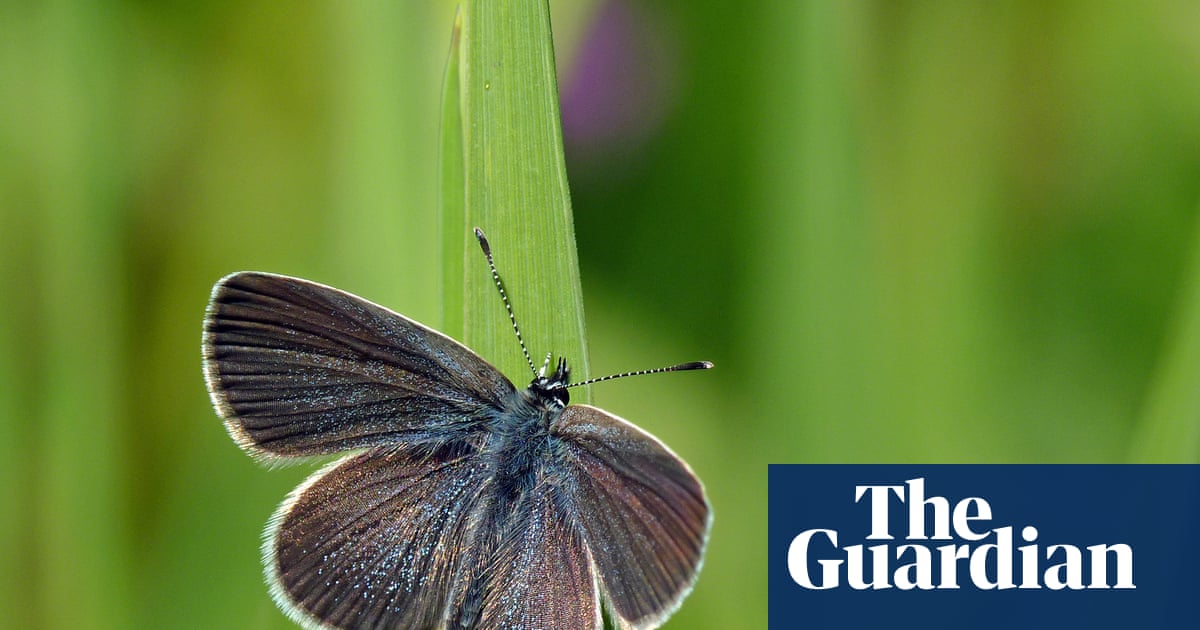
An “amazing” abundance of 5,290 butterflies, including rare small blues and dingy skippers, has appeared on land that was barren wheatfields just two years ago.
The speed with which nature has bounced back at Halnaker Hill farm in West Sussex has surprised experts after 133 hectares (330 acres) of intensively farmed land were turned into a commercial nature restoration project.
The farm’s relatively unproductive soils on the South Downs were cropped for wheat for 40 years, but after a final harvest in 2024 the arable land was sown with a special wildflower mix. Seven kilometres of hedgerows have been planted, seven hectares (17 acres) of new woodland created, three ponds dug and 54 hectares (133 acres) of herbal leys seeded, with carefully controlled mob-grazing on existing chalk grassland to improve its wildlife and biodiversity.
Halnaker Hill Natural Capital is a commercial nature restoration project that derives its income from selling biodiversity net gain (BNG) credits, which enable houses to be built in the wider region. Under BNG rules, developers are legally obliged to deliver an increase in nature on new housing estates or by buying credits for nature restoration elsewhere.
Halnaker Hill farm, where former wheatfields were sown with a special wildflower mix. Photograph: Halnaker Hill Farm
The independent ecologist Neil Hulme, who has advised Halnaker Hill on nature restoration and surveyed for butterflies, said he found “clouds of butterflies” on the former wheatfields last summer.
“The speed has amazed me, from a sterile landscape to one brimming with butterflies,” he said. “Despite being tiny, the small blue is very good at sniffing out its foodplant, kidney vetch. I knew it would come, but what I didn’t expect was it to come so soon and multiply so soon.
‘BNG can deliver nature by the bucketload,’ says Neil Hulme. Photograph: Southern News & Pictures (SNAP)
“Some people are a little bit unsure about BNG and the idea of monetising nature, but projects like this are showing so clearly how BNG can deliver nature by the bucketload. This isn’t greenwashing; this is the real deal.”
As well as seeing a profusion of skylarks, corn buntings, hobbies and dragonflies on the site, Hulme recorded 85 small blue butterflies and seven dingy skippers, which have never previously been recorded on the fields.
Surveys also found 547 small heath butterflies, and scores of common blues and green hairstreaks, alongside eight sulphur pearl moths, a highly localised species restricted to coastal areas of southern Britain and usually observed in ones and twos.
Halnaker Hill farm, which is delivering more than 850 units of BNG, forms part of the South Downs national park authority’s “ReNature” programme, which is tackling biodiversity loss and adaptation to global heating in the region. More than 7,700 hectares (19,027 acres) of land is being transformed into natural havens.
Nick Heasman, the head of natural capital for the South Downs national park, said: “It’s been wonderful to work with the team at Halnaker Hill to bring about real, positive change, demonstrating that BNG can make a big difference for nature, and this survey proves that. Just two years ago this was largely an arable landscape – showing how quickly nature can bounce back, given space, time and love.”
According to Hulme, it is relatively simple for any land manager to boost nature on chalk, simply by scraping off nutrient-rich top-soil and sowing specialist chalk grassland wildflower mixes if the site is not near any existing chalk grassland.
Up to eight sulphur pearl moths have been found on the site. Photograph: Neil Hulme
Next year he is planning to reintroduce the rare Duke of Burgundy butterfly to the site, with wild pansies also being sown to attract the Queen of Spain fritillary, a once-rare migrant that is increasingly common visitor to southern Britain.
“Projects like this fill me with optimism,” said Hulme. “If we can achieve this in just two years, the sky is the limit.”