
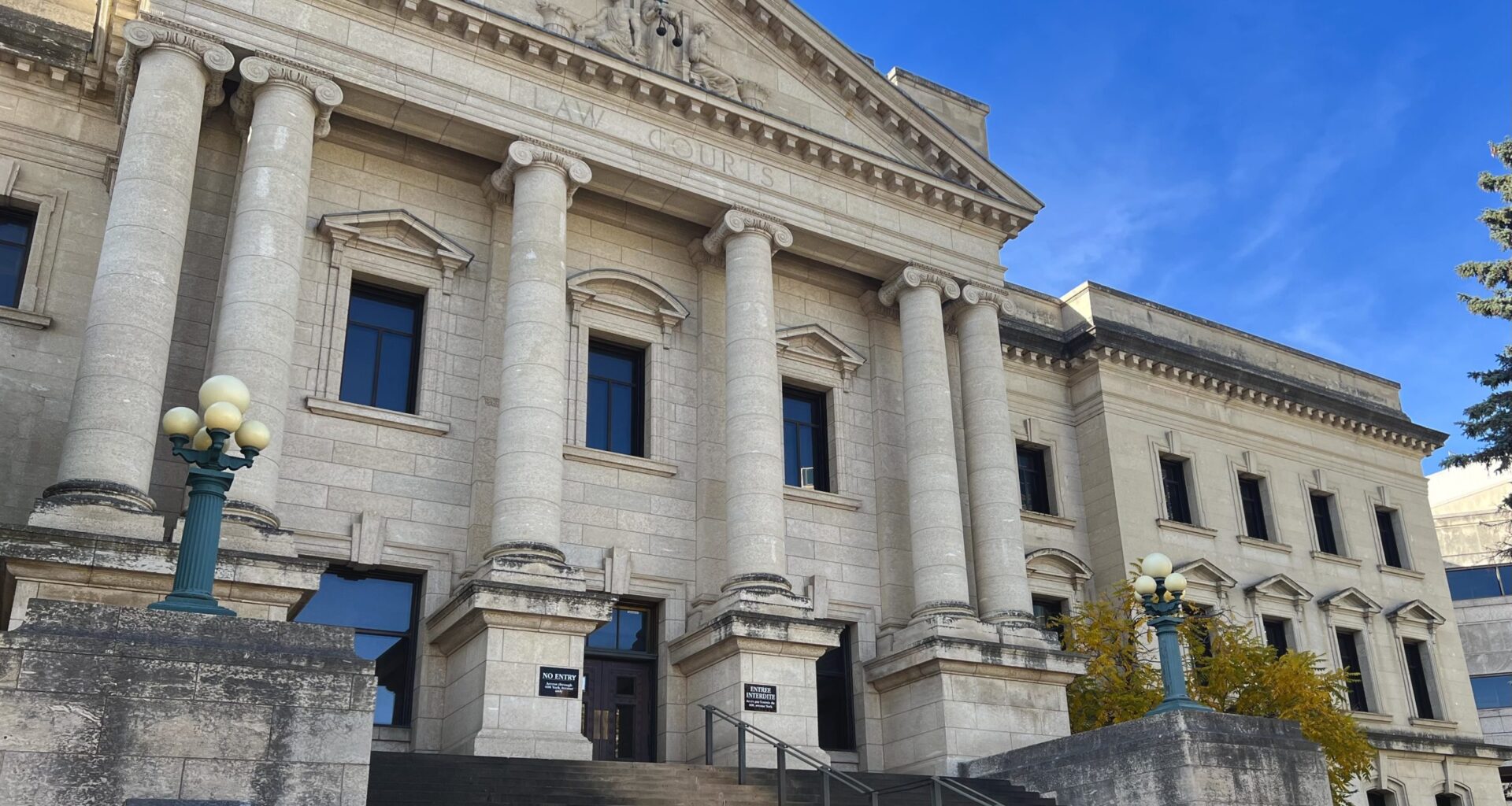
“This day, three years ago, Oct. 7, 2023, started for the residents of southern Israel with rocket barrages.” These were Winnipeg lawyer Murray Trachtenberg’s opening remarks to Justice Vic Toews in Manitoba’s Court of King’s Bench on Oct. 7, 2026. Trachtenberg’s evocative words quickly took on a provocative tone as he continued, “terrorists raped, mutilated, shot, decapitated, and burned babies, children, youth, and the elderly. In the end, some 1,200 people were massacred.” It was with this jarring imagery that formal arguments in the case of Hadass Eviatar and David Hoult vs. Congregation Etz Chayim (CEC) were launched.
But it was an unsigned letter, delivered to Eviatar and Hoult on Nov. 4, 2024, by CEC’s then-executive director, Jonathan Buchwald and, later, a visit from the Winnipeg Police Service (WPS), that launched the suit itself. The letter informed Eviatar and Hoult that they were no longer welcome as congregants at the synagogue. No meeting of the board of directors was held to consider the decision to oust them, a concern Buchwald addressed, according to court filings, by citing the fact that the decision was operational rather than one of governance.
Both Eviatar and Hoult had been active members since the formation of CEC, even serving on the board at various times. The couple was married at Rosh Pina, one of three synagogues that amalgamated to create CEC in 2002. Eviatar, an Israeli citizen who served in the IDF and is currently engaged in rabbinical studies, led Sunday services at CEC for more than 20 years.
The letter explained that CEC had received “numerous verbal and written complaints” about Eviatar’s “public conduct.” It referenced consequent “feelings of distress” among congregants and even noted that “members of CEC have expressed concerns for their safety while attending services and general programming at CEC,” as a result.
The letter went on to advise that Eviatar’s public association and condonation of certain individuals “suggests that (Eviatar had) aligned (her)self with a movement and ideology which is mutually exclusive and contrary to the existence of the Jewish people and the state of Israel as well as contrary to the mission, vision and values of CEC as well as CEC’s partnering organizations.”
Eviatar vehemently denies such allegations, pointing to the fact that she was born and raised in Israel, served in the IDF and still has many family ties to the region.
But in July 2024, Eviatar co-founded Manitoba Friends of Standing Together, a local chapter of the international group which is primarily focused on protesting Israel’s actions in Gaza. Eviatar has made multiple public appearances with Ramsey Zeid, president of the Canadian Palestinian Association of Manitoba, who is known to frequently make aggressively anti-Israel statements on the public record. For instance, he has defended Hamas’ Oct. 7, 2023 attacks stating, “When you treat people like that, when you back them into a corner, it’s just a matter of time before they get fed up and they fight back.” He has also reposted social media content calling Israel a “terrorist foreign entity” and referencing “demonic Zionists.”
The Nov. 4, 2024, letter from CEC did not actually purport to terminate Eviatar and Hoult’s membership. Rather, it outlined the concerns, noted that membership renewal was coming up and suggested the couple “carefully consider whether the values of CEC continue to align with yours and those of your family.” It went on to caution Eviatar and Hoult that, “Should you choose to renew, we would remind you of these expectations and we expect the above conduct and behaviour will cease immediately.”
According to an affidavit sworn by Eviatar, they did renew their membership, despite the letter and they continued to attend services until May, 2025.
Eviatar’s public appearance with Zeid was not the only issue for CEC and, over the months that followed delivery of the Nov. 4, 2024 letter, CEC’s concerns about those issues grew considerably. Like virtually all synagogues and easily identifiable Jewish organizations across the globe, CEC increased on-site security in the wake of the heightened antisemitism that followed the Oct. 7, 2023 Hamas attacks. Entrances were locked and monitored, congregants were required to register in advance for Saturday morning services, and security personnel were recruited to patrol the unassuming building that houses the congregations.
Hoult, a staunch critic of Israel’s conduct in Gaza, also opposed CEC’s security changes. As his criticisms of Israel became more vocal, so did his criticisms of CEC. Eventually, he published an article in the Winnipeg Jewish Post and News in which he declared, “Thus I protest the actions of my synagogue in keeping people out, I protest the actions of my community and I protest the actions of Israel because it is part of this world and it is sinning.”
Hoult then wrote a letter to CEC in which he described a hypothetical situation where the synagogue could be “gunned down.” That was the breaking point for CEC, the court was told during arguments. On May 29, 2025, a representative of Etz Chayim contacted the Winnipeg Police Service, reporting a letter that allegedly contained a threat to shoot congregants and identifying Hoult as its author. The following day, synagogue representatives met with police and requested that officers tell Hoult and Eviatar they were no longer permitted to attend services. Two officers subsequently visited the couple at home and warned that they could not return to the synagogue and that police would be called if they did. According to court filings, synagogue representatives also told police that the pair had been warned repeatedly about their behaviour, something they dispute.
Not long after WPS visited Eviatar and Hoult, CEC sent the couple a cheque for the unused portion of their membership fees. By the fall of 2025, court records confirm that Eviatar and Hoult had formally filed an action against CEC seeking to have the termination of their membership declared invalid. Almost a year later, the hearing date fell, perhaps by design or perhaps by haunting coincidence, on Oct. 7.
Emotions ran high in the gallery during the day-long proceeding. About two dozen people attended to observe the hearing and many seemed, at various times, engrossed, incredulous and upset.
While all of this might serve as a titillating bit of diversion for those who are dialled in, there is also an important legal principal at stake: does (and should) the court have the jurisdiction to impose its authority on a religious organization?
As he listened to the arguments of counsel at the Oct. 7 court hearing, Justice Toews repeatedly posed this question to counsel. The judge even made comments critical of CEC’s handling of the situation but returned consistently to the questions of whether the legal jurisdiction to reverse CEC’s decision exists under the law. “Even if I accept all of your facts, right? Does that lead to a remedy under The Corporations Act?” Justice Toews asked Trachtenberg.
For two hours, Trachtenberg dug in with a detailed account of what he characterized as a series of wrongs committed by CEC. He identified five people he believed were leading a campaign against Hoult and read several text messages into the record to support his argument.
One issue upon which CEC’s counsel, Simon Garfinkle chose to remain silent was whether Eviatar and Hoult are permitted to attend Etz Chayim cemetery grounds. CEC owns three Winnipeg cemeteries. Trachtenberg explained the termination letter his clients had received indicated they were no longer permitted on CEC property. There was no exclusion mentioned for cemeteries. When Trachtenberg raised the concern, the court invited Garfinkle to respond but counsel for the respondent declined.
Instead, Garfinkle used his time to argue that CEC is not subject to Manitoba’s Corporations Act in this context and that Eviatar and Hoult are, therefore, not entitled to the oppression remedy they are seeking under section 232 of the legislation. That remedy allows stakeholders to seek judicial relief when a corporation’s affairs are conducted in a manner that is oppressive, unfairly prejudicial or unfairly disregards their interests. Garfinkle argued that Eviatar and Hoult do not qualify as “stakeholders” with the requisite legal rights to bring such a claim. He maintained that CEC is a voluntary religious organization whose internal affairs do not fall within the court’s jurisdiction in these circumstances.
The legislation allows an application to be brought by “shareholders, security holders, creditors, directors, officers, or any other person the Manitoba Court of King’s Bench deems a ‘proper person.” Trachtenberg argued that the broad wording of “proper person” could include Eviatar and Hoult, allowing them to seek relief under the statute.
Although Garfinkle remained focused on the jurisdictional argument throughout his submissions, he did, at one point, take a moment to add that, given the current climate of antisemitism and the heightened security concerns facing Jewish communities, CEC had a responsibility to treat any potentially threatening communications as credible.
Justice Toews reserved his decision. The judgment, with reasons, is expected in the coming weeks.