
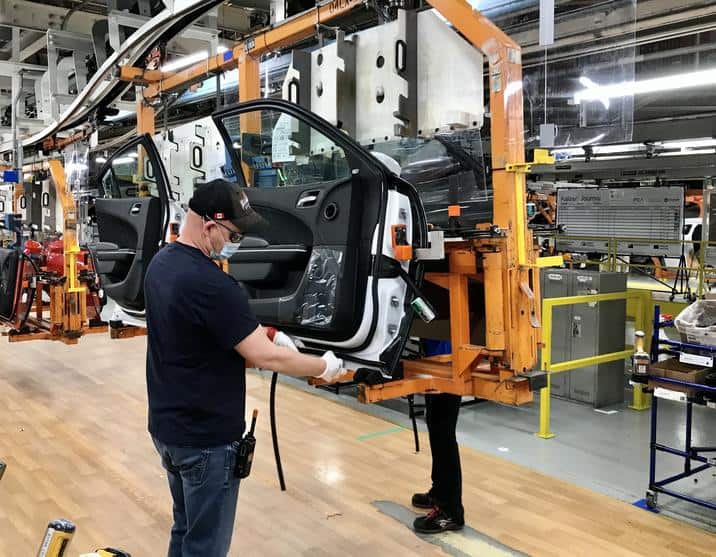
While an influx of $2.5 billion to help the auto industry is a welcome boost, Ottawa’s focus needs to be on reopening the Stellantis assembly plant in Brampton, the president of Canada’s largest private sector trade union says.
“Our auto sector and the workers who depend on (the plant) have been directly targeted by the Trump administration,” Unifor National President Lana Payne said in a release on Wednesday.
Prime Minister Mark Carney and Ontario Premier Doug Ford announced a $8.7-billion plan this week to help bolster the province’s key sectors — steel, critical minerals and auto manufacturing — as they continue to manage the fallout of tariffs from the United States.
The plan includes $2.5 billion for the automotive sector, with the federal government chipping in $1.5 billion.
And while Payne says the new funding will help support the auto industry amid the ongoing U.S. trade war on Canada, she says the government should “focus on sustaining threatened auto assembly operations in Brampton.”
“(Wednesday’s) announcement must propel both governments to address the most pressing challenge right now, and that’s to stop the closure and sale of Brampton Assembly plant and preserve auto assembly and the jobs that it supports,” Payne says.
The union is also calling for a solution to get workers back to the idled General Motors CAMI plant in Ingersoll.
Unifor workers at the Stellantis plant have voted overwhelmingly in favour of authorizing a strike as a bitter contract dispute with the automaker continues, with the future of the company’s shuttered Brampton Assembly Plant emerging as a major sticking point.
The vote followed two days of balloting on Oct. 17 and 18, as negotiations between the union and Stellantis remained at an impasse. The dispute comes as more than 2,200 workers at the assembly plant remain on layoff, with the facility’s future uncertain nearly three years after production stopped.
Last 30 Days: 60,728 Votes
All Time: 1,593,861 Votes
855 VOTES
What was the biggest factor in deciding your vote for mayor?
Stellantis is now pursuing a potential sale of the facility to Brampton-based Roshel Inc., a Canadian manufacturer of armoured vehicles. Brampton Mayor Patrick Brown has called the plant’s possible sale to Roshel a “betrayal,” and says Stellantis has allowed itself to be “bullied” by Trump’s attack on Canada’s economy.
Payne says the $2.5 billion in funding will “help automakers invest in modern machinery and upgraded production lines to strengthen the sector amid tariff turmoil.”
“We view this as a vote of confidence in our domestic auto sector that employs half a million Canadian workers,” she said. “It also reinforces a critical message: there is a future for auto manufacturing in Canada, and we must continue to fund it and fight for it.”
Unifor is calling for public investments to be paired with enforceable commitments, and says multi-billion-dollar funding agreements with automakers “must come with strict, long-term guarantees for Canadian production and jobs to prevent investment and manufacturing capacity from moving elsewhere.”
Canada has launched a dispute resolution process against Stellantis after the feds and the province pledged billions in subsidies to the automaker under various contracts. That included a joint commitment of $15 billion to help Stellantis partner with NextStar/LG for a new electric vehicle (EV) battery plant in Windsor.
INSAUGA Canada’s Editorial Standards and Policies
Stay in the know.
Subscribe now to receive our daily email of today’s top stories in your city!