
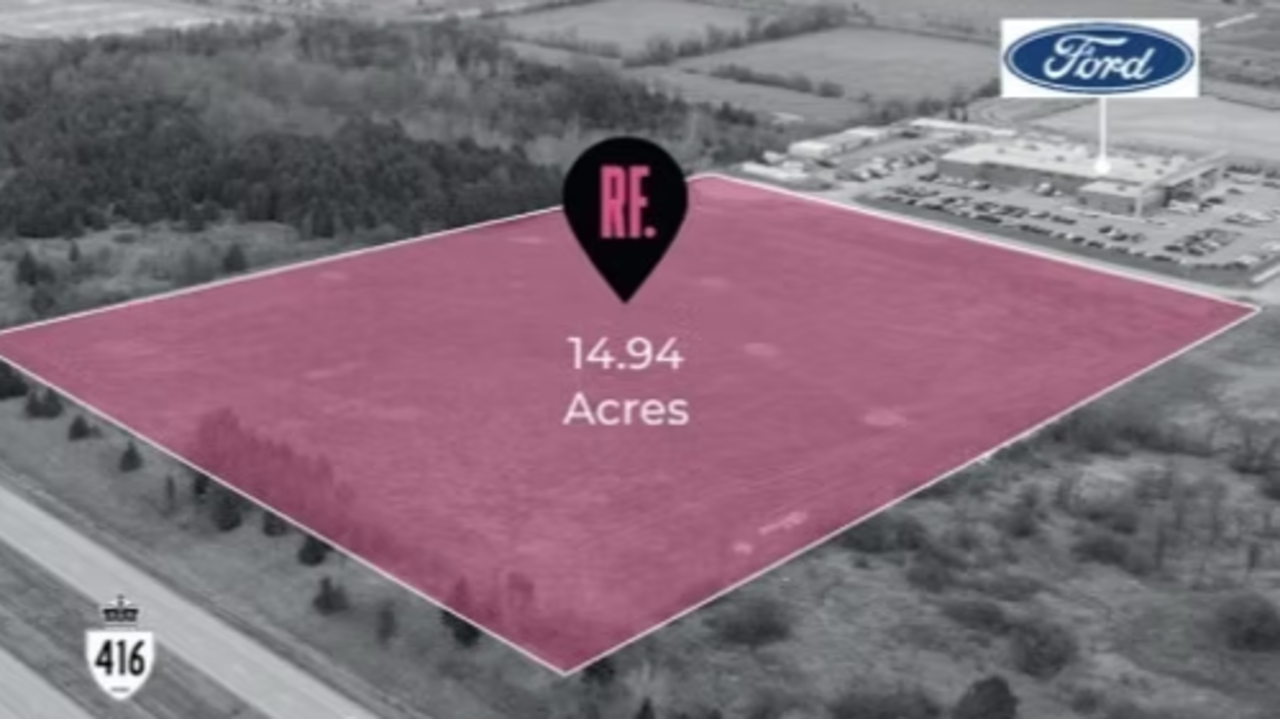
Rosefellow director of business development Adekambi Laleye says the company expects to break ground “in the next couple of months” on a new industrial facility on Dealership Drive in Barrhaven, just south of Amazon’s 2.8-million-square-foot fulfilment centre on Citigate Drive.
Get Instant Access to This Article
Become an Ottawa Business Journal Insider and get immediate access to all of our Insider-only content and much more.
The Montreal-based firm behind one of the largest industrial real estate developments ever built on spec in Ottawa is preparing to launch another major local project without a tenant in place.
Rosefellow director of business development Adekambi Laleye says the company expects to break ground “in the next couple of months” on a new industrial facility on Dealership Drive in Barrhaven, just south of Amazon’s 2.8-million-square-foot fulfilment centre on Citigate Drive.
Laleye says the plan is still being finalized, but it will include either a single building of about 300,000 square feet or two buildings of around 160,000 square feet, likely with 42-foot ceilings.
“We’re just working out the final details there,” he told OBJ at the Ottawa Real Estate Forum on Tuesday.
It would be the second speculative industrial project in Ottawa for Rosefellow, which constructed two buildings on Huntmar Drive in Kanata two years ago. One of those buildings remains unoccupied, but Laleye said he expects it to be leased by the end of this year.
The nation’s capital is one of the tightest industrial leasing markets in Canada, with an availability rate of 4.2 per cent in the third quarter, CBRE said earlier this month. That’s third-lowest among the 11 major cities the brokerage surveys, behind Winnipeg at 3.1 per cent and Calgary at 3.6 per cent.
At the same time, the availability rate of industrial space — which factors in both empty space and real estate that will soon hit the market — has nearly doubled in the past three years as new supply has been added to the city’s inventory and users look to cut expenses by downsizing or staying where they are.
But with federal defence spending set to rise from the current $75 billion annually to more than $95 billion by 2030, brokers say more and more companies are touring potential sites for factories, R&D facilities and warehouses in the National Capital Region as demand for military technology is poised to soar.
Laleye said that presents a massive opportunity for developers like Rosefellow, which is in talks to buy more industrial land in the Ottawa area.
“Obviously, there’s a lot of money that’s being unlocked right now by the federal government (for defence), so we’re going to see a lot of square footage absorbed,” he said. “Those (tenants) aren’t going to be able to wait the 18 to 24 months that it takes to build, so we’re going to continue to build on spec to make sure we’re ready for them when we need the space.”
Users in related fields such as aerospace are also flocking to Ottawa, said Laleye, who told a crowd of real estate executives on Tuesday that the region is just “two deals away” from not having any industrial spaces of more than 100,000 square feet left to lease.
‘When someone needs space, they need it now’
“The minute steel goes up, the phone starts ringing off the hook,” he said during a panel discussion on the future of Ottawa’s industrial market. “People don’t have the luxury of waiting anymore. When someone needs space, they need it now. Things change so fast.”
Neil Mason, a vice-president at the Ottawa office of Cushman & Wakefield who brokers industrial leasing deals, agreed.
“With all of this defence spending that’s coming in, it’s not all here yet, but there’s going to be this demand,” he said. “We’re going to have situations where we’re saying to (tenants), ‘We can have you a building in 18 to 24 months.’ But that’s going to be a challenge (for users), because that funding’s going to come in and they’re going to need to have space up and running right away.”
Asked whether the city can expect to see more projects the size of Amazon’s current warehouse in Barrhaven and an even larger 3.1-million-square-foot distribution centre being built for the e-commerce giant a few kilometres away, Laleye said those developments are “a bit of an outlier” because Amazon shut down all seven of its warehouses and distribution centres in Quebec last year and is now serving customers in that province from other locations, including Ottawa.
“But I think Ottawa will continue to attract large companies that will continue to set up large operations,” he said. “I don’t think it’s going to be a 3.1-million-square-foot facility, but I think other large facilities will be coming to the Ottawa market.”
Laleye said tenant requirements are changing. While most developments in Ottawa, including Rosefellow’s buildings on Huntmar Drive, currently have 32-foot ceilings, he said 42-foot heights are becoming the new standard in Montreal and expects the same trend to take hold in Ottawa.
“Flight to quality is a big thing right now,” Laleye said in an interview with OBJ. “People want to get out of the older (properties) and really maximize clear height, so that’s definitely a driving force.”
Labour shortage looming?
In addition, industrial users are demanding more power as AI, robotics and other emerging technologies become more prevalent in manufacturing and logistics operations, he noted.
Traditionally, industrial buildings in Ottawa have been equipped with a 2,500-amp power supply, he explained, but a growing number of tenants in larger buildings are now asking for 5,000-amp systems.
Still, while brokers and developers say they’re bullish on the future of the Ottawa industrial market, they also point to a few potential headwinds that could slow its momentum.
Matt Blasioli, a director at Ottawa-based industrial developer Avenue 31, noted there are already three massive projects either under way or proposed in the Ottawa region — the $1.4-billion modernization of the Canadian military’s special forces base at Dwyer Hill; Nokia’s new 750,000-square-foot campus in Kanata North; and a new data centre the federal government wants to build in the National Capital Region at a price tag of $1.5 billion to $1.8 billion.
Projects of that magnitude require a large number of skilled tradespeople, Blasioli explained, and he questioned where the workers needed to build all the projects will come from.
“There’s always been one big project that’s always kind of been sucking up labour,” he said. “And now we’re going to have three of them, maybe even more. We don’t know what else the government is going to announce. It just sucks up the local talent, and it sucks up materials.”
Blasioli said rising diesel prices and competition for materials from projects in the U.S. and other jurisdictions are driving up construction costs. Meanwhile, Ottawa also faces a potential shortage of industrial land with adequate power and other essential infrastructure, he cautioned.
“Running an industrial project on septic and well is not easy, especially if it’s a user that has manufacturing,” he said. “We need more serviced industrial land.”
Laleye said industry leaders and government officials need to act now to ensure Ottawa can accommodate future industrial growth.
“We have to work with local, provincial and federal governments to start unlocking a lot of that land and then start getting services out,” he said. “You can’t put these buildings on wells and septic tanks. It just doesn’t work long term. So it’s really working together to see what the market needs.”