
On 12 September 2026, at approximately 10:30 AM, I crashed shortly after starting a planned 45-mile ride on my ElliptiGO elliptical bicycle. I remember the beginning of the ride and making two turns, the second onto a flat, quiet road in a small-town neighborhood. The next thing I knew, I was on the ground, bleeding profusely from my nose, with several women helping me—I have absolutely no memory of the fall or any sense of why I went down (see “What a Broken Wrist Taught Me About iOS 27 Dictation and macOS Voice Control,” 21 September 2026).
My injuries were non-trivial, although they could have been much worse. I hit the left side of my head, cracking my helmet, strained muscles in my left hand, fractured the scaphoid bone in my right wrist, and picked up discrete points of road rash on my left ankle, knee, hip, chest, and elbow, plus all down the center of my face: forehead, nose, upper lip, and chin. Weirdly, despite the hand injuries, I had no road rash on my hands, even though I had forgotten to wear my biking gloves. The ElliptiGO mostly suffered scratches and abrasions, although the bar-end grip on the right handlebar was broken.
Whenever an incident involves memory loss, medical professionals become extremely interested in why. At the ER, I had a CT scan that showed no brain bleeds or other injuries, and since I was entirely lucid and talkative, they focused more on my hand and skin injuries. But when I talked to my primary care physician a day or two later, he referred me to neurology and cardiology to learn more about what happened.
Head Trauma or Blackout?
There were two basic possibilities. Most obviously, I hit my head! That can cause amnesia, as we all know from exciting movie plots. But another, more worrying possibility loomed. What if I didn’t remember what happened because I blacked out or had a seizure, and that caused the crash? People faint all the time, and in fact, I had a fainting episode four years ago while doing via ferrata at Whistler in British Columbia (see “AppBITS: Drink More with HiWater,” 13 February 2026). Plus, could my February 2025 skating accident have been caused by a similar brief blackout? Not being able to remember was maddening, because there’s a big difference between crashing because a dog ran in front of me and my brain turning off briefly.
Arguing against a crash caused by a car, dog, or some other external factor was the fact that all of my skin injuries were relatively small, just an inch or two in diameter. People who go down while riding at speed almost always end up with large scrapes covering much of the skin that was exposed to the road. How could I have hurt my ankle, knee, and hip without scraping any of the skin on my leg in between those spots? And if I were moving quickly, how did I not injure the skin on my hands?
Exploring the Data
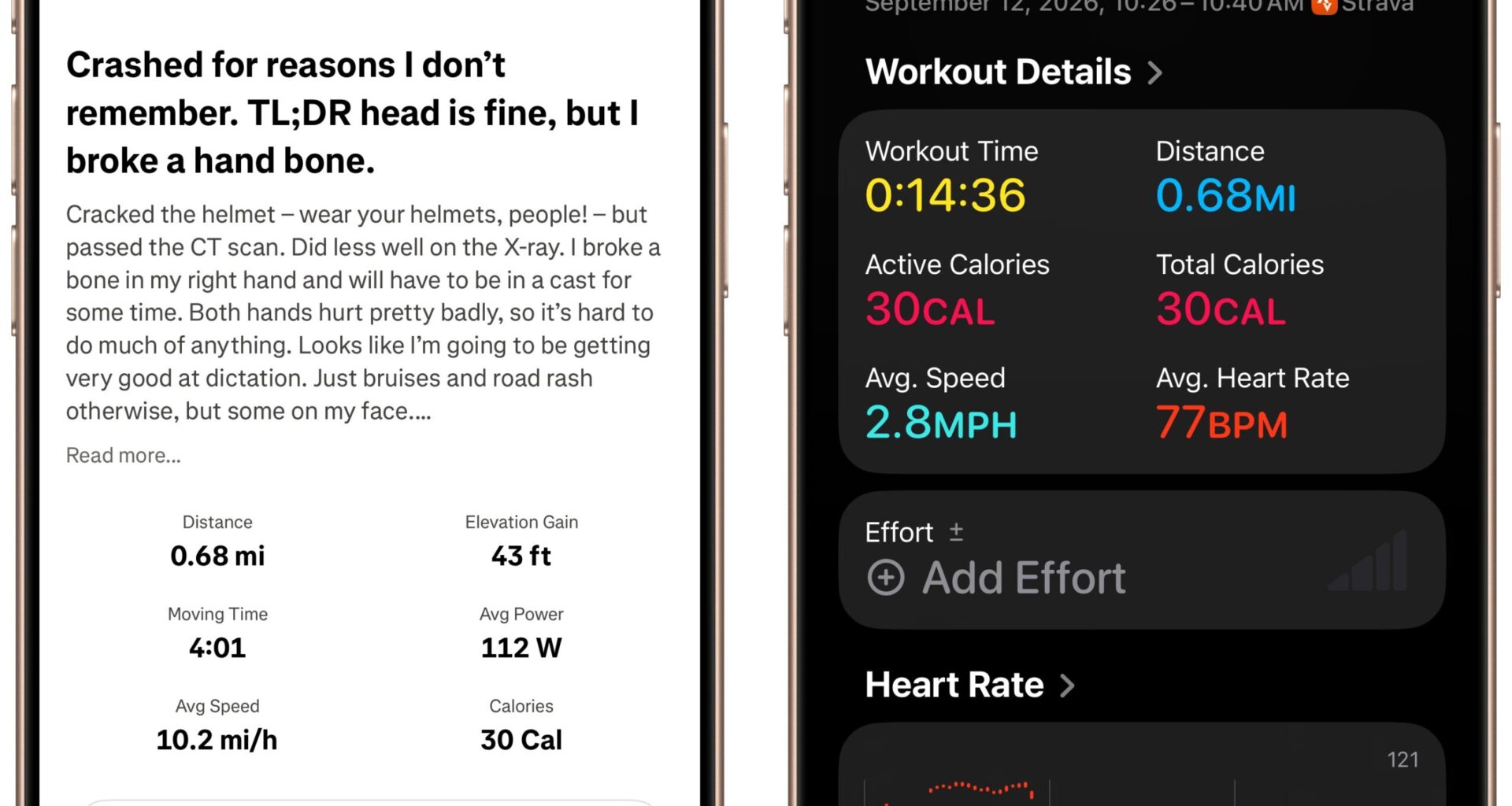
Perhaps my iPhone and Apple Watch could shed some light on the situation. Looking at my Strava effort, I could see that I started the ride at 10:26 AM and rode for about 4 minutes (and yes, Strava’s AI-based “Athlete Intelligence” is truly stupid—it seems to think that the ride was short because I was recovering from a crash rather than because I crashed). Because Strava (left) was running on my iPhone for navigation, it didn’t have heart rate data. However, I was also using Workouts on the Apple Watch, which does record heart rate data, so I have two entries in Apple’s Fitness app for the workout. Inexplicably, Fitness shows the Strava-sourced entry with extensive heart rate data (right), while the Apple Watch Workout entry has much less, the opposite of what I’d expect.
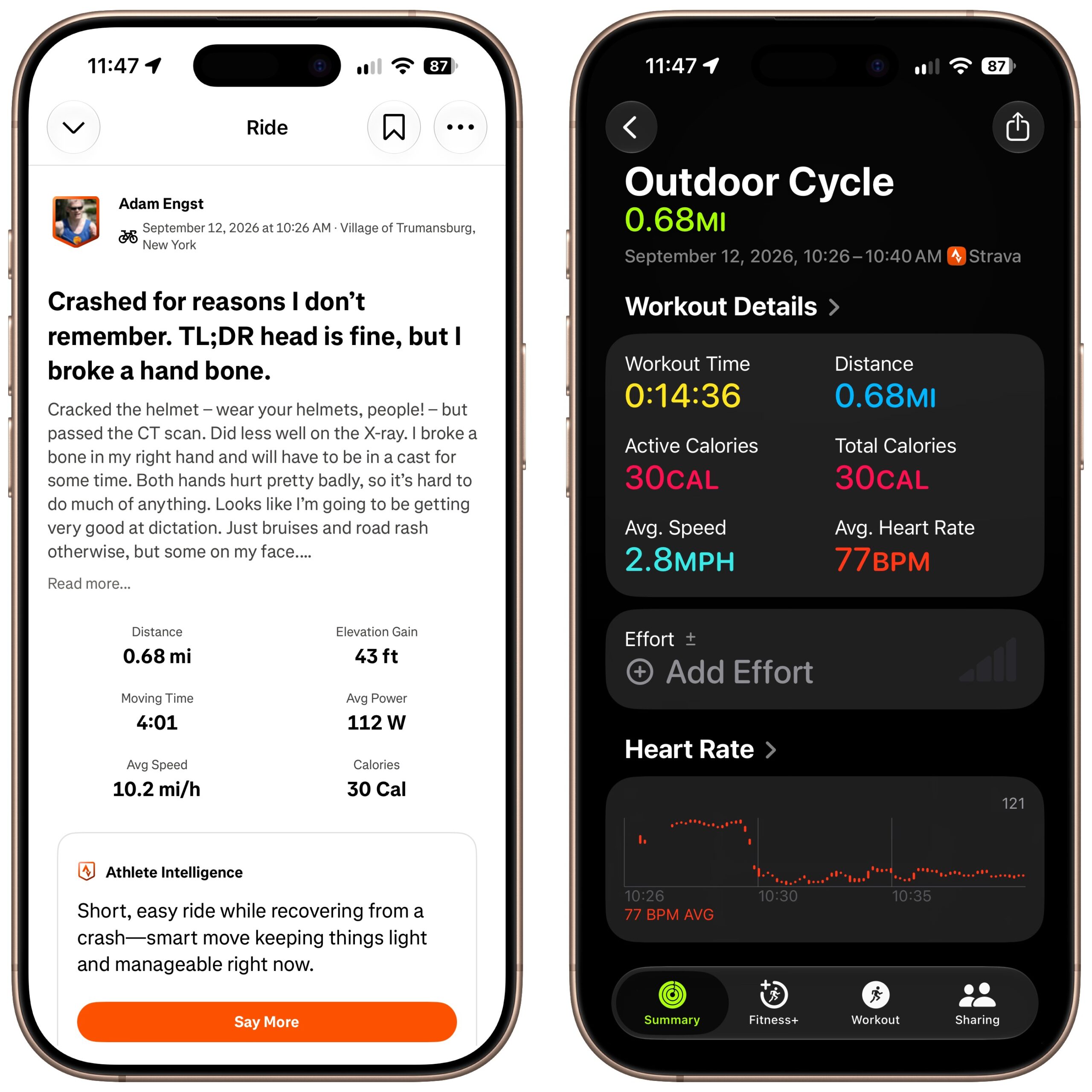
Aha! If I started at 10:26 AM and rode for four minutes, that would suggest I crashed at 10:30. The graph in the Fitness app pretty clearly shows a precipitous drop in heart rate from about 120 bpm to about 60. That suggests what’s called cardioinhibitory syncope, where a drop in heart rate causes fainting.
However, when I fainted at Whistler, my heart rate was 38 bpm, and it stayed that way for several hours in the ER afterward. Plus, I felt terrible when I woke up after fainting and continued to feel lousy for a few days afterward. In contrast, although the drop to about 60 came quickly, it remained there, and apart from the shock of falling, I felt basically normal within a few minutes after waking up. So something was different.
The next question was how this drop in heart rate compared to what my heart does after a normal workout. That was relatively easily answered by looking at previous rides in the Fitness app, which showed an average post-workout drop of about 25 bpm over 2 minutes. When I looked at the All Recorded Data screen for heart rate in Apple’s Health app, I discovered that the 60 bpm after the crash took only 46 seconds. More interestingly, the timestamps showed the heart rate drop starting at 10:30:12 and ending at 10:30:58, seemingly after the crash, not before it. Curiouser and curiouser.
My doctor was also interested in how long I was out. Unfortunately, the woman who helped me, and whose name and phone number I somehow ended up with, was second on the scene, and we’ve been unable to track down the first woman to ask her if she remembered seeing the crash or anything else from when she first came upon me. (In a classic small-town scenario, our friends who live nearby know her by first name and sight, but only while walking, so we have to wait until they happen to run into her again.) It appears I crashed at 10:30, and the Phone app shows me calling my wife Tonya at 10:41, so by then I was cognizant enough to make a phone call at the urging of my helpers. But that was 11 minutes later and thus not helpful.
By this time, I had neurologist and cardiologist appointments scheduled, and I wanted to provide them with as many of the details as I could summon along with a history of other potentially similar events, such as fainting at Whistler and falling while skating. (I had a couple of other situations where I felt lightheaded or had vertigo for unexplained reasons.) Between my injured hands and mental fatigue from the post-concussive symptoms, I decided that the best way to collect all this data was to talk at Claude and have it build what turned into an 8-page PDF summarizing everything I said. This turned out to be a fascinating and instructive experience, because Claude also wanted to analyze everything I told it and asked for data beyond the Strava speed graph and the Fitness heart rate graph.
Claude Digs Deeper
Although the Health app lets you see all recorded data, it does not let you export selected data, which is what Claude was prompting me to do. The only way to get data out of Health is to export everything by tapping the profile icon at the top right of the Summary screen and then selecting Export All Health Data. When I did that, I got a 255 MB ZIP file that expanded to a whopping 6.7 GB of data. BBEdit was able to open the main 4.7 GB export.xml file eventually, but it was way too big to work with in any real way. Claude was undeterred, though. Working in the Linux virtual machine that runs via Claude’s desktop app on my Mac, it converted the export into an SQLite database and queried it with Python. Magic! This enabled me to ask natural language questions about absolutely everything recorded in Apple Health since the beginning, which was 19 September 2014, right after I installed iOS 8.
Armed with this newfound capability, I asked Claude about all the data in Health in the minutes surrounding the crash. (I could also query it about fainting at Whistler and the skating fall, but there was much less data from both of those times.) For the cycling crash, Claude found GPS-related speed data along with heart rate readings, and even a recorded fall—Health has an Other Data category that records falls. Then it built a graph showing speed and heart rate with per-second precision for speed and every 3–5 seconds for heart rate data.
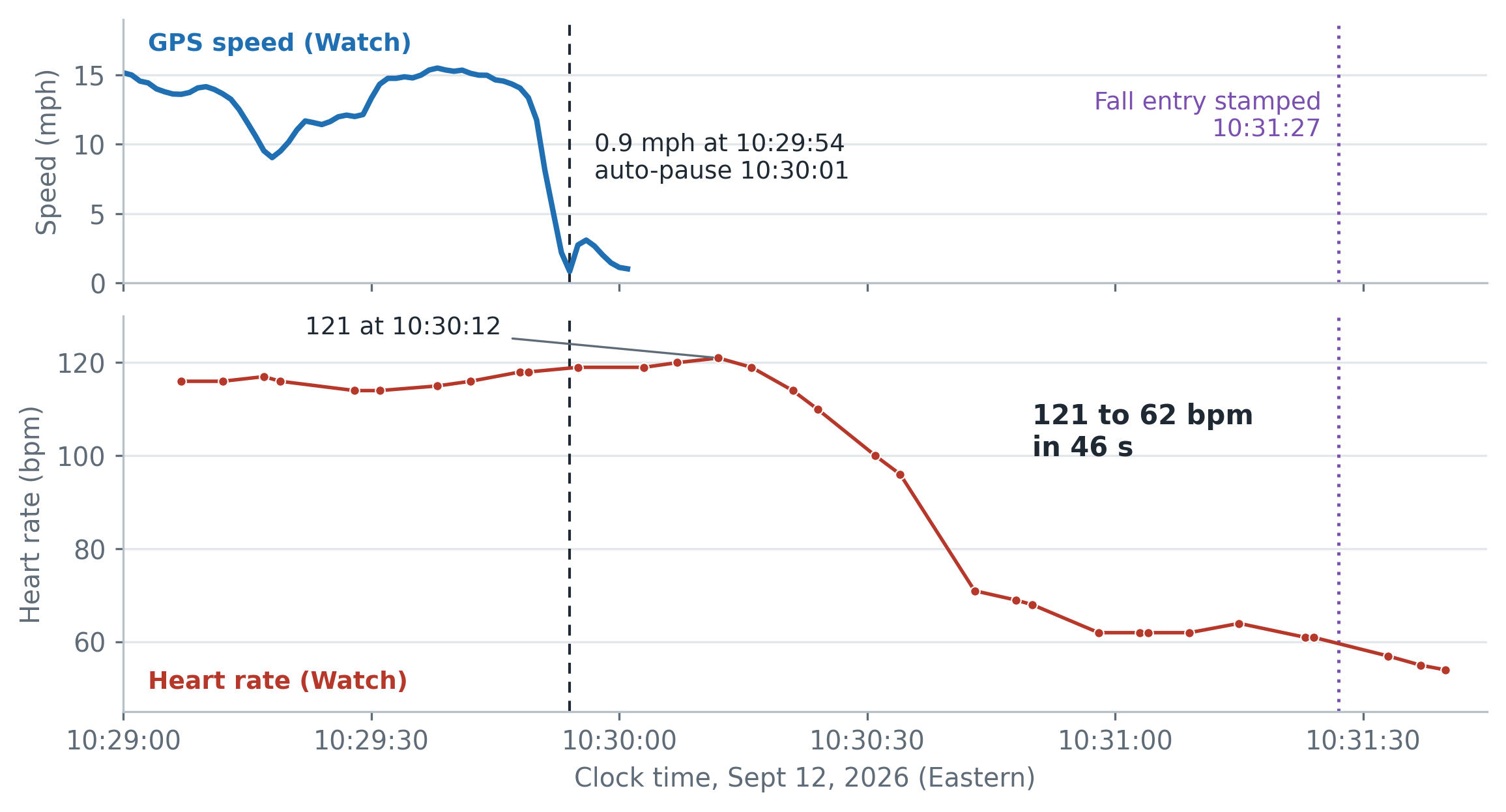
First, the graph confirmed that I didn’t crash at speed. Instead, I slowed down from 15 mph to almost a stop over about 6 seconds before falling. That suggests I felt something was wrong and braked, but couldn’t come to a complete stop before my brain shut off.
The graph also confirmed that the heart rate drop came after the crash. I probably hit the ground in the seconds just before 10:30, since the watch auto-paused at 10:30:01. But what about the fall entry being time-stamped almost 90 seconds later? This is weird. However, Apple says:
If your Apple Watch detects that you’re immobile for about a minute, it begins a 30-second countdown, while tapping you on the wrist and sounding an alert. The alert gets louder, so that you or someone nearby can hear it. If you don’t want to call emergency services, tap Cancel. When the countdown ends, your Apple Watch automatically contacts emergency services as well as your emergency contacts.
I don’t remember seeing the fall alert, let alone dismissing it, but there was no automatic call to emergency services in the Phone app, which suggests I canceled it just before it would have called. We athletes tend to assume that we’re fine and certainly don’t need help, no matter how bad the fall, so it’s entirely likely that I canceled the alert during the period of memory loss. I can’t explain why the fall was recorded, since Apple also says:
Falls are automatically recorded in the Health app, unless you reply that you didn’t fall when your Apple Watch asks. To check your fall history, open the Health app on your iPhone, then tap the Browse tab. Tap Other Data, then tap Number of Times Fallen.
Even though the fall data didn’t shed any useful light on the event, my cardiologist called the graph “mind-blowingly awesome” because it suggested that vasodepressive syncope (fainting because of a blood pressure drop) was far more likely than cardioinhibitory syncope (fainting because of a heart rate drop). In both cases, the brain doesn’t get enough blood, which is a Very Bad Thing, even for a very short time—hence the fainting. He was unperturbed by the quick drop in heart rate after the fall, saying that such a response was relatively normal. (The neurologist had me get an EEG and MRI, both of which were entirely normal and thus argued for syncope and against a seizure.)
Just the Facts, AI
While he was nice about it, the cardiologist was much less enthusiastic when I asked him if the overall 8-page PDF summarizing everything was useful. He said it was too much to read, especially in the short time he had for appointments, and he even preferred human-written medical notes to AI-summarized dictated notes, which he felt were unnecessarily verbose. My takeaway is that using AI to extract and summarize Health data for a medical professional can be extremely useful, but you need to put effort into making it focus on the essentials.
Personally, I’m still working my way through the medical flow chart. It looks like I’ll have a tilt table test sometime soon to see if that helps explain the fainting episodes, though I’m hoping the post-concussive symptoms continue to decline such that I can avoid having to see the concussion specialists. For now, the cardiologist reiterated his 2022 advice to drink more water and eat more salt, which I’m taking even more seriously this time. The next challenge will be to see if an app or an AI can help me figure out how I am possibly going to consume 5–7 g of sodium (not salt, which is only about 40% sodium) per day, given that I cook most of my food from scratch rather than eating the processed or prepared food that gives most Americans their excessive sodium intake. I’m also looking forward to getting a blood pressure monitor that syncs its data to Health so I can analyze the effects of these dietary changes.