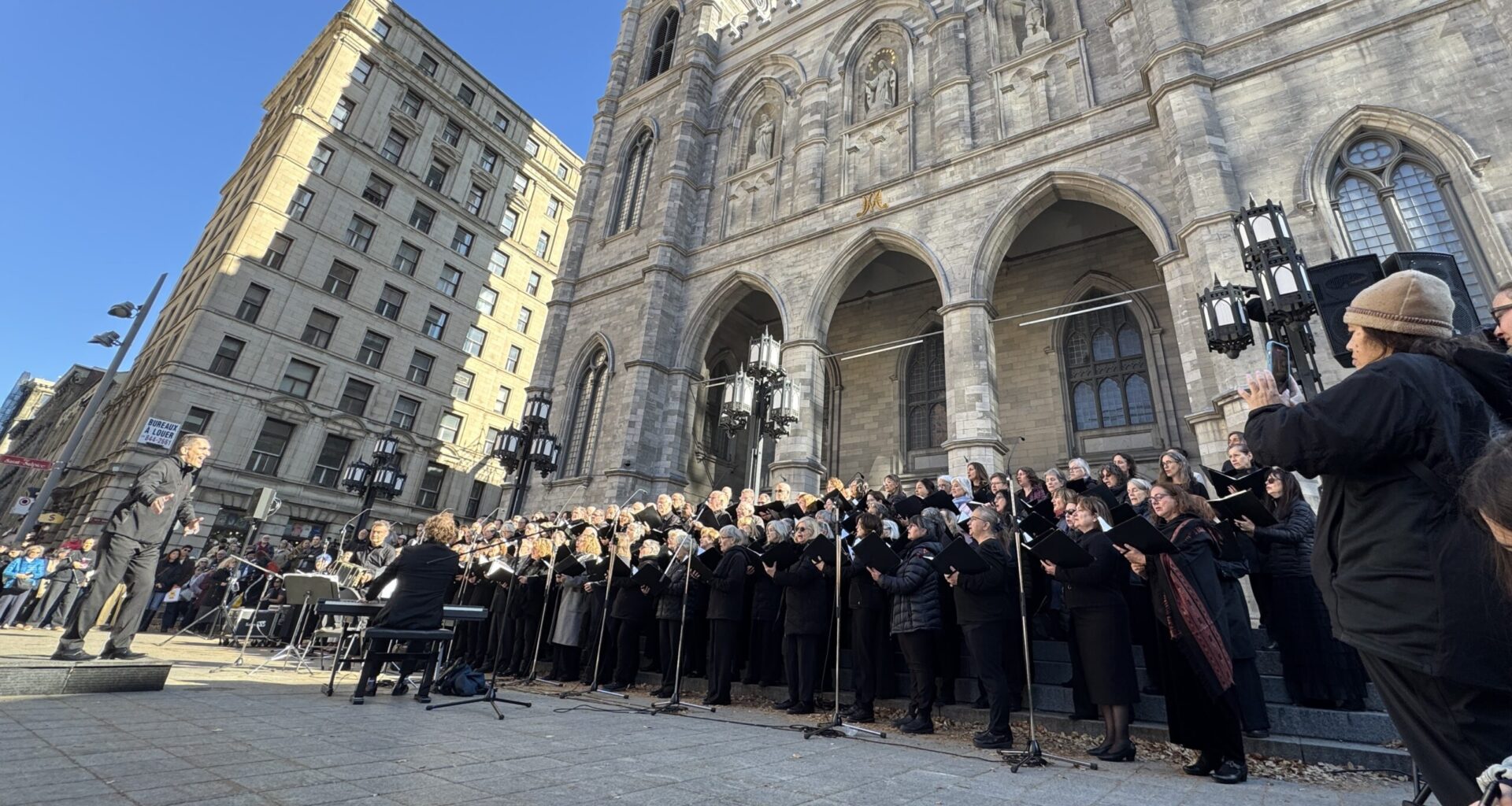
Montreal’s Notre-Dame Basilica unveiled its restored facade Sunday, marking a milestone in the ongoing restoration of the historic landmark.
The event marked first public presentation of the restored facade which had been hidden behind scaffolding for years crews carried out extensive masonry repairs and conservation work beginning about a decade ago.
More than 800 guests were expected to attend the event featuring performances both outside on the Basilica’s plaza and inside the church.
The program includes performances by the Société philharmonique du Nouveau Monde, featuring more than 150 musicians, Martín Palmeri’s Misa Tango under the artistic direction of Maestro Michel Brousseau, along with an organ interlude by Jean-Willy Kunz.
A $100-million restoration
While the facade is now complete, the broader restoration of Notre-Dame Basilica is far from over.
The overall project, covering both the exterior and interior of the church, is estimated to cost $100 million and is expected to continue for several more years. The Basilica has been funding the work through donations, fundraising campaigns and initiatives including its Le Firmament café on the plaza, a partnership with Café Saint-Henri.
Michel Issa, general manager of the Fabrique de la paroisse Notre-Dame de Montréal, previously estimated that interior restoration could take another five to 10 years with completed expected by 2035.
The project involves everything from masonry repairs to the conservation of historic murals inside the Basilica. Conservators have been working to preserve the building’s historic painted decorations rather than repainting them.
Dinu Bumbaru, director of policy at Heritage Montréal, says the long duration is normal for restoration of such historical monuments.
“Notre Dame Basilica is one of those few buildings in Montreal we could say that if we had in theory to relocate (…) Montreal into a safe planet we would consider taking it in the luggage,” Bumbaru said.
He says materials needed for the restoration work are in short supply these days compared to when the structure was build in the 1820s.
“We talk about natural heritage when we talk about the forest, but the greystone of Montreal is a natural feature that is used in buildings,” Bumbaru said. “It’s very hard to find (their equivalents) because the quarries are closed.”
Bumbaru adds that there was also a shortage of workers skilled in the kind of work.
“Somehow we didn’t realize that we were treating our labouring skills for building in a way that led them to become endangered species,” he added.
Keep it Factual
Add CityNews Montreal as a trusted source on Google to see more local stories from us.