
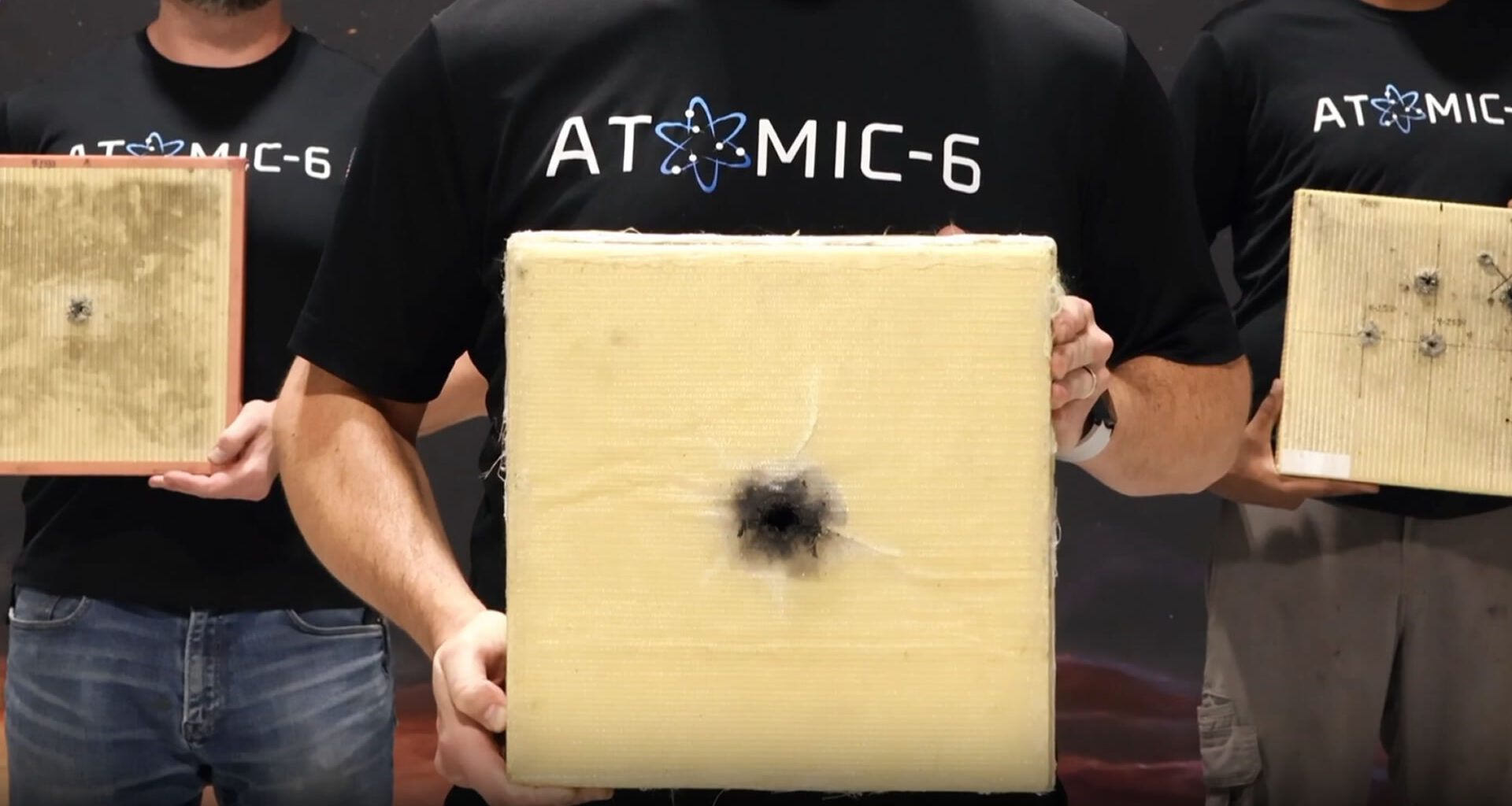
Atomic-6 has announced that its proprietary Space Armor technology has been deployed into space for the first time. Installed on a Portal Space Systems’ Starburst-1 spacecraft, the craft was launched aboard a SpaceX Falcon 9 during its Bandwagon-5 launch from Cape Canaveral, Florida.
Atomic-6’s Space Armor is a new lightweight composite armor for satellites designed to help them survive impacts from space debris. Specifically, it is designed to absorb impacts from tiny impactors without creating more debris of its own.
You can liken it to a kind of bulletproof vest for spacecraft. And the need for this kind of protection is only growing.
Currently, the space around our planet is full of junk. Not just dead satellites and discarded rocket stages, but millions of tiny fragments travelling at enormous relative velocities.
Even a tiny fragment can cause catastrophic damage when it hits a satellite at these kinds of velocities. Consider a 3 mm diameter aluminum sphere travelling at 7 km/s (15,659 mph/25,200 kph).
Space debris armor for satellites
If the debris only weighed about 38 milligrams, it could deliver something like 0.93 kilojoules of kinetic energy on impact. That’s roughly comparable to the muzzle energy of some powerful handgun rounds, although the physics of a hypervelocity impact are very different.
And, just like a bullet, the energy is concentrated into a relatively small impact area. Such small pieces of junk are also impossible to track and therefore avoid.
One solution is to simply clad your spacecraft in armor to take the hit. Various solutions exist today, but one of the most common is something called a Whipple Shield.
Such armor typically consists of an outer sacrificial bumper that is separated from the main craft by space. When hit, the projectile breaks up, melts, and partially vaporizes.
The resulting cloud of fragments spreads the impact over a much larger area, allowing the rear wall to withstand it more effectively. Another rear wall attached to the craft then safely absorbs this cloud of debris.
While effective, this armor can produce more debris of its own, turning a single piece of junk into even more. Such armor also increases the size of a spacecraft and can be bulky.
This is where Atomic-6’s armor comes into its own. Its solution is to provide a means of protecting the craft while also preventing the generation of even more junk.
Proof of the pudding is in the eating
It is also designed to be lightweight and relatively thin. The exact composition of its armour tiles is proprietary, but the company describes using a specialised fibre-to-resin manufacturing process. That suggests a carefully engineered composite in which reinforcing fibres are embedded in a polymer matrix.
The result is a relatively light material able to prevent penetration while also absorbing secondary debris. It is also described as radio-frequency transparent, meaning it can be applied not only to the main “hull” but also to antennae and other comms equipment.
While Space Armor has already undergone ground-based hypervelocity testing, its deployment aboard Starburst-1 offers an opportunity to assess its performance in orbit. Atomic-6 is actually hoping the spacecraft gets struck by debris, allowing the company to capture the impact on camera and assess the shield’s performance using onboard telemetry
“We’ve proven Space Armor® tiles can withstand debris traveling at extraordinary speeds without generating harmful secondary fragments,” Trevor Smith, CEO, Atomic-6, told PR Newswire.
“Now, we’re putting that technology to work aboard Portal’s Starburst-1, taking an important step toward scaling its deployment and making space safer and more sustainable,” he added.