
Nova Scotia’s marquee environmental law is five years old and it’s due for a public review, but most Nova Scotians will not be invited to weigh in.
The Environmental Goals and Climate Change Reduction Act passed in 2021 with all-party support, and it says the environment minister “shall request the round table to carry out a public review … no later than five years after this act comes into force.”
That deadline is coming up in November.
Environment Minister Tim Halman says he’ll meet with his roundtable — an advisory committee made up of members of the public — next month to bring him feedback on the act. He said that engagement satisfies the requirement.
“It’ll be a very comprehensive discussion on the goals, where we’re at, where we can go, how we can modernize,” Halman said in an interview, adding that he’ll be willing to tell the broader public what’s discussed.

Tim Halman has been Nova Scotia’s environment minister since the Progressive Conservatives formed government in 2021. (Robert Short/CBC)
Members of the roundtable are appointed for three-year terms, which can be renewed. It currently has 13 members:
Scott Skinner (Chair) Angie GillisJeff MacCallumLouise DelisleChijioke EmenikieMichel RaymondSteve MacLellanElisa ObermannJuanita SpencerJohn ChisholmMargaret MacDonaldSusanna FullerSachi Gibson
Tina Northrup, a staff lawyer at East Coast Environmental Law, said a review should invite feedback from all Nova Scotians.
“Whether that be in writing or through community dialogue sessions of some kind, I think that would be appropriate,” she said in an interview.
Northrup said now is a good time to evaluate how much progress has been made and think about whether the goals need updating, especially since the UN recently said it’s become impossible to keep global warming below 1.5 C.
“That changes the way we need to think about our commitments to reach net zero and our commitments to really take urgent action on climate change mitigation,” said Northrup.
Some goals abandoned
Nova Scotia’s legislation includes 28 goals. The Environment Department says 13 are complete — although some were completed late.
Many are ongoing, with deadlines at the end of the decade, and at least one is confirmed to have been abandoned. Others appear to have fallen by the wayside, including a mandate for more zero-emission vehicle sales, a solid waste plan and an active transportation strategy, although the government says work is still ongoing.
“It’s about priorities. We remain committed to the goals and we keep working on many of them, as we can,” Halman said.
“A top priority of this government is the clean renewable transition so that we emerge as a — as the premier says — an energy superpower,” he added.
To that end, two key goals in the act are to transition the power grid to 80 per cent renewable sources and cut greenhouse gas emissions at least 53 per cent below 2005 levels — both by 2030.
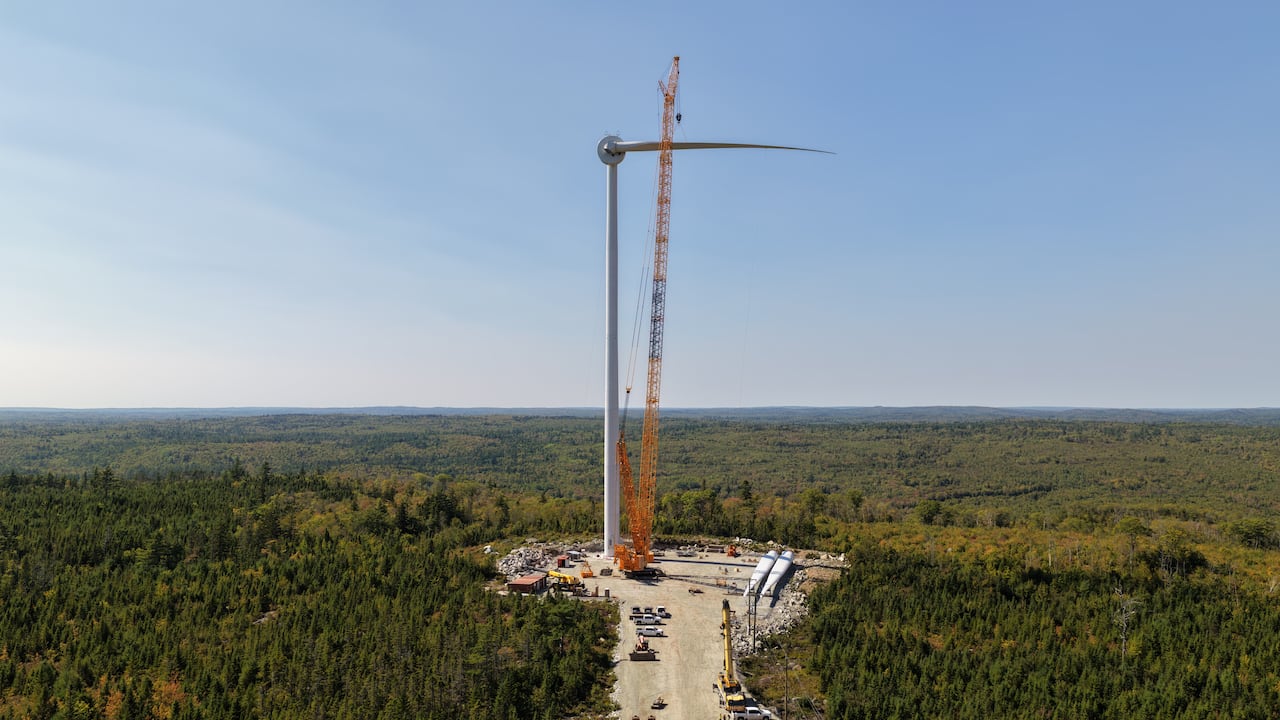
A crane lifts a turbine blade into place for installation at the Benjamins Mill wind farm in Hants County, N.S., on Sept. 17, 2025. Nova Scotia is counting on more wind farms going up before 2030 to meet its clean energy goals. (Brian MacKay/CBC)
While Halman says we’re on track to meet those targets, others are skeptical, including Northrup.
“I have not seen, myself, enough concerted effort being made by the province to convince me that the work is being done to ensure those reductions are achieved,” she said.
Northrup noted that emissions reductions have been relatively stagnant in recent years, and said the province is relying too heavily on several yet-to-be-built onshore wind farms.
Time to look beyond 2030
Marla MacLeod, director of programs at the Ecology Action Centre, said this five-year review is an opportunity to extend the province’s outlook on climate change reduction efforts.
“Many of the goals in [the act] are for 2030, and we’re getting very close to 2030. So now we need to be talking about: What do we want between now and 2035, 2040?” said MacLeod, who served a three-year term on the roundtable from 2021 to 2024.

Marla MacLeod is director of programs at the Ecology Action Centre and was a member of the environment minister’s roundtable from 2021 to 2024. (Taryn Grant/CBC)
To answer the question of what comes next, MacLeod said the province needs to solicit input from the broader public. However, she said it’s essential for Nova Scotians to have a detailed understanding of the progress that’s been made so far, and that’s not possible without more information.
“There should be an honest accounting of where we’re at,” she said.
The province’s annual progress report on the climate plan used to include an appendix with details about the work done on each goal. This year the report had no such appendix. Halman said at the time it was simply a formatting change. He reiterated that point this week.
“I think we’ve done a pretty effective job in being open and transparent in terms of how we’re reporting on these goals,” Halman said.
Work needed on transportation, buildings
Electricity is the biggest contributor to emissions in Nova Scotia, but second and third place go to transportation and buildings, respectively.
MacLeod said to reduce the transportation-related carbon footprint, there needs to be more government investment in public transit.
“Some things have happened — we have the formation of Link Nova Scotia,” she said, referring to the Crown corporation created in 2021 to address transportation issues. “But there’s a lot to be done on the transportation file to move … people around our province and our cities and our towns in a way that’s more sustainable.”

Lorrie Rand is co-owner of Habit Studio, a design firm that specializes in high-performance buildings. She’s also a senior adviser at ReCover Initiative, a non-profit focused on energy-efficient retrofits. (Neil Benedict/CBC)
Lorrie Rand, a building science specialist who works on passive and net-zero designs, said Nova Scotia has reduced its emissions with respect to buildings as a direct result of the act, but she wants to know what’s coming next.
The province adopted a set of new federal building codes for energy efficiency in 2025, which contains an escalating minimum standard for energy efficiency. It has committed to meeting new minimum standards up to 2027, but Rand said there are no commitments beyond that.
If the industry is going to continue improving the efficiency of new builds and retrofits, it needs to start getting ready now, she said.
“We don’t know beyond 2027 what trajectory the province of Nova Scotia is proposing, which I think is a problem,” said Rand.
She said builders need to know what skills their workers will need, and supply chains will need to adapt to provide the necessary materials.
“And every time we kind of jump, there’s a little bit of nervousness about what the jump means in terms of the cost of projects,” she added.
Rand said most of the projects she works on through the architecture firm she co-owns, Habit Studio, already meet the highest standard for energy efficiency.
“I want everybody else to come along. I want what we do every day to be the kind of industry norm, because it is doable.”
MORE TOP STORIES