
Move over Vancouver. Surrey may become the provincial government’s new favourite child.
With the B.C. Conservatives sweeping every seat south of the Fraser River, including all 10 ridings in Surrey, this area of the Lower Mainland is expected to receive more attention from the incoming government.
Much of that new political focus will fall on fast-growing Surrey, which is projected to surpass Vancouver’s population by 2030 to become B.C.’s largest city.
Re-elected Conservative MLA Trevor Halford argued Surrey should be seen as B.C.’s future economic engine, but was often “forgotten” about by the NDP.
“I think that (Surrey) has got the potential to really drive our economy,” said Halford, representing Surrey-White Rock for a third term. “This is an area that I think the NDP had taken for granted for nine years. … People were frustrated at the level of services that they were seeing in Surrey.”
In Vancouver, Conservatives now have four seats — three snatched from the NDP, plus one it won in 2024 — while the other eight ridings were held by the NDP.
Like Halford, newly elected Conservative MLA Garry Thind doesn’t believe Surrey should get special attention at the expense of Vancouver. Rather, he said there should be “balanced” commitments to municipalities throughout the province.
“(Surrey) always got treated as a second-class city by the previous government, and we never got the resources that we were supposed to get,” said Thind, who flipped Surrey-Guildford from orange to blue.
“By having all 10 seats in the favour of the Conservatives, I think we are in a very strong position to get things done for Surrey.”
That includes fighting for infrastructure projects that Thind contends were “neglected” by the NDP.
Conservative political strategist Angelo Isidorou believes Surrey already is the “epicentre of Metro Vancouver” given its fast pace of growth.
But the city’s voters felt “slighted” by the previous NDP government, he said, for three main reasons: Only Vancouver had a children’s hospital, despite the rising number of families in Surrey; Vancouver has had more subway expansions; and the perception that more government funding goes to Vancouver, despite a large number of taxpayers living south of the Fraser.
“Surrey and its residents have felt for some time as though they get the short end of the stick,” Isidorou said.
Just 48 hours before Saturday’s election, NDP leader David Eby had spent the entire day in Surrey, promising “big projects” such as SkyTrain expansions and hospitals.
“Surrey will soon be B.C.’s biggest city, and it’s at the heart of my vision for our province’s future,” Eby said last Thursday.
SFU political scientist Sanjay Jeram noted the NDP and Conservative platforms had similar promises for Surrey, including for transportation, schools and health care.
“These are things that had become somewhat of a consensus on the right and left,” he said. “It’s not like they were that far apart.”
On issues such as Surrey’s concern over not having its own children’s hospital, Jeram argued it is routine for specialized services, like pediatric or cancer care, to be located in the centre of large metropolitan areas, as they are in Toronto.
“It’s not like there’s been this explosion of infrastructure in the 905 (Toronto suburbs), even though it’s grown dramatically,” he said. “For the most part, if you’re attracting top (health care) talent to these kinds of institutions, usually they want them to be in the city centre, not in Surrey.”

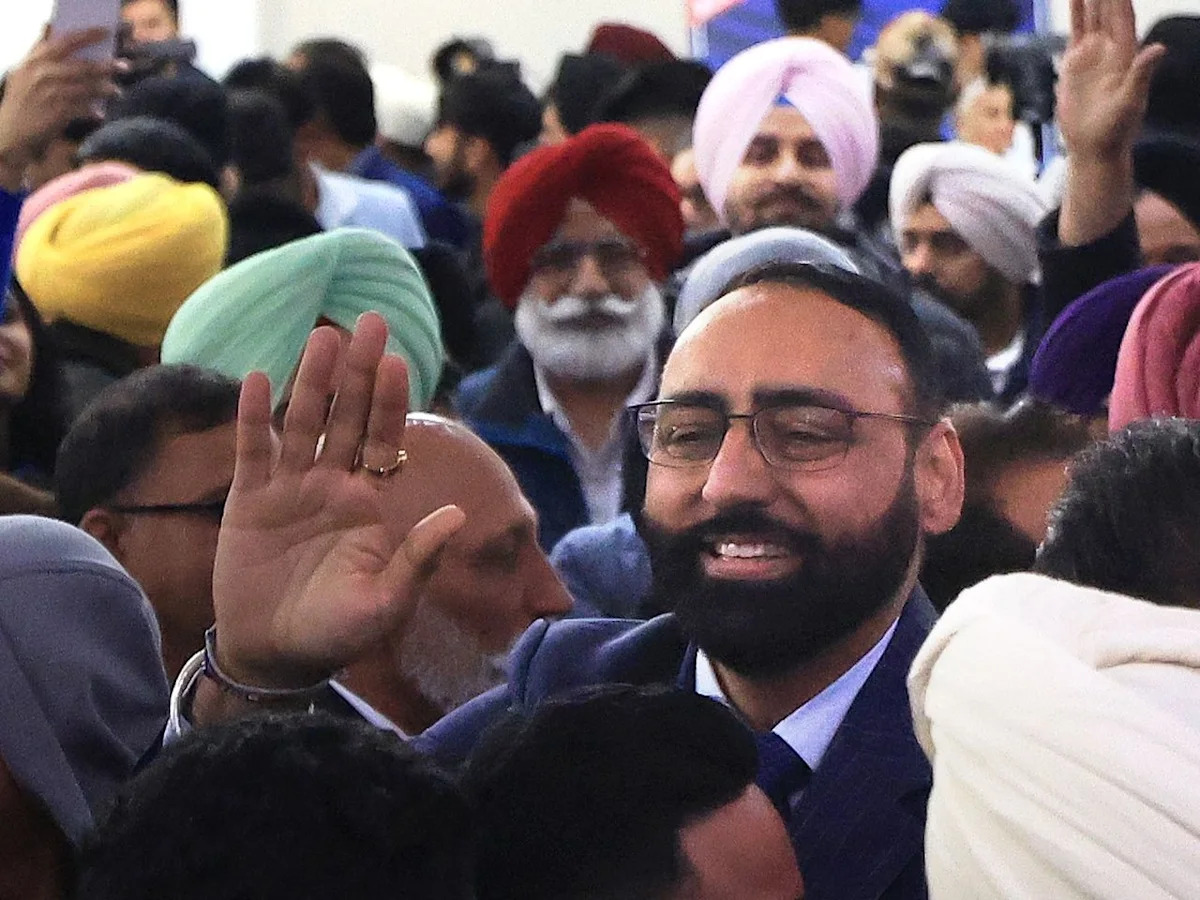
Surrey-Guildford MLA-elect Garry Thind is mobbed by supporters as he celebrates his win in Surrey on Saturday night.
Thind, though, asserted his party would fund a children’s hospital on land provided by city hall, because it is needed to serve Surrey’s population.
And Thind, a former Surrey school board trustee, maintained the NDP didn’t keep its promise to reduce portables in the city, saying the number of temporary classrooms has nearly doubled over the last decade.
Conservative premier-designate Lorne Doerkson also pledged to expand SkyTrain to Newton, backing the municipal campaign promise of newly elected Surrey Mayor Doug McCallum.
So how will Conservatives deliver on new infrastructure, when the party also promised a $1,000 tax cut for most British Columbians, as well as no future tax increases?
The new government will create conditions for a “thriving private sector” that will generate money to fund government investments, Halford said. For example, revitalizing B.C.’s flailing forestry industry in areas such as 100 Mile House, Prince George or Williams Lake will also benefit Surrey, which has thousands of forestry-related jobs.
Conservatives say they will also get help from the federal government for the SkyTrain expansion and promise to find provincial cost savings, such as building a cheaper bridge instead of the NDP’s more-expensive plan for a George Massey Tunnel replacement.
“We’ve got a lot of work to do,” Halford said.
Jeram predicted there would likely be a “heavy representation from Surrey” in Doerkson’s new cabinet as a nod to the city’s expanded seat count. Thind and Halford declined to comment on possible cabinet appointments.
Related