
MLB Network is nearly all-day media day coverage across MLB Now, MLB Central, MLB Tonight and MLB Tonight: National Pregame Show for the Brewers-Rays
The 122nd World Series may be in danger of being a sweep after Game 4 tonight, but regardless of how long the series runs, MLB Network is providing fans with no shortage of Fall Classic programming. With up to 13 hours of programming on game days, from MLB Central at noon ET through MLB Tonight postgame, coverage can run past 1 a.m. ET and the network is also producing the world feed distributed to MLB rightsholders around the globe. And, for the first time at the World Series, the league is streaming batting practice live on MLB’s YouTube channel.
The operation splits between Milwaukee, Tampa, and MLB Network’s Secaucus, NJ, headquarters, where the bulk of the directing, producing, graphics, acquisitions, and editing are handled for both the studio shows and the world feed. New this year are a drone flying throughout the day for every show and a concourse camera position that adds fan atmosphere to the studio coverage.
“It’s the World Series, so not only do we get that big-event feel but we can showcase different things each day on both the technical and editorial side,” says Marc Caiafa, SVP, production, MLB Network. “This isn’t a one-day thing; it’s a high level for however many games there are, and we’re able to do it all in the most efficient way possible thanks to the [infrastructure] we already have in place.”
Studio Shows: Split Between Site and Secaucus
Game-day programming includes MLB Central (12 p.m. ET), MLB Now (4 p.m.), Intentional Talk (5 p.m.), MLB Tonight: National Pregame Show (6 p.m.), and MLB Tonight following each game. In all, 19 on-air personalities, including five World Series champions, are contributing.
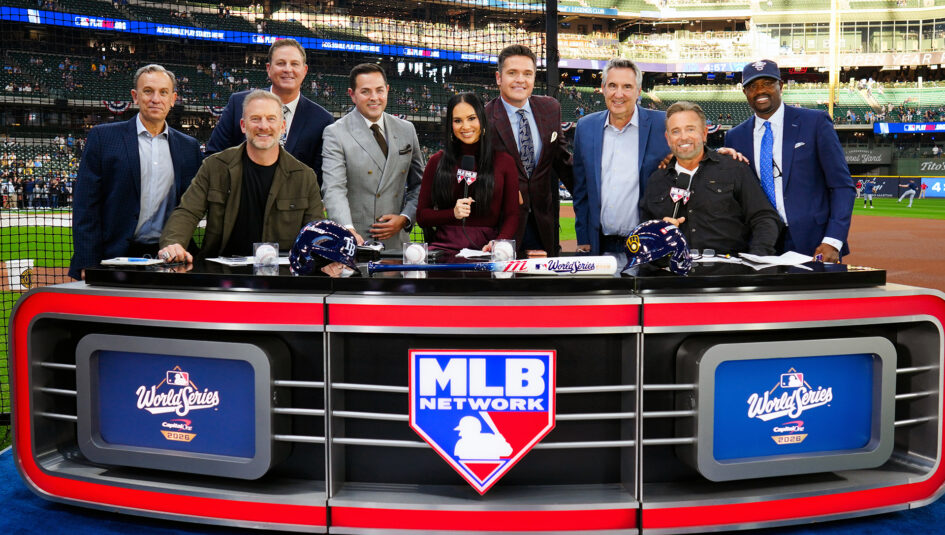 Members MLB Network pose for a photo prior to Game Two of the 2026 World Series presented by Capital One between the Tampa Bay Rays and the Milwaukee Brewers at American Family Field on in Milwaukee. (Photo by Daniel Shirey/MLB Photos via Getty Images)
The day runs on two different workflows, according to Mike Martin, VP, production and creative design, MLB Network. MLB Central is produced using MLB Network’s ballpark-camera infrastructure, ENG cameras, and the drone. The rest of the day’s shows go through the studio truck. All of it is directed and produced from Secaucus.
“It’s a coordinated effort between the site and New Jersey,” he says.
NEP’s Supershooter 1 is on hand in Milwaukee and Atlantic US is in Tampa. The studio camera complement includes two build-up cameras and a jib on the field set, two handhelds on the field, a studio build-up in the Viva Lounge, and two RF cage cameras. Three of the world feed’s hard cameras also serve studio programming.
On the field, MLB Network has deployed a new, lighter-weight version of its on-field set platform in both cities. Because both ballparks have roofs, no rain-location sets are needed. When the studio team comes off the field at 7:30 p.m. and FOX goes on the air, the show finishes its final half hour from a secondary position inside the ballpark.
“That concourse location really spices up the coverage a little, since we’ve done this for so many years” says Martin. “And, most importantly, it get fans involved more than ever.”
Also on hand is DJI Mavic 4 Pro drone provided by Dorosh Documentaries. It flies all day, from MLB Central through the studio shows and into the world feed. Although FOX has its own drone inside the ballpark, MLB Network is permitted to fly its drone inside for MLB Central.
“In Milwaukee, the directors did a great job showing off all the nooks and crannies of the ballpark, and we’re allowed to do the same in Tampa,” says Tom Guidice, who oversees operations and sets for MLB Network. “The difference is that it’s a lot harder to get the drone out. In Milwaukee, the roof was open during MLB Central, so the drone could fly in and out.”
Technical planning began the first week of September, led by Steve Dolce, director, remote technical operations, and Kelly Bournes, lead technical manager, with vendor commitments and a significant amount of fiber transport locked down before the finalists were known. The Brewers’ NLCS sweep gave the team a head start in Milwaukee, where MLB Network, the world feed, and rightsholders share a dedicated side compound. In Tampa, the compound is tighter and shared with FOX.
“Logistically, it’s tough until you get on the ground and figure it out,” says Dolce, “but it’s a great group of technicians, producers, and operations folks. We all know the drill.”
With two ballparks taht are relatively unfamiliar to major events like the World Series, Guidice adds, the studio team has focused on building rapport with each grounds crew.
“Both ballparks have been great and excited to have us,” he says. “And for us in the logistics world, we don’t have to worry about weather, which is awesome.”
World Feed: A ‘Sneaky-Big’ Show
As for the World Feed, Dave Flemming (play-by-play) and Ryan Spilborghs (analyst) are calling every game in the booth while Producer Mike Treanor and Director Jason Lobb are at the front bench. Game Creek Video is supplying the world feed trucks, with Apollo and Edit 2 in Milwaukee and Madison and Edit 3 in Tampa. On site, the world feed team includes a producer, director, AD, and two tape producers, a deliberately deep bench given the volume of FOX material coming in.
The core show is a traditional baseball complement of seven hard cameras plus a handheld, high-frame-rate coverage, and six EVS servers. What makes it complex, Dolce says, is the 35 to 40 additional feeds coming in from FOX, rightsholders, and other sources, along with four dedicated paths per city on which rightsholders cut their own shows on a switcher aux via the edit truck.
“It’s a sneaky-big show,” says Dolce. “We really get the most possible coverage out of what we have [deployed] out there
On Games 1 and 3, the world feed goes on the air at 7:30 p.m. with a 15- to 18-minute pregame show, joins FOX for roughly 15 to 20 minutes of introductions, and then returns to its own feed through first pitch and the rest of the game. The team also records a roughly two-minute segment before each game for Sportsnet’s pregame show, built from a shot list the Canadian broadcaster sends over.
For the world feed, a less familiar cast is an opportunity. “You’re seeing players on the big stage for the first time, and a lot of viewers don’t recognize them,” says Chris Pfeiffer, executive producer, world feed. “It gives us an opportunity to tell a lot of new and different stories.”
The on-site rightsholder roster is the largest MLB Network has hosted: NHK, ESPN International, RDS, TelevisaUnivision Mexico, TelevisaUnivision U.S. (Game 1), and Douyin (Game 4), MLB’s newest rightsholder.
“There’s a lot going on in terms of how we’re helping the rightsholders,” says Pfeiffer. “Its our job to serve all these righsholders not only with the World Feed but also to make sure they have everything they need.”
In terms of transmission, 46 transmit and 15 receive paths connect the ballparks to MLB Network and MLB’s BTC, serving both studio and world-feed needs. MLB Network’s MPLS network is the backbone, with BitFire and SRT paths for backup, and encoding and decoding handled by a mix of Ateme, Appear, BitFire, and Haivision gear. Virtual signage for four international regions and the four on-site rightsholders accounts for nearly a quarter of those paths.
Batting Practice Goes Live on YouTube
For the first time at the World Series, MLB Network is streaming batting practice live on MLB’s YouTube page before every game. (For Games 1 and 2, the network also produced @MLB’s Batting Practice Show on X with Ben Verlander, Jake Peavy, and Chris Young.)
The YouTube stream began in September as what Joe Alvaro, production engineering manager, MLB Network, calls a “science experiment.” The workflow is lean: ballpark-camera feeds are converted to SRT, ingested into vMix running on a virtual machine, and sent directly to YouTube.
Because the VM can be accessed remotely, Billy Lee, senior manager, social media, switches the stream from the field, selecting graphics from Google Cloud’s Scout Insights and choosing what goes to air.
“It looks excellent, and the reception has been great,” says Alvaro. “We’ve seen fans tweeting about it. They’re excited, because a lot of times gates are still closed for batting practice these days.”
Since neither franchise has won a title and the Brewers are back in the Fall Classic for the first time in 44 years, there is a unique story to tell for this Fall Classic.
“Something has to give between these two team,” says Caiafa. “Editorially, that’s a big focus and we’re thrilled to have some new faces involved.”
The creative team has also leaned into the ambiance and culture at both venues.
“We looked at what we could do differently this year, obviously with an eye on costs, to show off these cities,” says Martin, citing exterior and arrival shots, tailgating, and Brewers fans streaming into the ballpark.
The drone also has a role in showing how the domes play. Caiafa points to balls already striking rings and poles at both ballparks this postseason, particularly in Milwaukee and, to a lesser extent, at Tropicana Field.
Capping a Marathon Season
The World Series closes out a demanding year that began with MLB Network’s production of the World Baseball Classic world feed and included the debut of the ABS challenge system. MLB Network also houses NHL Network, and its season won’t end until the MLB Awards in Las Vegas in a few weeks.
“The WBC is a massive undertaking that’s in motion months before it begins,” says Caiafa. “It’s long, but when you’re prepared like everyone in this group and the hundreds back home, we do it as well as anybody.”
Martin calls the World Series a culmination of coordination between production and operations, between the site and Secaucus, and among the field crews, world feed, rightsholders, and MLB. “It’s cool to see it all come together and work so well,” he says.
Key vendors include NEP and Game Creek Video (mobile units), CP Communications (RF, mics, cage cameras, and auxiliary Dante gear), Portzawa (sets), Dorosh Documentaries (drone), Broadcast Services International, Pure Polish Fiber, Apache Resource Group, and Steve Roth Lighting.
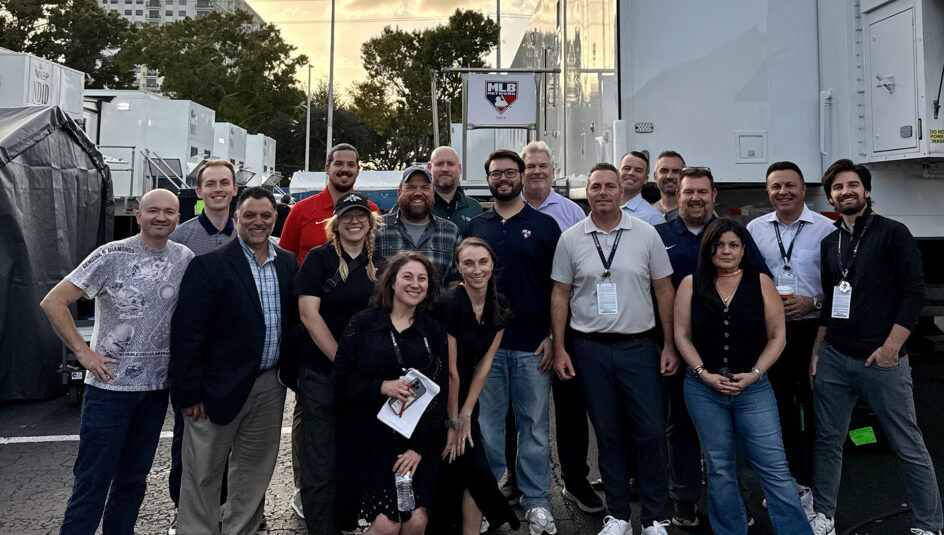
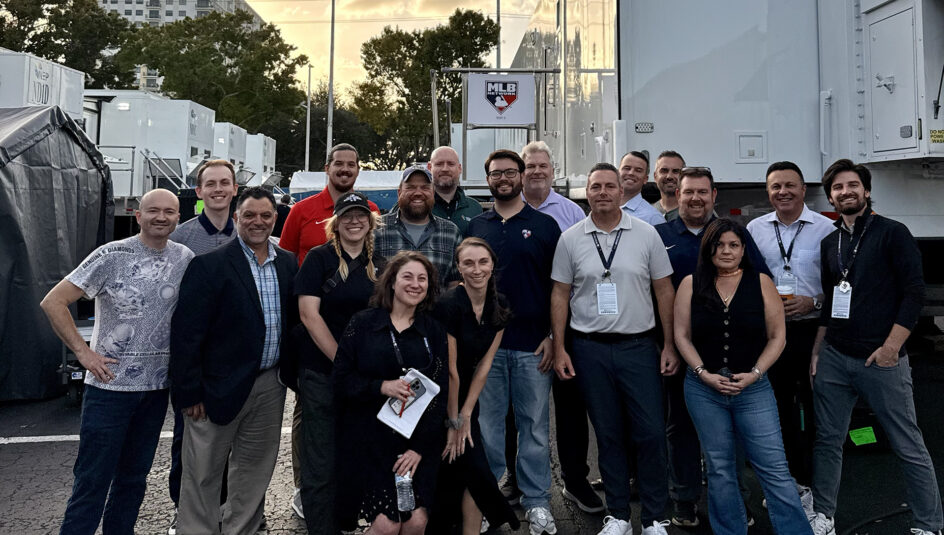 The MLB production and operations team on hand at in the truck compound in Milwaukee.
World Feed, on site: Executive Producer Chris Pfeiffer; Producer Mike Treanor; Director Jason Lobb; Associate Director Mike Kaas; Tape Producers Jason Russo and Robert Hutchins; Research Bryce Kerr and Doug Marino
World Feed, Secaucus: Graphics Emily Mastrobuoni and Brendan Kelly; Statcast Patrick Armstrong and Jason Naccarella; Editing William Joel, Andrew Batti, Sean Gerhard, Raul Vegas, Jacob Catalano, and Benji Dunaief
Studio production: Marc Caiafa, SVP, production; Doug Jaclin, VP, news desk and programming; Ben Friedfeld, content logistics and field production; Chris Arnowich, supervising producer, news; Mike Martin, VP, production and creative design
Production managers, Milwaukee: Brooke Berger, senior director, remote operations; Sam Calastro, senior international operations manager; Nerissa Brown and Eileen McMenamin, remote broadcast operations production managers; Jenn McGinity, senior production manager
Production managers, Tampa Bay: Ryan Delaney and Andrea Longueira, senior production managers; Megan Cain and Kimberly Christ, remote broadcast operations production managers; Ryan Stephens, specialist, remote operations
Both cities: Emma Roberts, production manager, operations. Travel logistics: David Beun, senior production manager; Lacey McKeon, manager, remote operations
Broadcast operations, Secaucus: Karen Ganjamie, VP, broadcast operations and network origination; David Maybrown, senior director, broadcast origination; Anna Marie Scotti, senior director, broadcast operations; Brian Reineke, manager, acquisitions
Batting-practice livestream: Joe Alvaro, production engineering manager; Billy Lee, senior manager, social media; Martin Montalto, senior coordinating producer; Dawnlynn Kulenich, manager, studio technical operations; Jake Soto, VP, engineering and IT; Angelo Sourias, robotic camera operator
Technical: Steve Dolce, director, remote technical operations; Kelly Bournes, lead technical manager; Tech Managers Jason Lamana, Ed Ryan, Jaime Wehner, Jon Hazel, Karl Keenan, Phil Marchesani, and Zach Newhouse
Remote camera operations: Dan Stillwell, director, remote camera operations; Remote Camera Engineers Adam Gress, Jessica Ham, Andrew Robbins, and Will Colon
“It takes a village, plus the dedication of everybody working hard to get us through the season,” says Guidice. “This is our jewel — it’s the World Series — so we hope it goes seven games.”