

Listen to this article
Estimated 5 minutes
The audio version of this article is generated by AI-based technology. Mispronunciations can occur. We are working with our partners to continually review and improve the results.
European Union officials say the details and exact title of Canada’s possible associate EU membership are still being internally debated — but the 27 countries are united in wanting the “closest possible association” with Canada.
Canada will host the EU at a summit in Montreal this week where the two sides are expected to announce new agreements on a number of key areas of co-operation, including trade, security and technology.
This year’s meeting will be one of the “most important summits the European Union has ever held,” one senior EU official said, speaking on background during a press briefing Tuesday morning in Brussels.
“It’s building a partnership that comes closer to membership than anything we’ve ever done before.”
WATCH | Is Canada joining the EU?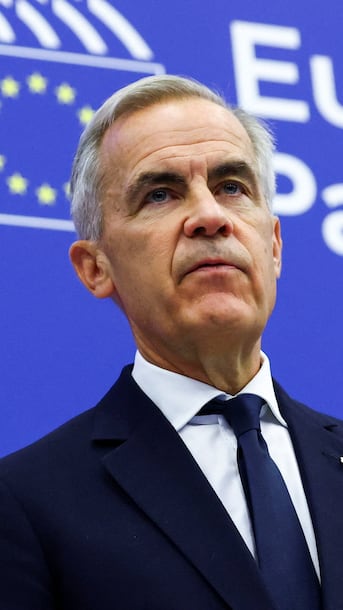
Is Canada becoming an ‘associate member’ of the European Union?
Associate membership? Strategic alliance? Whatever you want to call it, Prime Minister Mark Carney’s push for deeper ties to Europe are well underway. The CBC’s Marina von Stackelberg breaks down some of the changes Canadians could see should Ottawa and Brussels formalize the agreement.
However, the process is just getting started, officials stressed.
“This is uncharted territory. This is also the work that will need to be done between now and the next summit,” they said, which is expected to be held in 2027.
The officials acknowledged some member states have questions about what Canada’s new role will actually mean.
“But I can certainly confirm … there is no questioning from the member state side on their ambition for this relationship,” an official said.
Carney says summit launches year of talks
European Commission President Ursula von der Leyen surprised many last month when she announced the EU would begin the process of making Canada its first “associate member,” a status that does not exist within the bloc.
Prime Minister Mark Carney responded the next day during a speech to the European Parliament that Canada welcomed “the ambition” of associate membership, later telling reporters it was the substance of the relationship that mattered more than the name itself.
Speaking on Tuesday in Ottawa on his way into a cabinet meeting, Carney reiterated that stance, saying the two-day summit that begins Thursday would be the launch of formal discussions and negotiations over the next year.
WATCH | Carney speaks about the upcoming EU-Canada summit: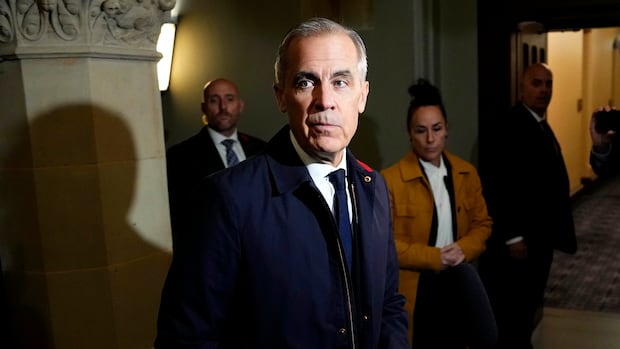
EU agreement ‘names or nomenclature’ don’t matter, says Carney
Prime Minister Mark Carney says what ‘matters’ at the EU summit set to take place later this week in Montreal is ‘Canada as a whole becoming a more independent, more sovereign nation so we can live our lives as we choose.’
“The good news is it doesn’t matter about specific names or nomenclature,” Carney said.
“What matters is the difference that it will make to the lives of Canadians … and Canada as a whole becoming a more independent, more sovereign nation, so we can live our lives as we choose.”
Associate membership would be unique to Canada
There are many unanswered questions about what associate membership would require from Canada and what it would mean for the other European countries that have spent years trying to join the EU.
Officials said Tuesday this type of associate membership would be specific to Canada.
“We’re embarking on the start of a journey, so let’s not already now determine exactly how far we go,” they said.
Officials would not say whether other countries had approached the EU looking to form a similar relationship as Canada’s.
Carney has repeatedly stated that Canada is not seeking full EU membership, and often refers to the enhanced partnership as a “strategic alliance.”
The prime minister has been aggressively seeking out stronger diplomatic and trade ties with other countries, including in Europe, as relations between the U.S. and Canada continue to suffer under the trade war, with U.S. President Donald Trump’s escalating tariffs and ongoing threats to annex Canada.
The EU is Canada’s second-largest global trading partner after the United States, totalling $178 billion last year.
Europeans have long list for closer collaboration
In Tuesday’s briefing, senior officials provided an array of topics where Europe wants to work more closely with Canada, some of which they hope to finalize at the Montreal summit.
One is an agreement between Canada and the European Investment Bank that would allow the EU to fund critical mineral projects in Canada.
Negotiations are also wrapping up on an updated EU-Canada competition agreement. It would help authorities on both sides of the Atlantic fight anti-competitive business practices.
On energy, EU officials mentioned a long-term joint study on the viability of exporting natural gas from Canada’s East Coast to Europe. There are hopes for Canada and the EU to stockpile critical minerals together and co-ordinate more on nuclear research and development.
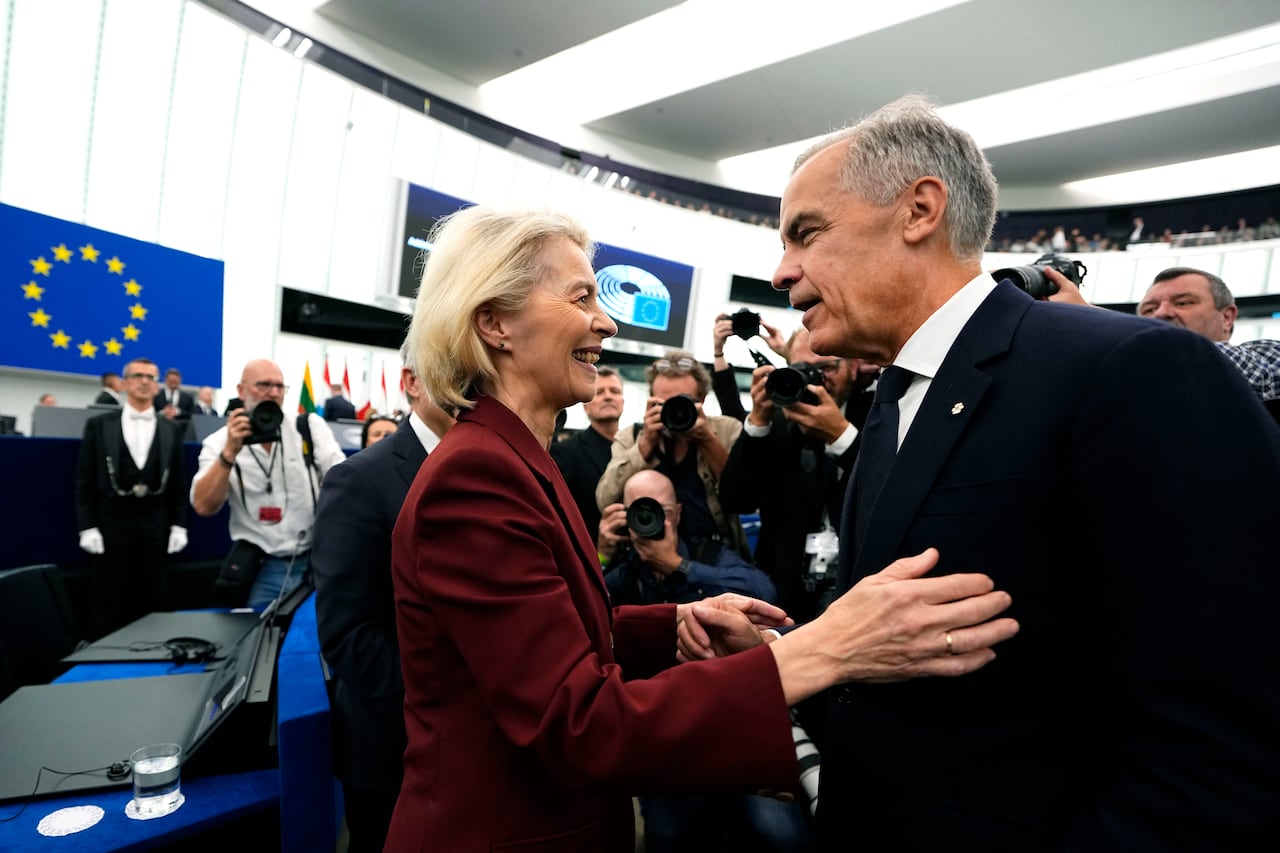
Carney is greeted by European Commission President Ursula von der Leyen as he arrives to address the European Parliament in September. The pair will meet again in Montreal this week. (Justin Tang/The Canadian Press)
On technology, the EU wants to give Canadian scientists and businesses access to its supercomputing infrastructure so they can research areas like Alzheimer’s, AI and more. Europe is also open to Canada being part of its satellite programs.
They’d like to see the EU and Canada decide on more policies together. That would include regular consultations between lawmakers on climate, energy, artificial intelligence, innovation security and more in what one official described as the “highest form of partnership imaginable.”
Carney has repeatedly said he hopes the alliance will make it easier for EU and Canadian citizens to learn and work in each other’s countries. Officials said Canada should fully participate in more of the EU’s research and education programs.
The summit is also expected to focus on more transatlantic business, with a special forum that will bring together 12 CEOs from leading companies in Canada and Europe.
The summit will include a meeting with Carney, von der Leyen and European Council President António Costa. Ten members of the European Commission will also sit down with several of Canada’s cabinet ministers, the officials said. European ambassadors to Canada are also expected.