
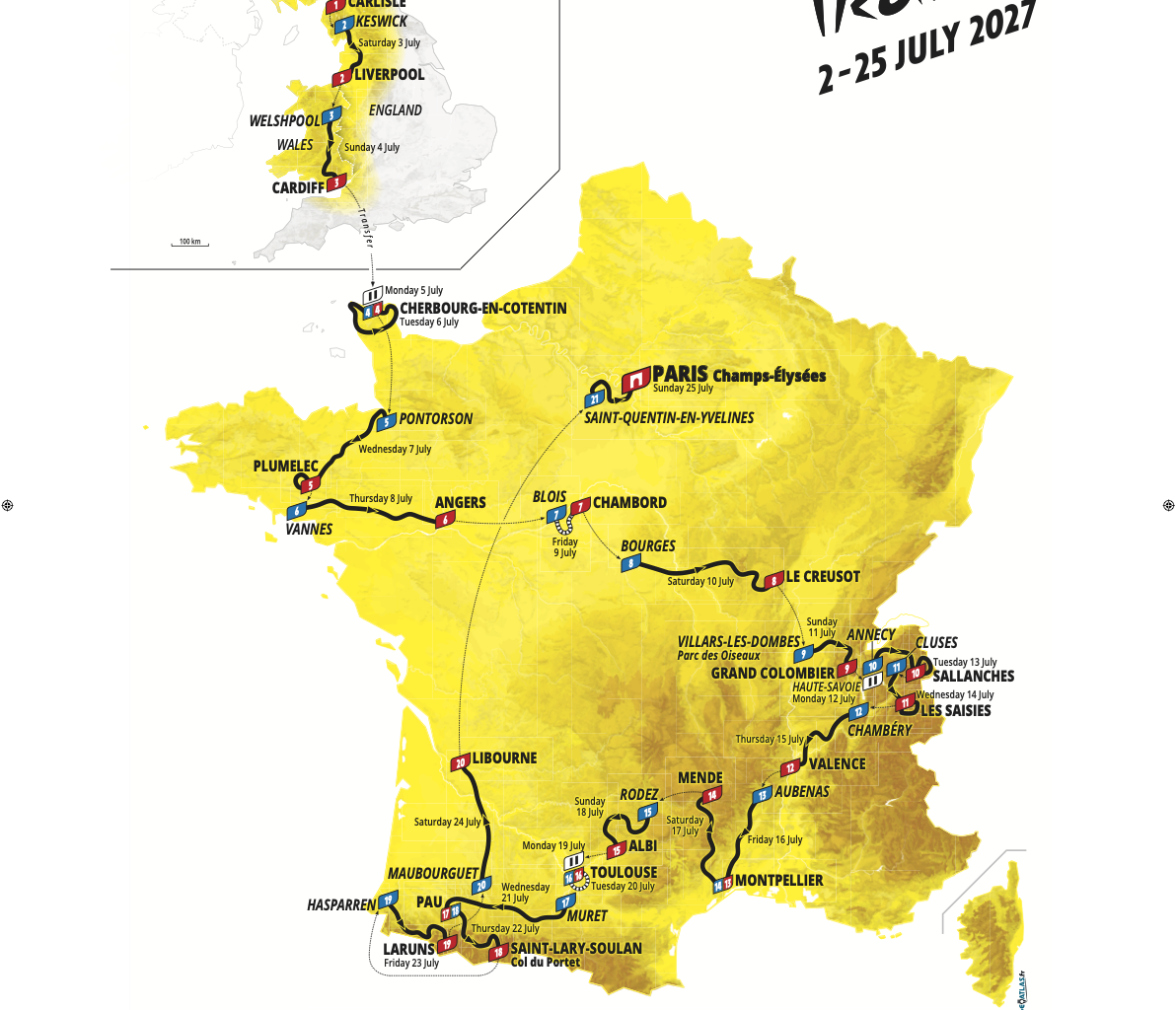
The 2027 Tour de France starts in Edinburgh, crosses three British nations, and stacks its hardest days in the Pyrenees. Two long time trials could decide much of it before the mountains do.
Christian Prudhomme unveiled the route of the 2027 Tour de France at the Palais des Congrès in Paris on Thursday. From July 2 to 25, the 114th Tour covers 3,479 km from Edinburgh to Paris.
A year after its southernmost start, in Catalonia, the race begins farther north than it ever has. The Scottish start shapes the whole first week. The roads get rougher on both sides of the Channel, and by the time the peloton reaches the Jura at the end of week one, it will have fought across nearly every kind of terrain the sport offers.
Britain has something for everyone. The sprinters target the first yellow jersey on the opening stage from Edinburgh to Carlisle. On stage 2, from Keswick to Liverpool, strong attackers will try to escape the bunch. On stage 3, from Welshpool to Cardiff, Geraint Thomas’s hometown, the overall contenders should move to the front. Across the Channel, the puncheurs keep their advantage on the stage 4 loop around Cherbourg-en-Cotentin and in Plumelec on stage 5, which climbs the Côte de Cadoudal twice.
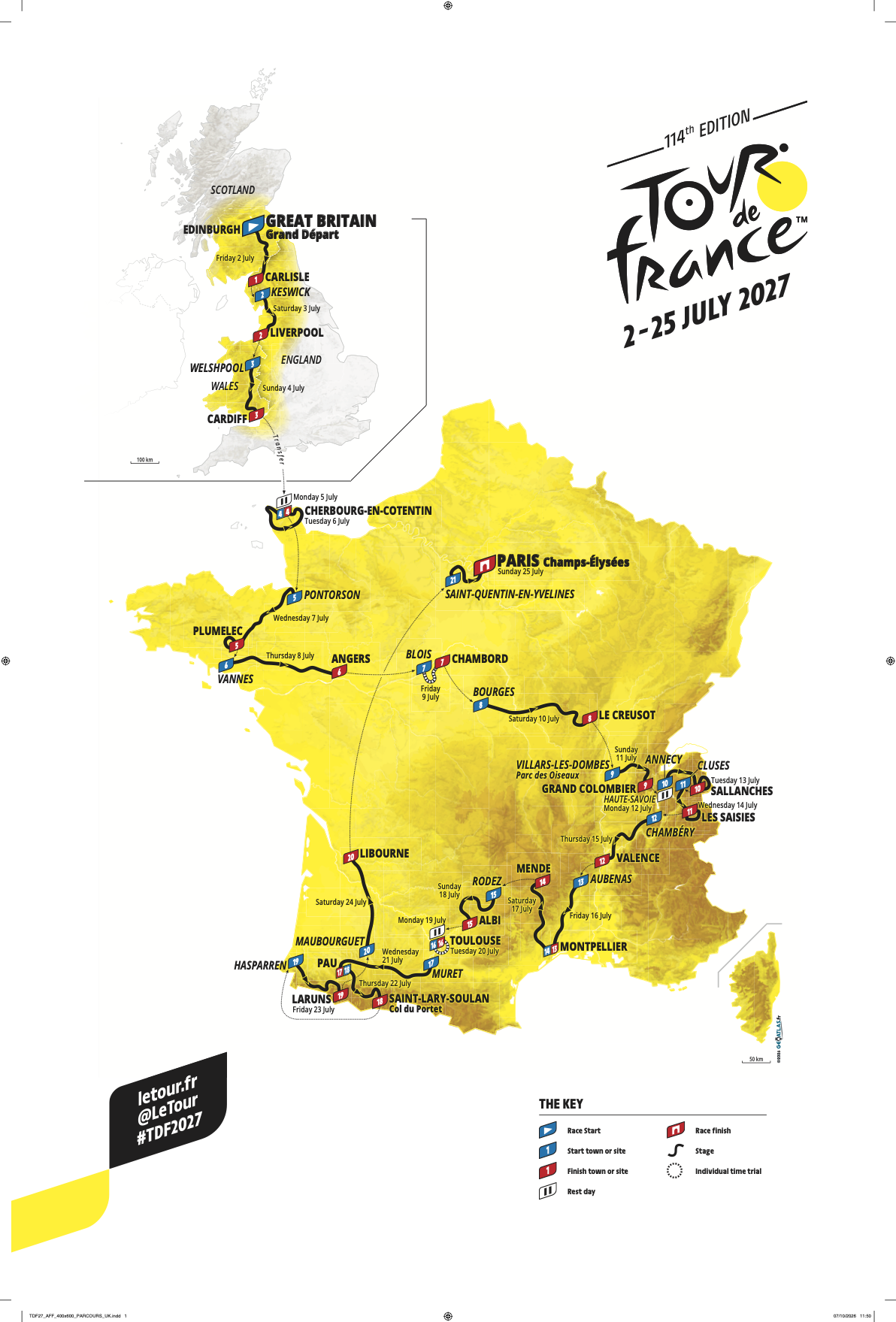 Map of the 2027 Tour de France. Image courtesy of ASO
The flat roads matter just as much. Stage 7 is a fast 38 km individual time trial from Blois to Chambord, past the châteaux of the Loire. Stage 16 offers the time-trial specialists a second chance on a 33 km course in Toulouse. Together the two tests total 71 km, the most individual time trialing in a Tour since 2012.
Any rider who gains time against the clock will have to defend it everywhere else. Stage 8 climbs the Signal d’Uchon before finishing in Le Creusot, recalling the chaotic July 2021 stage that Matej Mohorič won while Wout van Aert and Mathieu van der Poel fought for position behind him and Primož Roglič lost time. A week later, stage 14 from Montpellier to Mende shows again that a committed attacker doesn’t need the high mountains. The stage packs 4,300 meters of climbing through the Cévennes, makes the Tour’s first visit to the Cirque de Navacelles, and finishes on the Côte de la Croix Neuve.
Stage 10, from Annecy to Sallanches, climbs the Côte de Domancy twice. The same roads host the World Championships road races in late summer, on the climb where Bernard Hinault attacked to win the rainbow jersey in 1980. The final stage also looks ahead to the Worlds, starting in Saint-Quentin-en-Yvelines, which will host the track championships.
The sprinters get chances in Angers (stage 6), Valence (stage 12), Montpellier (stage 13), Pau (stage 17), and Libourne (stage 20). On the last day, they must survive the Montmartre circuit before contesting the Champs-Élysées finish, three weeks after the first sprint in Britain. Stage 15, from Rodez to Albi, is too hard for them and suits a breakaway.
The pure climbers get three summit finishes and long, hard sequences of climbs. On stage 9, the Col du Berthiand and the Col de Richemond come before the finish on the Grand Colombier. On July 14, stage 11 crosses the Col du Pré and the Montée de Bisanne before finishing at Les Saisies, a regular Tour pass that hosts a stage finish for the first time. In the Pyrenees, stage 18 runs from Pau over the Soulor, the Col du Tourmalet (2,115 m), and the Hourquette d’Ancizan to a summit finish on the Col du Portet (2,215 m), the first time the Tourmalet and the Portet have appeared on the same stage. Stage 19, the last mountain stage, starts in Hasparren in the Basque Country and builds to the Col de Marie-Blanque before descending to Laruns. The Pyrenees may decide the winner, but a contender could lose the Tour on almost any stage.
L’Étape du Tour de France 2027: To Les Saisies
L’Étape du Tour, the leading cyclosportive, brings 16,000 amateurs each year onto a Tour mountain stage a few days before the professionals ride it. The 35th edition takes place on July 11, 2027, on the route of stage 11 from Cluses to Les Saisies. The finish is new for both the Tour and L’Étape.
The amateur route covers 154 km and climbs 4,850 meters, including all five categorized climbs on the professionals’ stage. The Col de la Colombière comes early, but the hardest climbing is in the last 50 km. The first of those climbs is the Col du Pré, 12.6 km at 7.8 percent, which L’Étape riders already climbed in 2025 on the way to La Plagne. The second is Bisanne, 12.4 km at 8.3 percent.
The women’s L’Étape du Tour de France Femmes avec Zwift follows on August 8. Its 138 km route crosses the volcanic range around the Puy de Dôme, a day after the professional women finish their race on the summit.
(Visited 54 times, 54 visits today)