
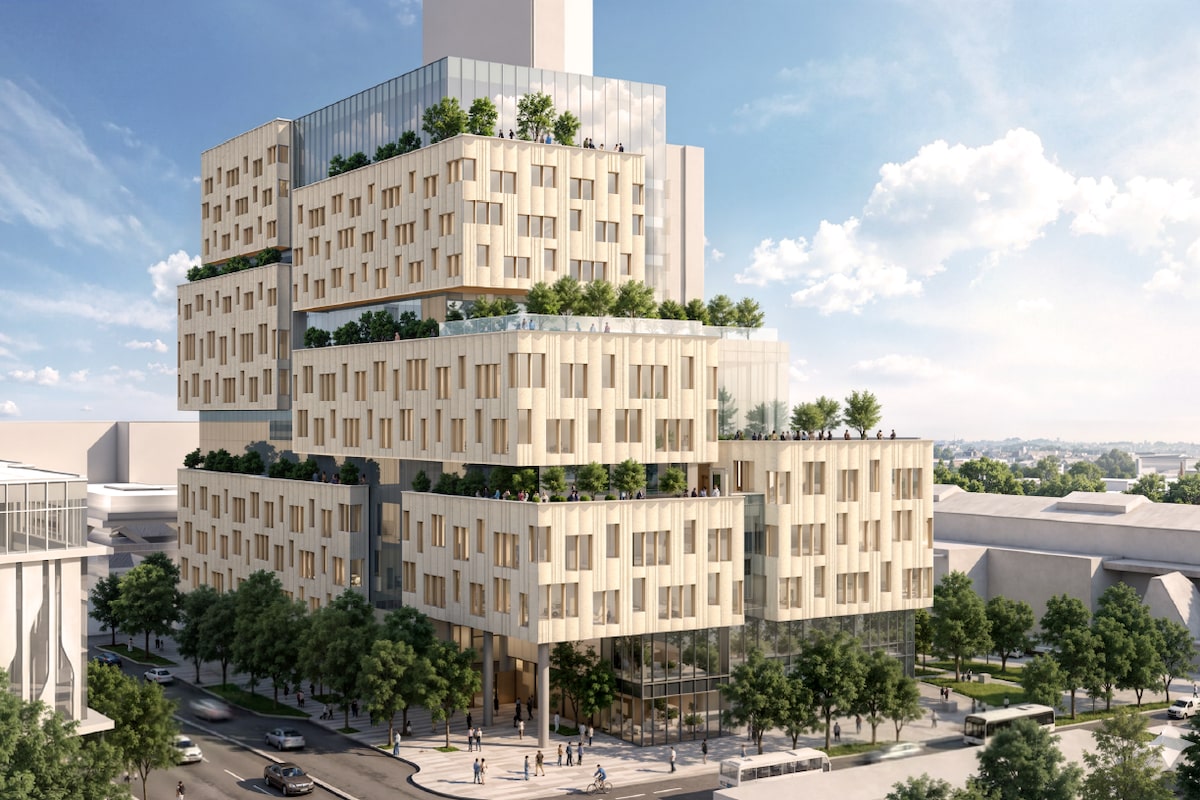
Simon Fraser University’s Stephens Family School of Medicine will soon open at Centre Block, a new purpose-built, mixed-use development in Surrey, B.C. Once complete, the school is expected to occupy seven floors of the 12-storey building.Supplied/Stantec and Revery Architecture
Simon Fraser University in Surrey, B.C., will soon welcome its first class of future primary-care doctors at its new medical school in the city’s Central Business District.
Amid a countrywide doctor shortage, the SFU Stephens Family School of Medicine will do double duty: It will educate future physicians, while its new building will better integrate amenities in a growing city.
“[The development] brings higher education, health care, research, office and retail space together on one site next to Surrey Central Station,” says Bill Aujla, president and chief executive of the Surrey City Development Corp., a real estate development company. “That mix is what turns a city centre into a true downtown.”
Centre Block, a massive two-phased master plan for municipal land adjacent to the city’s Central SkyTrain Station and the former site of a now-demolished recreation centre, supports Surrey’s long-term vision for economic growth, innovation and education.
The development is expected to add roughly two million square feet of office and retail space. It’s also one of several infrastructure projects under way to meet the demands of the rising population of Surrey, one of Canada’s fastest-growing major cities.
Other continuing developments include the Newton Community Centre and a new 10,000-seat City Centre Arena as Surrey posts population growth averaging 10,877 people a year for the past five years, largely owing to immigration. Dubbed British Columbia’s “second downtown,” it’s on its way to surpassing Vancouver to become the province’s most populous city, with a projected population of 783,690 by 2041.
Meeting the need for more primary care practitioners
SFU’s Stephens Family School of Medicine is hoping to close the gaps in Canada’s health care system, with a long-term goal of educating and training more family-medicine practitioners.
According to the Canadian Medical Association, more than one in five Canadians don’t have a family doctor or nurse practitioner they see regularly.
“We saw the need for a medical school focused on family practice and primary care,” says Peter Hall, vice-provost and associate vice-president of academics at SFU.
Similar to stacked Jenga blocks, the structure includes sculpted stacked buildings that blend with the flow of downtown Surrey, the area’s exterior cityscape and the activities taking place inside the building.Supplied/Stantec and Revery Architecture
A campus with a purpose
Set to open in 2030, the new SFU medical school building will anchor downtown Surrey’s new Centre Block development, serving as a multiuse hub that’s easily accessible by transit.
It will occupy the former site of the North Surrey Recreation Centre, demolished in 2025, and sit directly adjacent to the SFU Surrey campus and Surrey Central Station. It will also be located to the south of City Hall, a public plaza and the City of Surrey’s municipal hub.
“This site is an integral part to connecting that urban landscape together, as well as the bus and the SkyTrain transit systems to create a real active node and a sense of community,” says Darren Burns, vice-president of design and innovation for buildings at Stantec, the project’s architect-of-record and main consultant who jointly partnered with Revery Architecture on Centre Block.
SFU’s Stephens Family School of Medicine is Western Canada’s first new med school since the University of Calgary’s Cumming School of Medicine was founded in 1967. It will take over seven floors of the 12-storey mixed-use development and feature retail at grade, in addition to four floors of office space for the City of Surrey.
“This Centre Block project aligns well with Surrey’s official community plan and the desire to have a civic hub and to expand an academic hub,” Mr. Burns says.
SFU already has a strong presence in Surrey’s city centre, with an academic campus that includes the School of Interactive Arts and Technology, the School of Mechatronic Systems Engineering and the School for Sustainable Energy Engineering.
Community building
The university’s new medical school will include high-tech classrooms, research spaces, administrative offices, an outpatient clinic and a 49-space child-care centre. The publicly accessible family outpatient clinic will occupy the second floor of the building and incorporate educational training and other community health services. Five floors of academic space will also sit directly above the clinic and right below SFU’s dedicated floor for child care.
“The building is activated at the street level, at the pedestrian level and 360 degrees around to make it feel really connected and bring in the community,” Mr. Burns says.
The structure’s design looks like sculpted stacked buildings, similar to a Jenga game, that seamlessly blend with what’s happening inside the building, while connecting to downtown Surrey and the area’s exterior cityscape.
Inside the building, an open atrium will welcome visitors and is surrounded by multilevel gathering places, including dedicated Indigenous student spaces.
“We have an Indigenous consultant on our team to help with that engagement and to help with reaching out to the community,” Mr. Burns adds, saying the team has engaged with Indigenous knowledge keepers and a steering committee to incorporate Indigenous themes into the building.
As the university’s new urban campus grows in Surrey, Mr. Hall is hopeful that the school can secure funding to build additional student services such as health and wellness programs and housing.
“Our Surrey campus until now has been a bit fragmented,” says Mr. Hall, adding that the SFU is hoping the new med school building will provide a sense of identity, cohesion and integration.
He points to Britain’s University of London as a hub worth emulating as SFU intends for its new med school building to serve Surrey’s civic and business communities.
“The University of London prides itself on being halfway between the old commercial city of London and Westminster and acting as an integration point between commerce and government,” Mr. Hall says. “There may be something here, eventually, like that.”