

Listen to this article
Estimated 3 minutes
The audio version of this article is generated by AI-based technology. Mispronunciations can occur. We are working with our partners to continually review and improve the results.
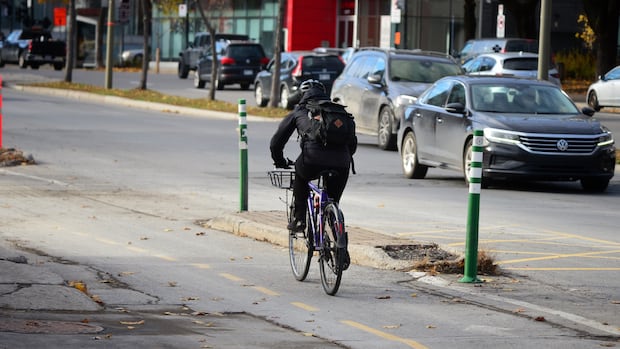
Technical audits of four Montreal bike paths have found no reason to dismantle them based on safety concerns, the City of Montreal announced Wednesday.
The audits were mandated by Mayor Soraya Martinez Ferrada’s administration, following through on a promise she made during last year’s mayoral campaign.
City engineers reviewed bike paths in four boroughs: Rachel Street in the Plateau-Mont-Royal, Côte-Sainte-Catherine Road in Outremont, de la Commune Street in Ville-Marie and Meilleur Street in Ahuntsic-Cartierville.
Alan DeSousa, the member of the city’s executive committee responsible for mobility and infrastructure, said Tuesday that although the technical audits do not recommend dismantling the paths based on safety concerns, they will be subject to more scrutiny in the future.
“At first glance,” DeSousa said, the concerns are not ones of safety, “but rather of cohabitation.”
According to him, the city is currently compiling data from citizen surveys, which will be used to validate — or invalidate — the results of the technical audits.
“It’s premature to jump and say that the preliminary report is accurate. I want to wait until we have all the information,” DeSousa explained.
DeSousa says once the technical review is paired with the results of the community surveys, the city will put together a final report and release it to the public.
The future of each bike path will be determined based on the results of that report.
Vélo Québec not surprised by preliminary report
The CEO of Vélo Québec, Jean-François Rheault, told CBC’s Daybreak Tuesday morning that it is good news the preliminary report doesn’t recommend dismantling bike paths, but he isn’t surprised.
“Building bike lanes is a professional act done by engineers. They put their personal responsibility on the line when they do, so of course they are not going to build anything dangerous,” Rheault said.
Although the organization, which promotes cycling across Quebec, doesn’t expect any extraordinary results from the final report, Rheault says the audit could still be a worthwhile process, particularly if it highlights the safety bike lanes bring.
“If the elected official can state loud and clear that bike lanes are important and save lives, then it would have been very useful,” Rheault explained.
Ericka Alneus, the interim leader of Projet Montréal, is more critical of the current administration’s decision to examine bike paths in the city.
The head of the official opposition at city hall argues the process is a waste of public funds.
“We are happy that science has prevailed,” Alneus said. “Unfortunately, what is sad is that it did cost us $1,000,000 just to reaffirm that the City of Montreal has great engineers.”
The preliminary report was released two weeks after the province of Ontario began the process of dismantling 19 km of bike lanes in Toronto’s downtown core, a move that drew both criticism from Mayor Olivia Chow and protests from citizens.